

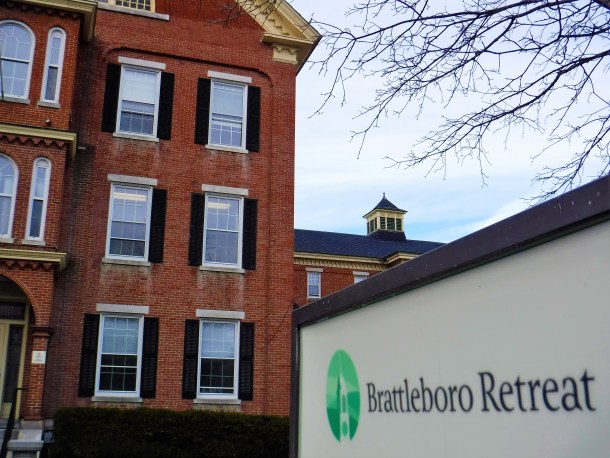
[F]unding and logistical issues have led Brattleboro Retreat administrators to alter their plans to build more mental health beds.
Despite the changes, officials say the Retreat still is expected to have a dozen acute psychiatric beds ready for the state’s use early in 2020, as planned.
However, Retreat President and Chief Executive Officer Louis Josephson said $5.5 million in state funds allocated for the project won’t go as far as initially estimated. That led the Retreat to change the scope of the project and reduce the amount of work happening at the Brattleboro hospital’s campus.
The Retreat has “refocused on delivering the best plan for 12 beds,” Josephson said.
The planned Brattleboro Retreat beds are an attempt to ease pressure on Vermont’s overburdened mental health system. Some psychiatric patients are waiting for significant periods in hospital emergency rooms because no inpatient beds are available, and regulators have found evidence that those patients are suffering mistreatment.
In an appearance Tuesday before the House Corrections and Institutions Committee, Mental Health Commissioner Sarah Squirrell said the state needs “additional inpatient capacity … so we can successfully move people through stages of care.”
“When we look at our overall mental health system of care, and we look at some of the challenges we have and long wait times in the emergency departments, that really is symptomatic of a larger problem in our system, which is flow,” Squirrell said.
The University of Vermont Health Network is planning a new, 25-bed psychiatric facility in Berlin. But the 12 new Retreat beds would come online much faster, and state officials have been pushing for that project to move as quickly as possible.
Squirrell and Deputy Mental Health Commissioner Mourning Fox told lawmakers on Tuesday that the Retreat project still is on schedule, but there have been some complications including the discovery of asbestos.
“We all understand the challenges of working in old buildings in Vermont,” Squirrell said.
In an interview, Josephson said asbestos was found in the Linden Lodge building across the street from the Retreat’s main entrance. Crews will be addressing the hazardous material, he said.
While not the only complicating factor, asbestos was “part of the overall consideration of cost and time” that led administrators to make changes to the expansion project, Josephson said.
Originally, the Retreat planned to move an existing mental health unit from the hospital’s Tyler Building to Linden Lodge, and then put the new state beds in Tyler. But the plan now is for the state’s beds to be placed at Linden Lodge, and nothing is happening in the Tyler building.
Also, the initial plan called for a total of 16 new inpatient psychiatric beds, though the state was contracting only for 12 of those. Those additional four beds now have been deleted.
Josephson said allowing for more space in the unit “really helps us manage the patients and their needs.”
The changes prompted some committee members to wonder why the Retreat still needs all of the state money that had been allocated for the project. “I’m just trying to figure out where our $5.5 million is going,” said Rep. Alice Emmons, D-Springfield and chair of Corrections and Institutions.
But Josephson said it became clear as the Retreat embarked upon the project that the $5.5 million couldn’t cover renovations in two buildings. “Better to do one space well than two spaces inadequately,” he said.
Buildings and General Services Commissioner Chris Cole said his department has reviewed the Retreat’s new plans, and he said the costs are “all within the ballpark of what are reasonable expenses for what they’re proposing to do.”
Squirrell said her department also is on board with the changes, partly because the state’s new beds now will be in a better environment. It’s become clear that “constructing the beds at the Linden Lodge makes more sense,” she said. “It makes more sense from a space capacity, (and) from a clinical capacity.”
“Overall, as we reviewed this plan with them, we actually gained some clinical access,” Squirrell added. “We (also) gained better access to outdoor space.”
Additionally, Squirrell said the new plan allows for more flexibility for the planned state beds.
“Our capacity needs may change,” she said “The Linden Lodge actually affords itself to better transition to different levels of care down the road.”

