




Jon Margolis is VTDigger’s political columnist.
[T]he professors at the University of Vermont are complaining.
So what else is new? Professors have been complaining for the last 400 or so years. That’s what they do. Baseball players spit. Actors preen. Pre-teen girls giggle. Professors moan and groan, convinced that they are the few remaining islets of culture and grace surrounded by a foreboding sea of hostile Philistines. T’was ever thus.
Meaning they are wrong?
Not always. Not right here and right now. These cranky academics have a legitimate gripe and are performing a valuable service, even if some of what they and their student supporters say verges on the sophomoric.
No surprise. Many of those students are actual sophomores. The professors are not, but they mingle with them.
Thus a group calling itself the Coalition for Student and Faculty Rights complained (and at least one professor agreed) that the process for choosing the new university president was “undemocratic.” The student newspaper, the Cynic, charged that Suresh Garimella was chosen “behind closed doors.”
Who thought university presidents were ever chosen democratically? Or not chosen behind closed doors?
But the university bigwigs invited this criticism by promising a transparent presidential search process in which several “finalists” would come to campus to meet with faculty and student representatives before the trustees chose a new president.
Instead, the university announced that only Garimella would visit the campus. But that wasn’t accurate, either. One other “finalist” came. Nobody is saying who it was.
Transparency, thy name is not UVM.
Opening up the process, said the trustees, discourages applicants who won’t want their current employers to know they are in the job market.
But with a closed process, universities have hired some real turkeys. Only a leak to the local newspaper (that’s transparency) saved Penn State from appointing a president who was under criminal investigation and ended up in jail. Other institutions have hired presidents who turned out to have been accused (and in at least one case convicted) of financial or sexual misconduct.
According to a report by Professor Frank Lomonte of the Brechner Center for Freedom of Information at the University of Florida, the executive search firms that help universities find new leaders “typically specify in their contracts that their services do not include running background checks.”
That appears to be the case with Witt/Kieffer, UVM’s headhunter consultant firm. Asked if his firm conducts personal background checks, senior partner Dennis Barden would only say that “it is a standard part of our process to verify information offered us by candidates.”
That would not include finding out whether a candidate had ever been charged with a crime. Asked specifically whether Witt/Kieffer seeks that kind of information, Barden abruptly hung up.
So apparently it does not. There is not a scintilla of evidence that Suresh Garimella has ever been accused of anything. But if he had been, the University of Vermont wouldn’t know.
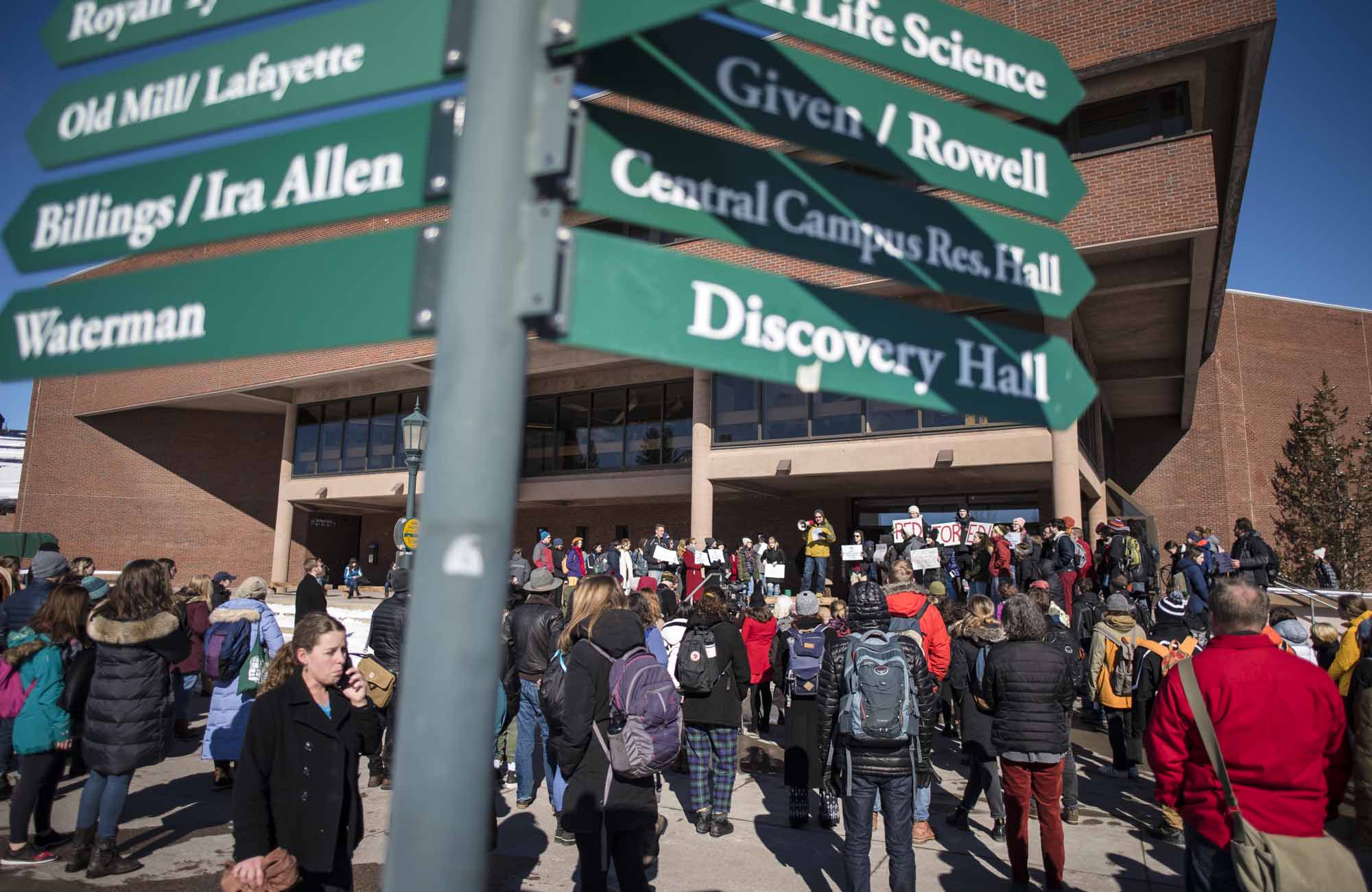
Even before the dust-up over the new president, the arts and humanities faculty – the professors of English, sociology, philosophy, art history, classics, and the like — were protesting cutbacks in their fields as more money flows to the science, tech, and math departments.
Again, nothing new. At least since the 1820s, poets and scientists have been talking about and sometimes fighting about what scientist/novelist C.P. Snow (in the 1950s) called the “mutual incomprehension” between the scientific and “literary” cultures.
But that’s not the UVM debate. What bothers the humanities faculty is not that the trustees and the administration prefer physics and biology to history and poetry. It’s that they see a university establishment devoted to itself, its budget (and therefore its fund-raising), its bureaucracy, and its responsibility to train students in skills that will get them good jobs.
That’s not the same as being devoted to education, in either the arts or the sciences.
A university has to raise money, balance its budget, administer itself. And let’s be honest, American public universities have always been vocational schools. Higher-end vocations: mechanical engineering, business administration, medical technology, not just carpentry, plumbing and welding. Still, the point was to give people the skills to earn a good living.
Now forget for a minute that reams of research show that music or sociology majors can earn a good living. More central to this discussion is that for a century and a half American public universities have combined that vocational mission with a devotion to the most robust and demanding scholarship and instruction in the arts, literature, history and philosophy.
At its best, this devotion was not in conflict the university’s vocational mission. The two meshed. At their foundation was a democratic vision. State universities, according to the legislation that established them (by Vermont’s own Justin Morrill), were to provide “liberal and practical education.”
Both. Equally.
What many professors fear now is that the UVM establishment is no longer committed to that vision. University spokespersons and trustees of course deny it, pledging their commitment to the liberal arts.
But if their actions don’t totally belie their words, they certainly raise doubts about them. Bit by bit, less money goes to the standard liberal arts departments. The Classics Department has been so shriveled that it recently reported that its “institutional situation has become highly precarious,” to the extent that the survival of Greek and Latin majors is in doubt.

Meanwhile, the university is spending $95 million on what it calls a “multipurpose center.”
It’s a gym. Read the descriptions. Yes, it will have facilities for “health, fitness, wellness.” But basically it’s a better forum for the basketball team.
College basketball is great fun and the team should have up-to-date facilities. But if there is a word for an institution that has a new basketball arena but no Greek and Latin majors, that word is not “university.”
Maybe the real debate here isn’t over the purpose of a university. Maybe it’s over the purpose of life, about which the UVM top brass appears to disagree with John Adams.
“I must study politics and war,” wrote Adams (Harvard, class of 1755) as the American Revolution began “that my sons may have liberty to study mathematics and philosophy … in order to give their children a right to study painting, poetry, music, architecture, statuary, tapestry, and porcelain.”
Too bad Adams isn’t available to run UVM.
