

Editor’s note: Mark Bushnell is a Vermont journalist and historian. He is the author of “Hidden History of Vermont” and “It Happened in Vermont.”
[I]t all started with a dream.
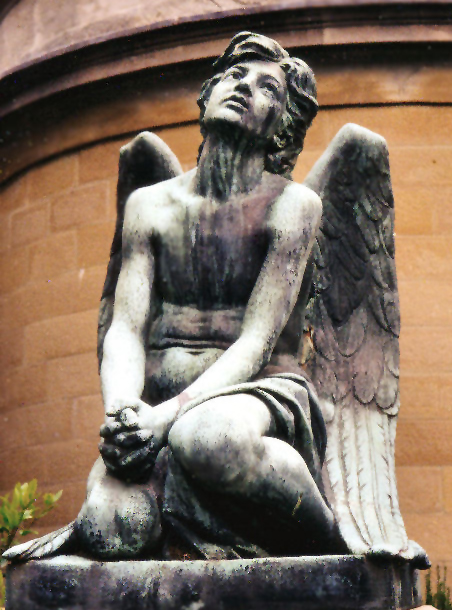
On July 1, 1805, Betsy Merrill dozed off in the parlor of her Springfield home and met an angel. This dream – or vision, as some people came to view it – was just the first in a series that would test the faith of Betsy’s community and upend its social order.
Nothing might have come of the dream if no one had witnessed it. But Betsy was not alone that day. A local minister, William Babcock, was there, too. He described Betsy’s troubled sleep in his diary: “[She] talks audibly, & very sensibly, she begins talking after labouring for some time, heaving her breast, as if much oppressed, breathing very short, and after sighing & groaning. She then went into travail of the Soul & continued so for a considerable length of time, in a sound sleep, or perfect insensibility as to surrounding objects.”
At first, Babcock doubted that Betsy had seen an angel. He wrote in his diary that he was “exceedingly tired with Sister Betsy…she either is deceived, or means to deceive.”
But soon he began to see things differently. Babcock came to believe that Betsy had been visited by a divine messenger. “O my God I long for such a Gift of Dreaming as Sister Betsy enjoys & thinks little of,” he wrote in his diary, which provides most of what we know about the Babocks and their congregation.
The preacher had spent the previous five years combing the Springfield area, trying to build up a congregation of Freewill Baptists. The denomination had broken from the Baptist church over the issue of salvation. Freewill Baptists believed that everyone was potentially saved, not just the pre-selected few. But the Freewill Baptists also believed the promise of salvation wasn’t guaranteed. People could lose it if they lost their faith.
Soon, Betsy reported seeing the angel regularly, and not just in dreams. The angel began appearing to Betsy in “manifestations” while she was in a trance-like state. Whatever state she was in, Betsy risked mockery by admitting her visions, even in that intensely religious era. Theology professors and church leaders of the period tended to believe direct contact with the divine was impossible. For half a century, doctors had classified people who saw angels as insane.
But for whatever reason, the angel kept visiting Betsy, who evidently told Babcock, who then recorded each visitation in his diary. Over the next six years, Betsy would report seeing the angel 175 times.
This supposed pathway to God is apparently what drew Babcock to Betsy. Judging from his diaries, Babcock had long been sexually repressed, but was sometimes unable to control his passions. In 1802, while serving as an itinerant preacher in Vermont hill towns, he had alienated parishioners by stopping mid-sermon, walking across the room and kissing a woman. His explanation – “I told them the woman desired it & I felt it (my) duty to gratify her” – didn’t sway many churchgoers.
Ostracized for his behavior, Babcock found a home in Springfield where he arrived in time to witness Betsy’s dream, and later to court and marry her. At age 40, Babcock was twice Betsy’s age. The two became the center of local controversy when they were suspected of sleeping together after they were engaged, but before they were married.
Still, they were a pair to be reckoned with – particularly Betsy, whose angelic visions gave her remarkable power within the church, especially for a woman. Convinced Betsy was able to provide a direct conduit to God, Babcock largely stepped aside.
Speaking through Betsy, the angel soon became something of a parent to the congregations Babcock oversaw in Springfield and in neighboring Fishersfield, New Hampshire, settling many major disputes. The angel, which Betsy described as male, was the final word on how the congregations were organized, on religious interpretation and on which church members were sufficiently devout. Suspected adulterers and thieves found themselves accused by the angel. At times, Babcock even called on the angel to approve a particular sermon. Most of the arguments he settled, however, were domestic issues involving the Babcocks, such as whether to buy land and who to befriend.
The visitations, which were discussed publicly, drew new people to the church. Some came in order to be closer to the angel. Some came to gawk. Eventually, other members of the church began reporting that they, too, had met the angel.
(A church historian, working in the 1860s, wrote disparagingly about the rash of sightings that ensued, terming them the “Angel Delusion.” Subsequent church historians took a similar view. In 2002, academic historians Susan Juster and Ellen Hartigan-O’Connor delved more deeply into the events for an article in Journal of the Early Republic, from which details for this column were drawn.)
By 1810, other women began to have visions that challenged Betsy’s place as the angel’s oracle. They seemed to be competing for the angel’s attentions. One of the women, Bathsheba Aldrich, reported having a “walking manifestation” that lasted for four hours. Several days later, Babcock wrote in his diary, Betsy had her own “walking manifestation” in which she saw various members of the congregation struggling with their souls, many of them lying prostrate on the floor. Immediately afterwards, Bathsheba had another vision, this one lasting until one in the morning.
Bathsheba and Betsy began to direct church services in which they led “converts in various stages of spiritual distress and release,” according to historians Juster and Hartigan-O’Connor. William Babcock noted in his diary that the meetings drew “a rabble of young people,” who apparently saw the services as more a form of entertainment than religious rite. At one of the meetings, Babcock wrote, “a perfect riot ensued – at the close of which one of the Selectmen nailed down the windows & locked & bar(r)ed the Doors.”
Services led by the women were disorderly in another way. They turned the congregation’s hierarchy on its head. For a time, women carried the most authority in the church. With the clout of an angel on their side, the women wielded remarkable power. The advice they reported getting from the angel gave them control over whom they married, over their families’ finances and even over their minister.
The women of Babcock’s congregation weren’t alone in claiming to see visions. During the early 19th century, new evangelical groups, including the Freewill Baptists and Methodists, arose that democratized religious experience. Followers believed that common men, and even women, could have a personal connection with the divine.
Among those in Babcock’s church who said they had conversed with an angel was a woman named Trueworthy Dudley. Bathsheba and Betsy doubted Dudley’s sincerity, but Babcock believed in her. Eventually, however, Dudley tried to use the angel’s messages to develop an inappropriate relationship with a man in the congregation. Bathsheba and Betsy convinced Babcock that he had been wrong to trust Dudley and he rejected her as “wholly given up to Satan.”
Bathsheba would be the next to fall from grace. Her visions became more and more odd. She claimed to have spoken while in some sort of trance with a similarly visionary Englishwoman named Tryphenia Chaffin, who said she “been in Hell about 20 years” for denying her visionary gift. Later, Bathsheba confessed to Babcock that she had received “a message … respecting her unfaithfulness & dishonesty in the work of the Lord.” That was enough for Babcock, who declared that “much evil, very much has been done through the unfaithfulness of this highly favoured woman.”
With Betsy and Bathsheba, the two leading visionaries, discredited, reports of visits by the angel to church members became less frequent. So too did actual visits to church, as congregants trickled away. Other area ministers started questioning the veracity of the visions seen in Springfield and Fishersfield.
This is where the story of the Babcocks and their flock becomes fuzzy. Babcock’s diary, which provides most of what we know of these events, ends on Oct. 9, 1811. On that date, the couple’s young son, Joshua, died and Babcock lay down his pen.
For years, the preacher had been pressing his wife for them to leave town, but the angel had told him not to move until Betsy gave the okay. Records show that by 1816, the family had moved to Barrington, New Hampshire. What finally convinced Betsy to leave Springfield? Perhaps the spirit moved her.
