

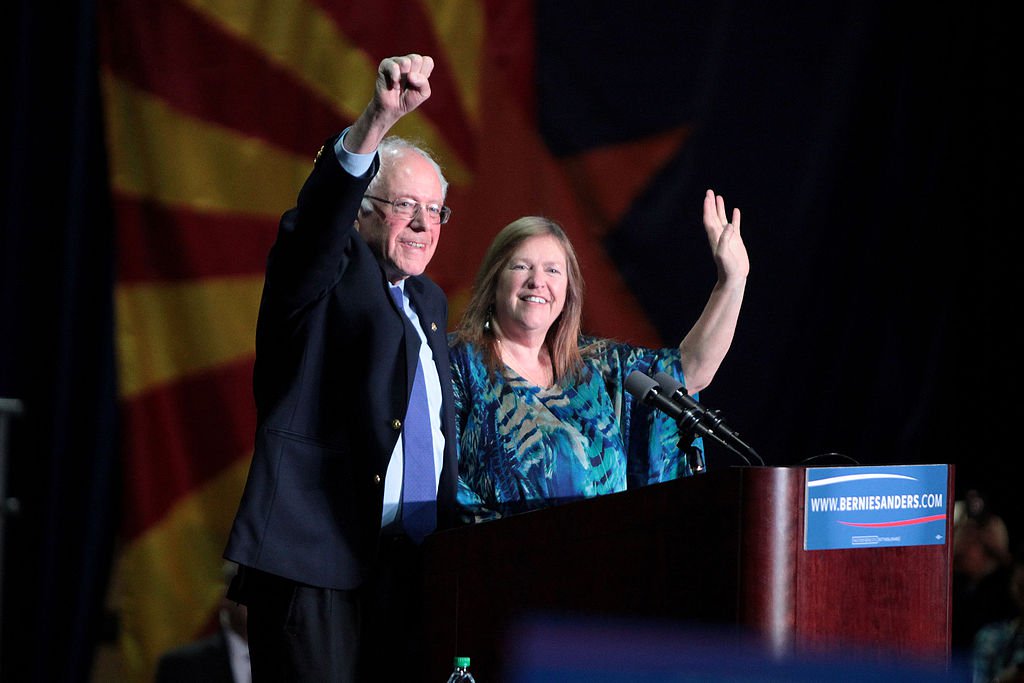
[L]ong ago in what seems like another world, the wife of a Democratic candidate for president, a woman who also had her own professional life and who was being criticized for it, said “I suppose I could have stayed home, baked cookies, and had teas.”
Boy, did that cause a stir, with political journalists and assorted commentators complaining that the wife – Hillary Rodham Clinton – had no respect for stay-at-home wives and mothers.
Last month the wife of a Democratic candidate for president said she was “honored” to be his wife, and that it “might not be politically correct to identify myself as a wife, but it’s one of the great honors of my life.”
Boy, did that cause a stir, with political journalists and (an expanded army of) assorted commentators complaining that the candidate’s wife – Jane Sanders – was content to be a wife.
So things have changed?
Not entirely. In both cases, the reactions were overblown. The “baked cookies” wisecrack was the beginning of a statement that included saying that her professional work “has been aimed … to assure that women can make the choices whether it’s full-time career, full-time motherhood, or some combination.”
But that wouldn’t have been as good a story. Why let nuance get in the way of a juicy headline? Perhaps for the first time but certainly not for the last, the political press treated Mrs. Clinton as poorly as it could.
In Jane Sanders case, the commentators used her whole quote. They just seemed to forget about the rest of her life.
Jane Sanders has been a community organizer and an educator. She was the provost of one college and for seven years the president of another. That presidency was not, to put it as gently as possible, a rousing success. It precipitated the demise of Burlington College and an investigation into whether she had lied to bankers as she sought loans to purchase a new campus.
She was not charged. But she was in the news. Anybody who has been paying the least bit of attention to Bernie Sanders campaign has to know that Jane Sanders, in addition to being his proud wife, is a professional woman with accomplishments (and failures) of her own.
But remembering that context wouldn’t have been as good a story. Neither would realizing that her remark was light-hearted, personal, unrelated to how a candidate might seek to govern the country, and therefore no big deal.
Now whatever difference may once have existed between political analysis and cultural anthropology has either evaporated or been expunged, so all lighthearted, personal remarks are plumbed for their depths. The possibility that they have no depths may no longer be discussed.
What seems to have prompted most of the furor was not Jane Sanders calling herself a “proud wife,” but mentioning “politically correct,” and saying that being Bernie Sanders’ wife was part of her identity.
In some circles, identity is a very big deal these days, perhaps because too many people think about themselves too much.
So the words were barely out of Mrs. Sanders’ mouth before the (usually) perceptive political journalist Dave Weigel took to his Twitter account to snark, “we’re not at CPAC anymore.”
For the benefit of the politically un-obsessed (perhaps better described as “sane”), CPAC is the Conservative Political Action Conference, which had just completed its annual extravaganza. The (usually) perceptive Weigel appeared to be operating under the assumption that only conservative wives consider their wifedom a great honor and central to their identity.
An assumption unsupported by actual evidence.
Weigel was not alone. “Bustle,” an online magazine intended primarily for women (though founded by a guy, Middlebury alum Bryan Goldberg) reported that what Jane Sanders said “ignited a flurry of debate … with some arguing the senator’s wife was playing into conservative stereotypes about progressives.”
Just what that meant was unclear because this “flurry of debate” took place on Twitter, a mechanism that does not lend itself to clarity.
It has, however, had one noticeable impact: by transforming everyone into an expert, it has altered political journalism.
There was a time not so very long ago when political reporters quoted people who spoke for more than just themselves. They had been elected to office, or at least had run for office and gotten some votes, meaning they had a following. Or they were leaders of (or spokespersons for) organizations – businesses, unions, political parties, advocacy groups.
Now, thanks to Twitter, reporters quote people who are … people. Stipulate for the purposes of this discussion that they are decent, intelligent people. But why should anybody pay attention to their political analysis? Each one speaks only for him- or her-self. Very democratic and participatory. Not very meaningful.
“Jane’s use of the highly charged term ‘politically correct’ which has been weaponized by the right-wing strikes me as less than coincidental,” said one Twitter commentator. She did not explain what was coincidental about it, but did add, “this is a very loud dog whistle meant to be heard by conservative voters put off by female presidential candidates.”
Perhaps this means something. Just what it may mean is a mystery.
Whether these Twitter furors have any political impact is impossible to determine. Unhappiness about how Jane Sanders identifies herself does not seem to have hurt Bernie Sanders’ fundraising or public support as reflected in polls. It could be that only a subset of online commentators and Twitterers care very much about identities, or about how the spouse – as opposed to the actual candidate – expresses him/her-self. Mrs. Clinton’s cookie wisecrack didn’t stop her husband from getting elected.
But now that political analysis has merged with cultural anthropology, be prepared to hear more about the spouses, which include an unprecedented number of men: Jonathan Gillibrand (husband of Sen. Kirsten Gillibrand), Bruce Mann (Sen. Elizabeth Warren’s husband), Douglas Emhoff (married to Sen. Kamala Harris), or John Bessler (Sen. Amy Klobuchar’s husband).
And the only other spouse in addition to Jane Sanders who’s gotten much attention lately: Chasten Buttigieg. He’s the husband of candidate Pete Buttigieg.
Maybe things have changed.
