

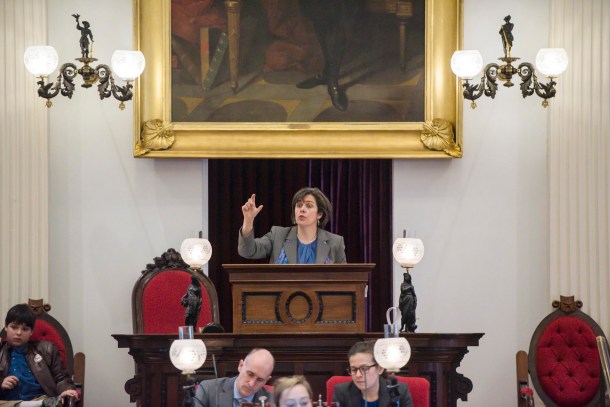
The Vermont House on Tuesday gave preliminary approval to a measure that would double the tax on heating fuel and boost funding for low-income home weatherization.
But before the legislation was advanced by a vote of 81-60, it faced resistance from lawmakers with concerns that hiking the tax would disproportionately burden Vermonters with lower incomes. House leadership also used parliamentary procedures to dodge a vote on an alternative proposal with a more progressive tax.
Fiscal analysts project that the legislation, which would hike the tax on heating oil, propane, kerosene and dyed diesel fuel from two to four cents per gallon, will raise an estimated $4.6 million in additional revenue for low-income weatherization.
Expanding funding for the state’s weatherization program, which helps Vermont homeowners optimize energy efficiency and reduce carbon emissions, has become a major priority among Democrats this session.
Rep. James Masland, D-Thetford, who sponsored the fuel tax increase, told lawmakers that the cost of the tax increase for the average household would be about $15 per year.
The financial benefits for households can be large: An average of 30 percent less fuel consumption and savings as high as $500 per year on energy costs.
“If we’re serious about helping low-income people with weatherization … this is it,” he told the caucus of House Democrats Tuesday morning.
But many House members — enough to uphold a veto from Gov. Phil Scott — are concerned that doubling the fuel tax will be regressive and place an undue burden on low-income Vermonters.
Rep. Heidi Scheuermann, R-Stowe, said low-income renters will likely bear the brunt of the new costs from landlords who will pass them on to tenants.
“Some people will certainly take advantage of this but they will generally be homeowners, low and middle income homeowners,” Scheuermann said. “But it will be paid in large part by low-income renters.”
Rep. Topper McFaun, R-Barre Town, said the bill was a paradox.

“We’re taxing a commodity and the cost of that is being passed on to the very people that we’re trying to help,” he said.
During a caucus meeting on Tuesday, some Republicans called the proposal a “carbon tax,” because it taxes fossil fuels.
Democrats, who have said they don’t plan on advancing a carbon tax measure this session, rejected that claim, arguing that carbon taxes are increased levies on gas meant to encourage drivers to purchase less.
“What people thought of as the carbon tax didn’t reinvest a lot of money in the things that would help people adjust to a more severe climate or reduce our carbon footprint, it just tried to steer people away from a behavior,” House Speaker Mitzi Johnson said Tuesday. “This is an existing program, we’ve heard year after year after year that they could use more money.”
Democrats said waiting lists for low-income Vermonters seeking to weatherize their homes ranges from two to four years.
People who may feel the pinch from the new tax are going to be the ones who see the benefits of the funding, they say.
“Unlike the gas tax and unlike the sales tax, this revenue goes entirely to low-income families,” said Rep. Janet Ancel, D-Calais, who chairs the House Ways and Means Committee.
Some who supported raising additional money for weatherization, but were concerned about doubling the fuel tax, wanted to consider raising the income tax on the wealthiest Vermonters to raise the funds.

Rep. Cynthia Browning, D-Arlington, put a proposal on the table that would have shifted the cost to the top two income tax brackets.
“If we want to do a good thing … why do we do it in a regressive way?” Browning asked on the House floor, introducing her amendment.
Democrats moved to split Browning’s amendment into two sections: one including provisions that would raise income tax rates, and another that would direct new income tax revenue to the weatherization fund.
By dividing the proposal, House leadership was able to withdraw the amendment — claiming the proposals were not germane — and avoided a vote on the amendment. They argued that the two parts, individually, weren’t relevant to the weatherization proposal.
Browning accused Democratic leadership of using “parliamentary maneuvers” to avoid a vote.
Rep. Robin Chesnut-Tangerman, P-Middletown Springs, said Tuesday that he was drafting an amendment that would use a higher income tax rate on Vermonters for a final vote in the House on Wednesday.
