

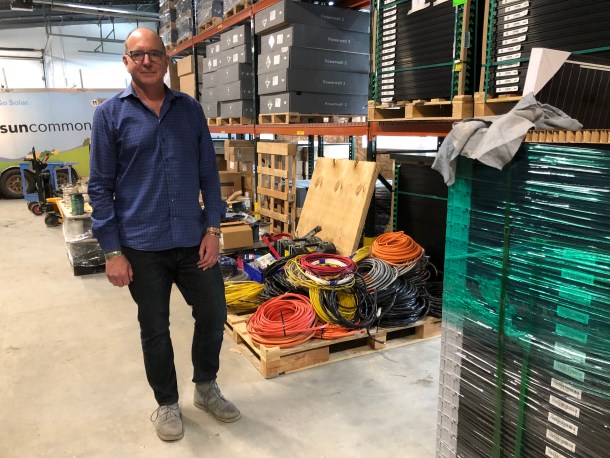
Peterson started SunCommon with James Moore in 2012 after the two met while serving on the board of the Vermont Public Interest Research Group.
Peterson was born in Las Vegas and raised in Los Angeles. He studied government and economics at Dartmouth College and then worked as an ambulance medic and an LA police officer for nine years. He also did a stint in that state’s Department of Justice before working on more than a dozen progressive political campaigns in California, including that of Tom Hayden, a leftist who served in both the California Assembly and the California Senate.
Peterson moved to Vermont in 1996 to work for Ben & Jerry’s as “chief of stuff,” a role that had him sharing an office with the eponymous founders of the ice cream empire for 12 years.
Now Peterson helps run a company with 160 employees in Vermont and in Rhinebeck, N.Y., where SunCommon acquired a business last year. SunCommon has 25 one-acre outdoor solar installations that serve about 30 families apiece, part of a “community-supported solar” program that lost momentum after a reduction in net-metering-related incentives. Now SunCommon focuses on residential solar installations, electric vehicles and power storage.
VTDigger spent some time talking to Peterson about SunCommon and the fast-changing renewable energy landscape in Vermont. The interview has been edited for length and clarity.
VTDigger: What goal did you and James Moore have in setting up SunCommon?
Duane Peterson: We wanted a market solution to climate change. We were deeply aware of climate disruption, and offended at the slow pace of reacting to its dangers. We were going to dramatically increase adoption of clean energy. The technology is sound, the policy is in place, and what we thought was lacking was helping folks go solar.
We believe everyone has the right to a healthy environment and a safer world, and the clean energy is where that starts. Our mission is to knock down the barriers and make it easy and affordable for people to get in, and we are using business as a force.
We settled on residential rooftop solar as the renewable energy most likely to accelerate and the easiest to explain. It’s visible and it’s distributed, so we could actually help create a community of people who belong to something bigger, and could help advocate for clean energy.
VTD: How does SunCommon find customers?
DP: We applied the community organizing model of marketing. We believed that people would want clean energy, but they are busy with their own families, their own jobs. They are not experts. So we thought if we did all the legwork and packaged this up so it was easy, and if we could make it affordable then adoption would increase. Through organizing we made this offering available to people.
So we get in front of a room of five or 200 people and say, “You may be concerned about climate change, you may just want to save money. The clean energy repowering of our economy is underway, and here is how you can participate.”
VTD: How does this make money?
DP: We want to get paid, but getting wealthy is not the goal.
We build and sell clean energy generating equipment. We’re installing solar-powered heating and cooling at a significant savings to our customer, we are installing EV charging stations, and when those are powered by solar that makes it an even cheaper fuel, and we’re installing home energy storage.
We have sold 1,000 cold weather air source heat pumps. About a quarter of our residential systems include solar home heating and cooling.
When people ask how much does solar cost, our goal is to get it to be less than you were paying for your electricity. That doesn’t always work out. Where does your roof face? Do you need an electrical panel? How steep is your roof?
VTD: SunCommon is a benefit corporation or B Corp, a company that balances profit and social purpose. How is that reflected in its work?
DP: Replacing fuels with solar is cleaner, safer less polluting and vastly cheaper.
Vermonters spend $2.6 billion dollars a year on energy, one third on electricity, one third on heating our buildings, one-third on transportation. Two-thirds of that $2.6 billion leaves our state when we buy liquid fuels like fuel oil or propane for heating. It’s an insane concept. Almost all of us fuel our vehicles with gasoline or diesel, and these are the dirtiest, most expensive fuels possible.
There is a huge opportunity to dramatically reduce the burning of liquid carbon-based fuel in the open atmosphere and also save Vermonters gobs of money and build a very thriving business.
We’re installing solar-powered heating and cooling at a significant savings to our customers, we are installing EV charging stations. Our very innovative utility, Green Mountain Power, sees the benefit to the utility and to the grid and so they are helping our customers pay for batteries, making it even cheaper for the customer in exchange for the utility having occasional access to that remote power in peak periods.
This is a business that brings in revenue, and the more revenue we generate, the more good we can do.
VTD: What are your plans for expanding electric vehicle stations?
DP: We only have a few sprinkled around the state. We’re going to build some commercially around Vermont and own them; we’re looking at where. The ones we have here, people can come and fill up for free, because we generate so much electricity.
VTD: What’s next?
DP: To the degree we may have figured out how to use the business as a source for good, we feel obliged to extend that. This is not limited to the peculiarities of Vermont.
The Hudson Valley has five times Vermont’s population, and yet only half the solar penetration. And New York’s regulatory framework and incentives are significantly superior to Vermont’s. There’s just a tremendous opportunity, and that’s where the expansion will happen. We’ll continue growing in Vermont with a fixed base, but the big opportunity is there.
We’ll prove to ourselves we can do what we want and need to do in the Hudson Valley and then keep moving.
