


[T]he House Ways and Means Committee Friday passed legislation that would establish a paid family leave program in Vermont funded by a mandatory payroll tax and administered by a private insurance carrier.
The paid leave legislation advanced by the House’s tax writing committee would grant workers 12 weeks of family leave or eight weeks of medical leave. Employees on leave would receive 90 percent of their weekly wages if they make at or below the Vermont livable wage, which is currently $13.34 an hour.
Wages employees earn above that would be replaced at a 50 percent rate, unless they make more than 2.5 times the livable wage, where the wage replacement maxes out.
The proposal, which was passed in a vote of 7-4, represents a more moderate paid family leave program than what a different House committee passed last month. The new proposal is more in line with other states’ paid leave systems, like Washington state, which offers the same wage replacement rates.
The previous paid leave legislation, passed by the House General, Housing and Military Affairs Committee, would have offered employees 100 percent wage replacement for 12 weeks. The program would have been funded by a split .93 percent payroll tax on employees and employers and administered by the Vermont Department of Labor.
Under the new proposal, it would be up to employers to determine who pays the .55 percent payroll tax: They could require employees to pay the cost, split it in some way, or cover it entirely for their employees.
The chair of the House Ways and Means Committee, Rep. Janet Ancel, D-Calais, had indicated earlier this week that she was seriously considering harnessing a third party insurance company to administer the paid leave program in an effort to roll out the program faster and save the state start-up costs.
Using a private carrier would spare the state millions in IT and staffing investments, and allow the state to start paying the benefit to workers more quickly.
If Vermont’s Department of Labor ran the program, fiscal analysts say the state would have to collect a payroll tax for months to build a reserve fund before workers could see the benefits.
“I think we were concerned about the money, the need for the reserves, the complexity,” Ancel said of a state-run paid family leave program.
“If insurance carriers are available to bid on a program like this, it made sense to start there.”

Under the new legislation, the state would have until September to contract with a private insurer. However, if the state were to be unable to find an insurer that could offer the benefit at a price that’s at or below than what it would cost the state to administer the program — which is estimated at around $100 million annually — the Department of Labor would run the program itself.
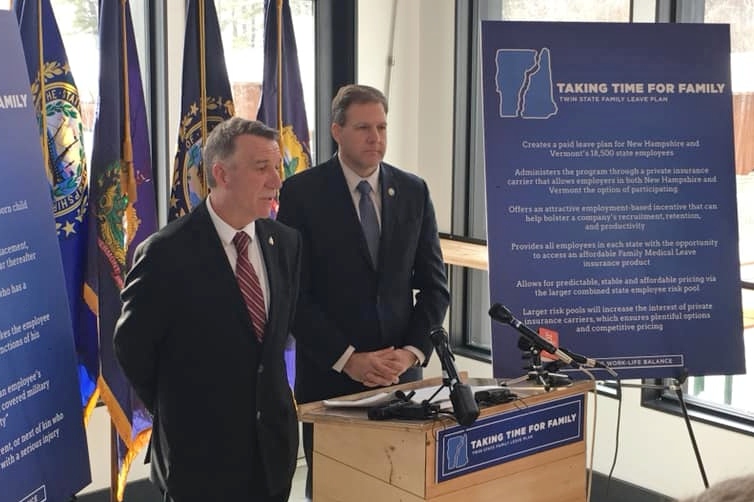
Gov. Phil Scott, who has pitched the Legislature his own voluntary paid family leave plan with New Hampshire Gov. Chris Sununu, has also advocated for a privately administered program.
After seeking input from insurance carriers, his office announced last week that six insurers had expressed interest in contracting with the state to offer the program.
The Scott administration however, has also signaled it will not be able to support a paid family leave program like the House Ways and Means bill, which is mandatory and funded through a payroll tax. He vetoed a paid family leave bill last year because it was funded by a mandatory tax on employers.
Some lawmakers agree with the governor that the program should not be mandatory, and that businesses should be able to elect to offer the benefit.
“If we put this new burden on the businesses, they’ll just pay the workers less,” said Rep. Cynthia Browning, D-Arlington, who has advocated for a voluntary paid family leave program.
“I support this in concept, but I want to start really small. We can always grow it.”
On the other hand, some had hoped for a program that more closely modeled the legislation passed by the Housing General and Military Affairs Committee.
Ashley Moore, the Vermont director of Main Street Alliance, an organization that advocates for small business interests and has pushed for a mandatory paid leave policy is concerned about an insurance party administering the program.
She worries that opposed to the state, a private company operating the paid family leave program would be motivated by profit.
“Not only does that introduce the risk of higher costs,” she said. “But there is also an incentive on behalf of the company to deny claims.”
Correction: The bill moves to the House Appropriations Committee, not to the House floor.
