


This story by Jordan Cuddemi was published by the Valley News on March 11.
[W]HITE RIVER JUNCTION — Windsor Superior Court will be the next Vermont courthouse to launch technology that allows defendants to be arraigned via video conference, a system used in New Hampshire for almost 15 years and first launched in the Green Mountain State in 2015.
Having defendants appear on video from the jail will cut down on transportation costs, increase safety for sheriff’s deputies and inmates, and help with timing and scheduling at the courthouse, said Jeffery Loewer, the chief information officer for the Office of the Court Administrator.
Video appearances are currently used in at least two other counties in the state, including Chittenden and Bennington, and it is being rolled out in several others.
“It is good basic infrastructure to put in the courts,” Loewer said. “In Chittenden, it is part of their everyday life now.”
Typically in Windsor County, a sheriff’s deputy transports a defendant from the jail in Springfield to the White River Junction courthouse — about 32 miles — for an initial court appearance and arraignment. If a judge orders the individual held on bail or sets high cash bail, the sheriff then drives the person back to Southern State Correctional Facility.
Defendants will have the option to appear via video instead of making the trip to the courthouse, Loewer said. There isn’t a hard start date, but officials said the court could start using the technology later this month or next month.
Some defense attorneys, including Defender General Matt Valerio, have raised concerns about the process. They say it makes it harder for an attorney to give advice to a defendant and can create unintended bias in the courtroom.
“It dehumanizes the accused,” Norwich-based attorney George Ostler said recently. “Arraignments are a crucial stage of the proceeding. It’s the first time the judge gets to see the accused and gets the information. I don’t care how big the TV screen is, it’s not the same.
In addition, having a client appear via video inhibits the attorney and client’s ability to confer privately while in front of the judge, Ostler said.
“There is no really good way for the client to communicate with the lawyer if they aren’t together,” he said. “It’s a real bad shortcut.”
On the other hand, Windsor County State’s Attorney David Cahill said testing the technology “makes sense.”
“Video arraignments have been successfully implemented in other states and are to some degree accepted as the norm there,” Cahill said. “It makes sense to pilot them in Vermont — given the potential to save time, money, and fuel, not to mention the safety benefits of avoiding taking prisoners on a road trip.”
New Hampshire has used video arraignment technology since 2005 and deploys it in both its Superior and District courts. Chittenden County was the first place where the technology was launched in Vermont, linking defendants at Chittenden Regional Correctional Facility to Chittenden Superior Court in Burlington via video in 2015.
In part because of its small size, Orange County won’t use the technology.
The idea to pilot the technology in Vermont started when the Legislature challenged court officials to come up with cost-saving and other measures. Video arraignments popped up during those discussions, Loewer said.
Once it launches, the technology in Windsor County will only be used for “Rule 5 proceedings,” which is the initial court appearance, and arraignments, and only with the OK from the defendant. If the defendant doesn’t want to be arraigned via video, he or she will be transported to the courthouse.
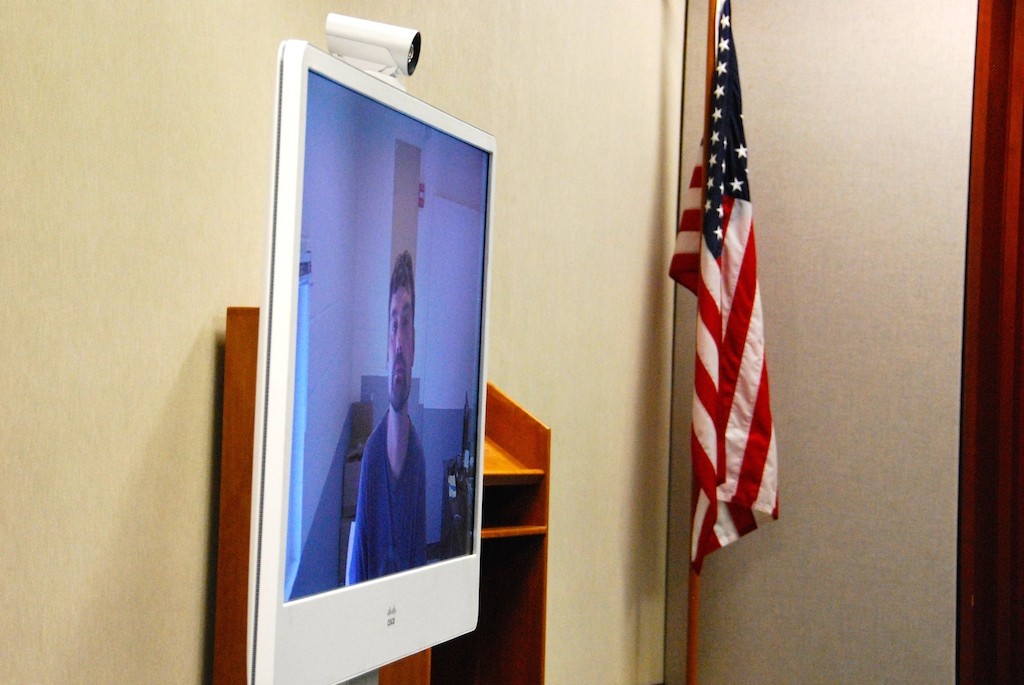
The state is leasing the video conference equipment. The main courtroom in White River Junction has a 55-inch video monitor mounted to the wall, with a camera placed atop it.
Each set up, or “endpoint,” costs about $15,000.
There also is a monitor and camera at the Springfield prison; each unit costs about $2,500 per unit, Loewer said.
