

[M]indi Hertzog, an Orlando, Fla. mother of three who travels frequently for work, sometimes swaps stories with other nursing mothers about the strangest places they ever breastfed a baby or pumped milk for later use.
Often it was the backseat of a car, a bathroom or someone else’s office at work. Hertzog’s mother-in-law, fearing breastfeeding would make others uncomfortable, once tried to banish her to an upstairs bedroom. Another time, Hertzog said, she used a 10-square-foot “mother’s room” at the Orange County Convention Center near Orlando with about 40 other women coming and going.
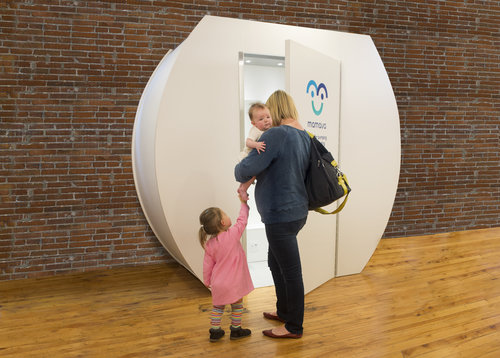
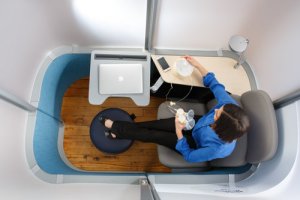
For that reason, Hertzog greatly appreciates the Mamava booth at the Orlando International Airport, which offers a clean and private space with an electrical outlet. Mamava is a Burlington company that made its first booth for nursing or pumping milk in 2013 and now sells units to the operators of public places such as airports, stadiums, zoos and universities. The company recently shipped its 700th unit and is now looking for other innovations that help nursing mothers on the move.
“It’s crazy that there’s not more resources,” said Hertzog, who is something of a Mamava pod evangelist. She said she once pumped milk at a miniature golf course under cover of a blanket. “You do what you can.”
Mamava is the creation of entrepreneurs Christine Dodson and Sascha Mayer, two mothers who met in 1998 while working at the Burlington design firm JDK. They started the company in 2013 with help from their employer.
The two have completed three separate rounds of funding, the first, in 2015, an equity round of about $450,000 led by Fresh Tracks, the venture capital firm based in Shelburne. In 2016 they received another infusion of money from convertible debt, and in March 2018 a round of equity funding led by AngelList, a Boston angel fund platform, raised $1.45 million for Mamava. They now run their own company in Burlington with 25 employees, managing the construction of Mamava units in three sizes.
The sleek-looking Mamava pods are made in Springfield at Konrad Prefab, a company created in 2016 by architect and fabricator David Jaacks, who worked with Mamava in its early days when he was at a fabrication company in Rhode Island and the units were made of high-pressure laminate and particle board. He used a $540,000 loan from Vermont Economic Development Authority and Mascoma Bank to start his own business and now has 14 employees in a 25,000-square-foot factory.
Mamava’s relationship with Jaacks started with a recommendation from the Vermont Manufacturing Extension Center. At the time, Jaacks had a background in designing and building trade show booths and store fixtures for large, national companies like Foot Locker.
Jaacks took Mamava’s suggested design and simplified it with the goal of creating customized graphics he could create on a large-format printer. He switched to making the units from ACM, or aluminum composite material, created from two thin layers of aluminum with a polyethylene core that was chosen because it is lightweight and the surface can be digitally printed. Jaacks said Konrad makes Mamava’s original version, which is about 4 feet by 8 feet and 90 inches tall, and its larger wheelchair-accessible version, which is 5 feet by 9 feet and 90 inches tall. Another, smaller version is made by the furniture company Steelcase, and then an inflatable version is made overseas and imported, he said.

The smallest units start at $9,000, and the largest goes for $25,000, including customized graphics.
Jaacks said he can compete with offshore fabricators because he has invested in tools such as modeling software that significantly reduce his labor costs.
“We’re trying to use as much technology as we can,” he said. “Technology actually is the great equalizer. People will no longer have to chase labor anymore because of automation and technology.”
Chinese factories that make the kind of products Konrad does, he said, haven’t been quick to make large capital expenditures on technology.
Jaacks believes Mamava will succeed because there is growing demand for the pods. One reason is that employers over a certain size are required to provide basic accommodations for breastfeeding mothers at work under the Fair Labor Standards Act. A bathroom doesn’t count as that space.
Beyond that, Jaacks expects accommodations for breastfeeding to follow the same general path that the Americans with Disabilities Act did.
“Twenty-five years ago, people said, ‘I’ve got to put a ramp in front of my building?’” he said. “It wasn’t until 10 or 12 years after that you saw a large implementation of those services for people with disabilities being responded to and taken seriously.”

Mamava isn’t just a lighted box. There are security concerns, and the units must be accessible to emergency personnel, and small enough to be practical in a crowded airport terminal, yet large enough that the person using it can relax. They also have to suit the many other building, maintenance, service and safety codes for structures in individual settings.
“There are very few objects that can sit equally inside an incredibly busy airport terminal or at a zoo or in an office building or at City Market,” Jaacks said.
Not everyone can talk about breastfeeding with ease.
“Many of our customers are facilities people,” Dodson said. “They are generally male, and it’s interesting to hear salespeople talk about their conversations. They are just embarrassed and don’t know what questions to ask.”
At the Milwaukee County Zoo, which has three of the units, Public Relations Coordinator Jennifer Diliberti-Shea said some mothers initially interpreted the arrival of the units as a message that the zoo didn’t want breastfeeding in public areas.
“It was just an option to provide a private area for mothers to pump or breastfeed, and once that was relayed to them, they were fine with it,” Diliberti-Shea said.
The Minnesota Vikings football team was one of Mamava’s earliest customers. Erin Swartz, director of brand and creative for the Vikings, mentioned to her COO in 2014 that she was having a difficult time finding a place to pump milk. Soon after, the COO spotted a Mamava unit in an airport and ordered one for the team’s U.S. Bank Stadium in Minneapolis. Another one followed for the team’s orthopedics and practice center, and now there are five.
“We had lines to use them early on during our games,” said Swartz, noting that women make up about 45 percent of game-goers. “We realized they were in higher demand than we thought they would have been.”
The Vikings don’t plan to buy more Mamava units anytime soon. Last year, the team opened a room for mothers that holds seating for up to four women, a changing area, and two private nursing areas.
“We’ve come a long way,” Swartz said.
Mamava the company has come a long way, too. Dodson and Mayer have been invited to talk about their product on national TV, and have had scores of media mentions, including last month’s Forbes list of “50 Women-Led Startups That Are Crushing Tech.” They also have an app that allows users to both find and unlock the units, and the app contains information about other breastfeeding accommodations.
The timing does seem to be right. This week, the Port Authority of New Jersey announced it was opening 28 new Mamava units at its four airports, replacing the 28 smaller versions it had in place previously. City Hall in Boston unveiled a Mamava unit on Friday in honor of International Women’s Day.
Dodson sees the Mamava pods as a way to create more awareness about breastfeeding accommodation in general.
“We want Mamava to be synonymous with breastfeeding. Maybe we design the next breast pump, maybe we collaborate with other companies in the industry to provide more support,” she said. “For us, success is about having Mamavas and breastfeeding accommodations so prolific that it’s not a conversation we ever need to have again.”
