

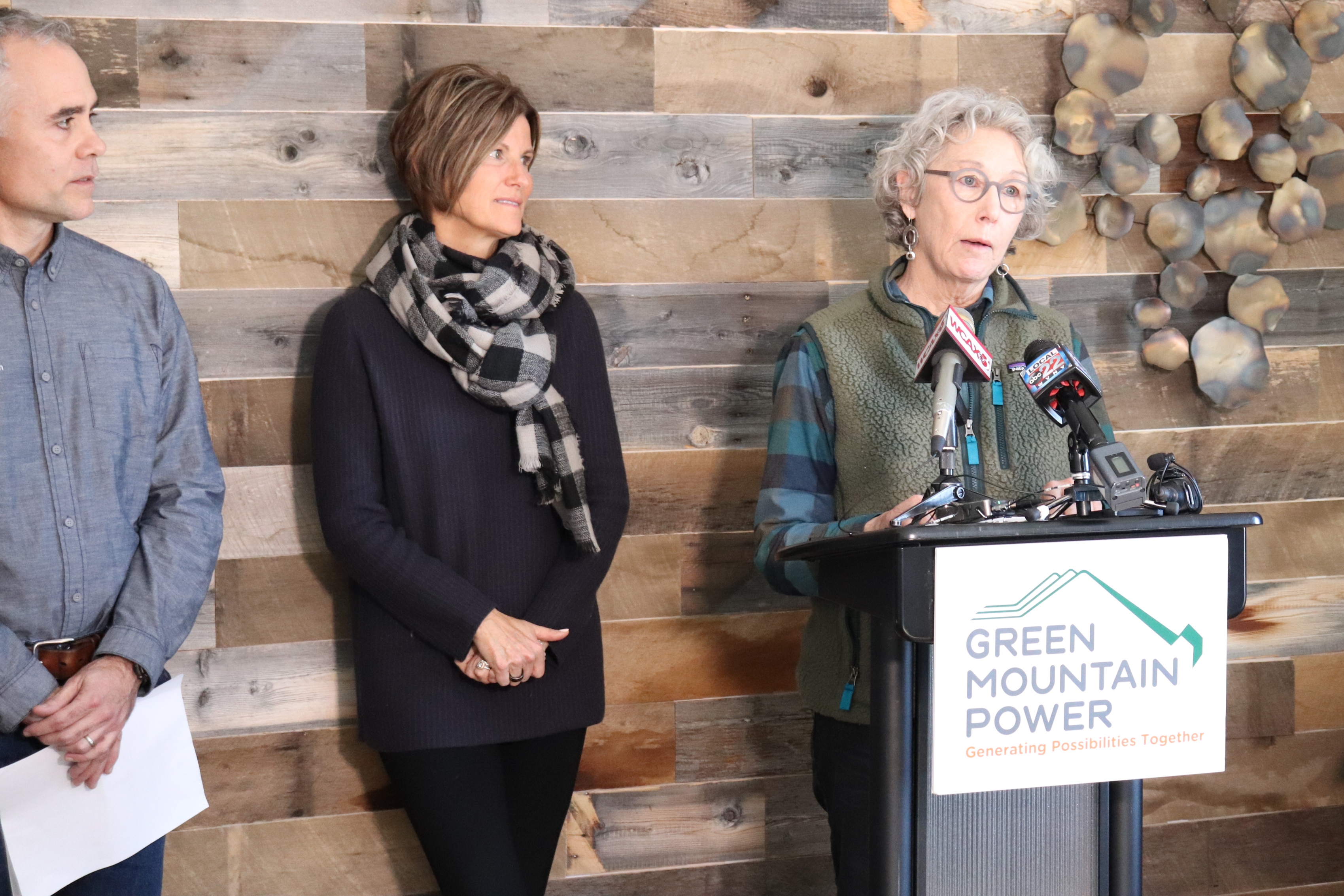
[H]INESBURG — The state’s largest utility has partnered with a renewable energy trade group to provide upfront payment for customers who hook up an energy storage battery to the grid.
Carole McCay’s journey into home renewable electricity generation was held up as an example for Vermont’s energy future at a press conference Tuesday in her Hinesburg home. McCay said she installed solar panels on her house three years ago through SunCommon, the state’s largest solar company.
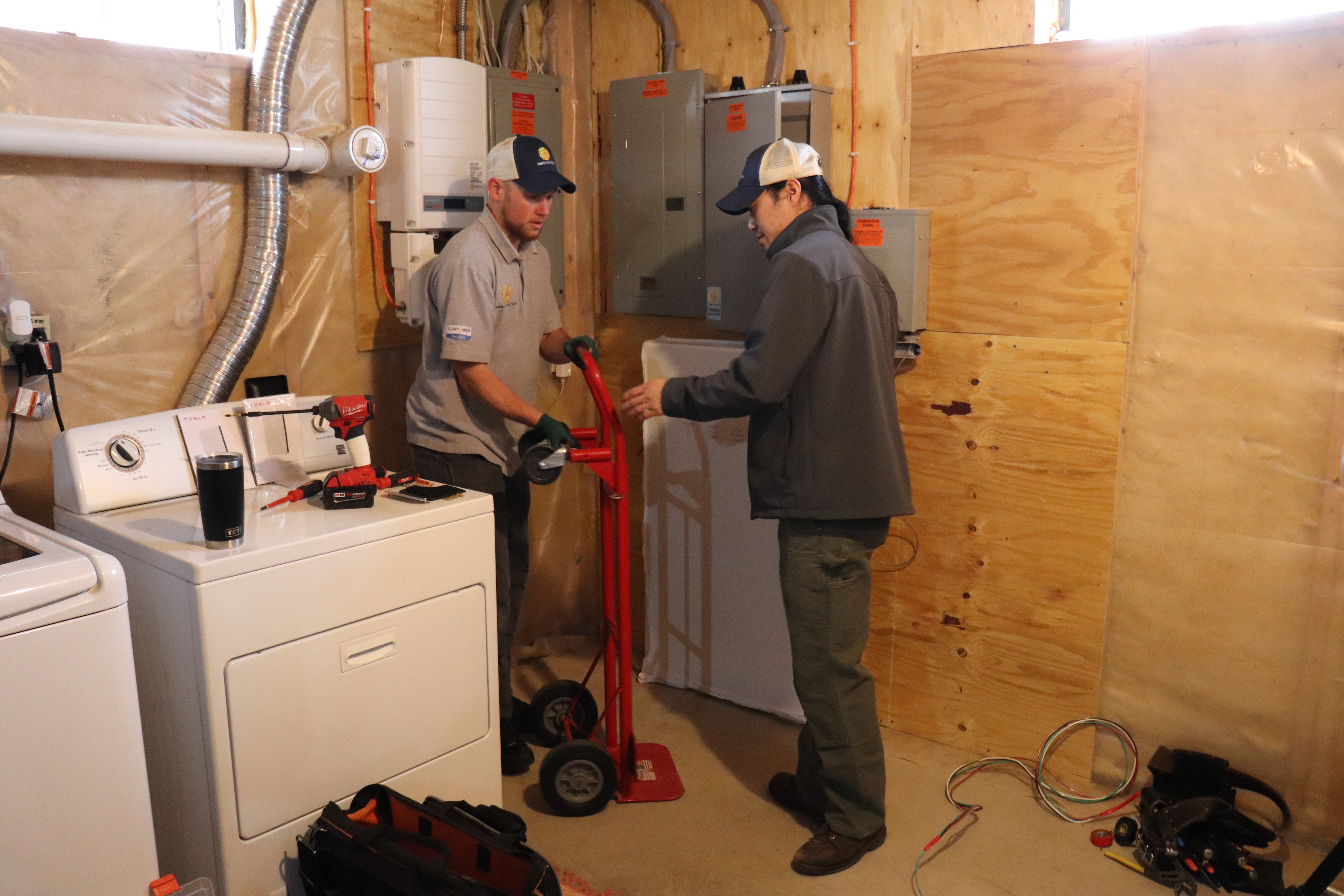
She let reporters go down to her basement to watch SunCommon employees Tae Wills and Ben Kozak install a Tesla Powerwall. The new incentive offered by Green Mountain Power shaved off about half of the upfront cost of the battery, she said.
“Clean energy appeals to me — it’s a little thing I can do for the environment,” said McCay.
The home energy storage pilot program is the latest effort by Green Mountain Power to draw on stored energy to reduce peak demand, which is when electricity is most “carbon intensive,” said the utility’s CEO Mary Powell. Lowering peak demand also saves customers money by driving down transmission and capacity costs.
“We’re excited to see more homeowners take control of their energy and support a smarter electrical grid,” said Powell.
Green Mountain Power partnered with Tesla to install Powerwall batteries in customers’ homes last year, which it says saved $500,000 during a peak last July. The utility has installed combination solar and battery storage projects in Rutland and Panton and has received approval from the state’s Public Utility Commission for three more similar projects in Ferrisburgh, Essex and Milton, said Kristin Kelly, director of communications for GMP.
Olivia Campbell Andersen, head of Renewable Energy Vermont, said that energy storage also provides backup power for homeowners when their electricity goes out in a storm. Over the past two decades, the Green Mountain State has seen more extreme precipitation events than any other time in the historical record, according to a report from the National Oceanic and Atmospheric Administration.
“In Vermont, we are tragically — like everyone else in the world — already experiencing the early impacts of climate change,” said Campbell Andersen.
Customers can receive an upfront payment of $850 per kilowatt of battery storage they enroll for 10 years in exchange for allowing the utility to access stored energy during peak demand. Electric vehicle chargers can also be enrolled in the program for a $10 a month bill credit but are not eligible for an upfront payment.
GMP particularly wants to encourage customers with solar panels in grid-constrained areas to add energy storage units and will provide an extra $150 per kilowatt enrolled.
The incentives will be available until 2 megawatts of storage, or roughly 600 customers, enroll. The battery storage pilot program is part of the utility’s Tier III requirements under the state’s renewable energy standard, said Kristin Carlson, vice president at GMP. She said the program will save customers $300,000 after payout to participants is factored in.
Depending on the success of the pilot, the utility plans to file with the state’s Public Utility Commission to continue the incentives, she said.
