

[L]iving in a free society can be a bummer.
Consider former Rep. Kiah Morris, D-Bennington. Someone (no one knows who) broke into and vandalized her house and car. Someone (everyone knows who; he’s proud of it) bombarded her online with obscene and threatening racist messages such as, “every time you attend a political rally … I will troll the hell out of you. Maybe I’ll bring a friend or three with me.”
Until finally, insecure in her own home, the only African-American woman in the Vermont Legislature quit the seat to which she would have been re-elected last November.
Morris, who did harm to no one, is the loser here. So is her family. So are her constituents who wanted her to represent them. So are the other legislators who valued her participation.
The winner? Her tormentor, Max Misch, a self-described “white nationalist” who will not be charged with a crime for harassing Morris.
A bummer, all because what Max Misch did is free speech.
Now consider Attorney General TJ Donovan.
No, what is happening to him is not remotely comparable to what Morris and her family endured. He still has his job. There are no reports of anyone threatening him or his family, who, as far as anyone knows remain secure in their home.
But he’s being assailed for not seeking stronger “hate crimes” laws (he is), for deciding that his office would not investigate the Bennington Police Department’s handling of the case, for refusing to prosecute Misch.
In the corridors of the Statehouse, Democrats are wondering whether, just from the crass political perspective, Donovan blew it.
“The base is very much on Kiah’s side,” said one Democratic activist. Assuming, as almost everyone does, that Donovan will run in a Democratic primary for higher office one day, “he’d have been better off pressing charges.”
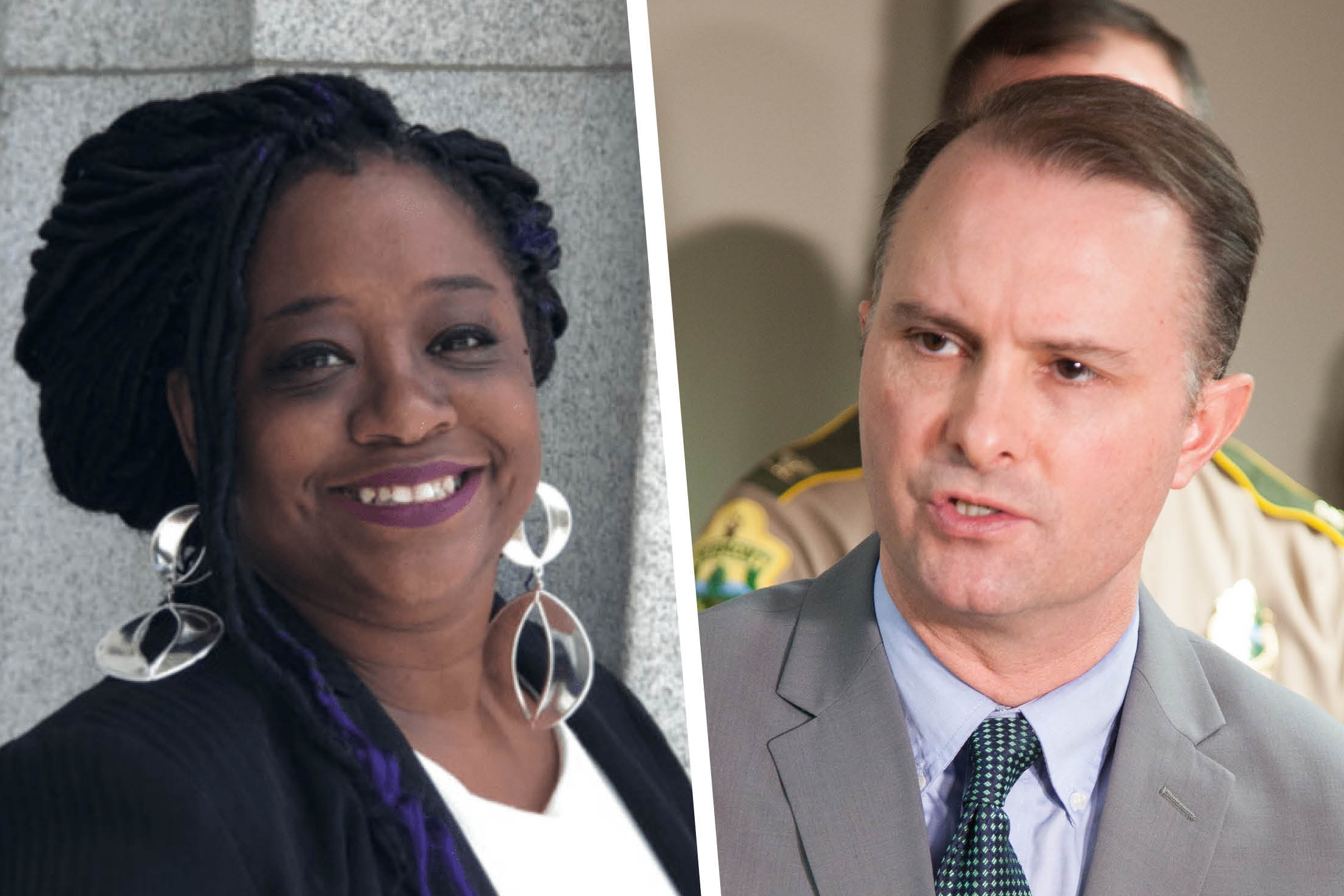
All that talk intensified last month when Donovan and Morris appeared together at a Bennington press conference where he announced he would not file charges against Misch, and Misch – shameless, but with an apparent instinct for the theatrical – showed up.
The attorney general, standing next to Morris at the podium, said nothing, rather like a batter not swinging at a soft, fat, pitch right over the middle of the plate. Here was a chance to challenge perhaps the least popular person in Vermont.
Where were Donovan’s political instincts? Maybe they aren’t as sharp as often assumed. Because he comes from a family of successful politicians, because he’s won every election but one (and that one a primary against an entrenched incumbent, and it was close), Donovan seems like a political colossus.
As he may turn out to be. But as a political performer, he’s average. From the podium, he can make an acceptable partisan speech, but he’s hardly charismatic. At a press conference or a legislative committee, he is soft-spoken, more diffident than dynamic.
None of this is a character flaw. Nor does it mean that he couldn’t be a very good governor, senator, or congressman. Soft-spoken and diffident often mean thoughtful and responsible, which is what he has tried to be – if a bit clumsily – in handling this case.
More responsible by far than some of his critics, who have insisted that he bring charges against Misch without saying just what those charges would be, as though a person can be prosecuted for being a bad guy.
“I can’t charge someone because I dislike him,” Donovan said.
Robert Appel knows this. Appel, once head of Vermont’s Human Rights Commission, is Morris’ lawyer, and agrees that “you can’t prosecute someone for being a racist creep.”

But both he and his client, he said, think Misch could be prosecuted for violating 13 VSA (that’s Vermont Statutes Annotated) Section 1027, which forbids “disturbing peace by use of … electronic communications,” or perhaps the laws against stalking (13 VSA 1061-1063).
“What Kiah and I say is bring the charge and see what a jury does with it,” Appel said. “That’s why we have judges and juries.”
A reasonable position for an advocate to take. But Donovan said he has considered those charges and doubts that they could “survive arraignment or the first motion to dismiss” before being thrown out of court.
He seems to be right. The U.S. Supreme Court has determined that even “speech that supports law-breaking or violence in general” is protected “unless it directly encourages people to take an unlawful action immediately.” (Brandenburg v. Ohio, 1969).
Vermont Law School professor Jared Carter, who is not involved in the Morris-Misch case, said that from what he has seen the material Misch sent to Morris “doesn’t sound like it would qualify as what the Supreme Court calls a true threat.”
The Supreme Court, Carter said, has made it “very hard” to prosecute anyone for what he or she has said, even if it appears threatening or intimidating.
So while urging Donovan to prosecute Misch may sound enlightened and progressive, it is also urging the state’s chief law enforcement officer to pursue – at taxpayer expense – a process he is convinced will fail.
Is that sending a message that Vermont will not tolerate racism or is it grounds for impeachment?
And if the process were pursued, when it failed (as it almost surely would), the winner once again would be Misch.
Maybe in such sensitive matters the best course is strict adherence to the laws as interpreted by the courts, not using the criminal justice system to send a message.
Whether Donovan should investigate how the Bennington police dealt with the burglary and vandalism at Morris’ house is a separate question. Robert Appel is not sure it’s the attorney general’s job.
“For the chief law enforcement officer to go after a department is daunting,” Appel said, with possible “conflicts of interest involved” because the Attorney General’s Office is required to defend the state police and sheriffs departments if they are sued.
The real problem, said Appel, is that Vermont, like most states, has no mechanism for policing the police.
Some of Donovan’s critics argue that by not prosecuting Misch he effectively gave racists permission to do more, such as posting signs earlier this month outside a Burlington synagogue and two gay rights organizations.
Whoever posted those signs already had permission. They may have defaced private property, but the messages on the signs, in addition to being bland (some said “America First”), are without doubt constitutionally protected free speech. Vermont has no power to make it anything else.
And perhaps should pause before trying. It would be almost impossible to craft a law that would criminalize racially offensive speech that would not also give employers a path to try to imprison workers who complained about company policy, utility companies a chance to urge prosecution of homeowners who said nasty things about its efforts to run a transmission line through their neighborhood, the government to seek jail terms for anti-war protesters. Free speech often protects the weaker, the poorer, outsiders, minorities.
Whatever else it may be, living in a free society can be complicated.
