

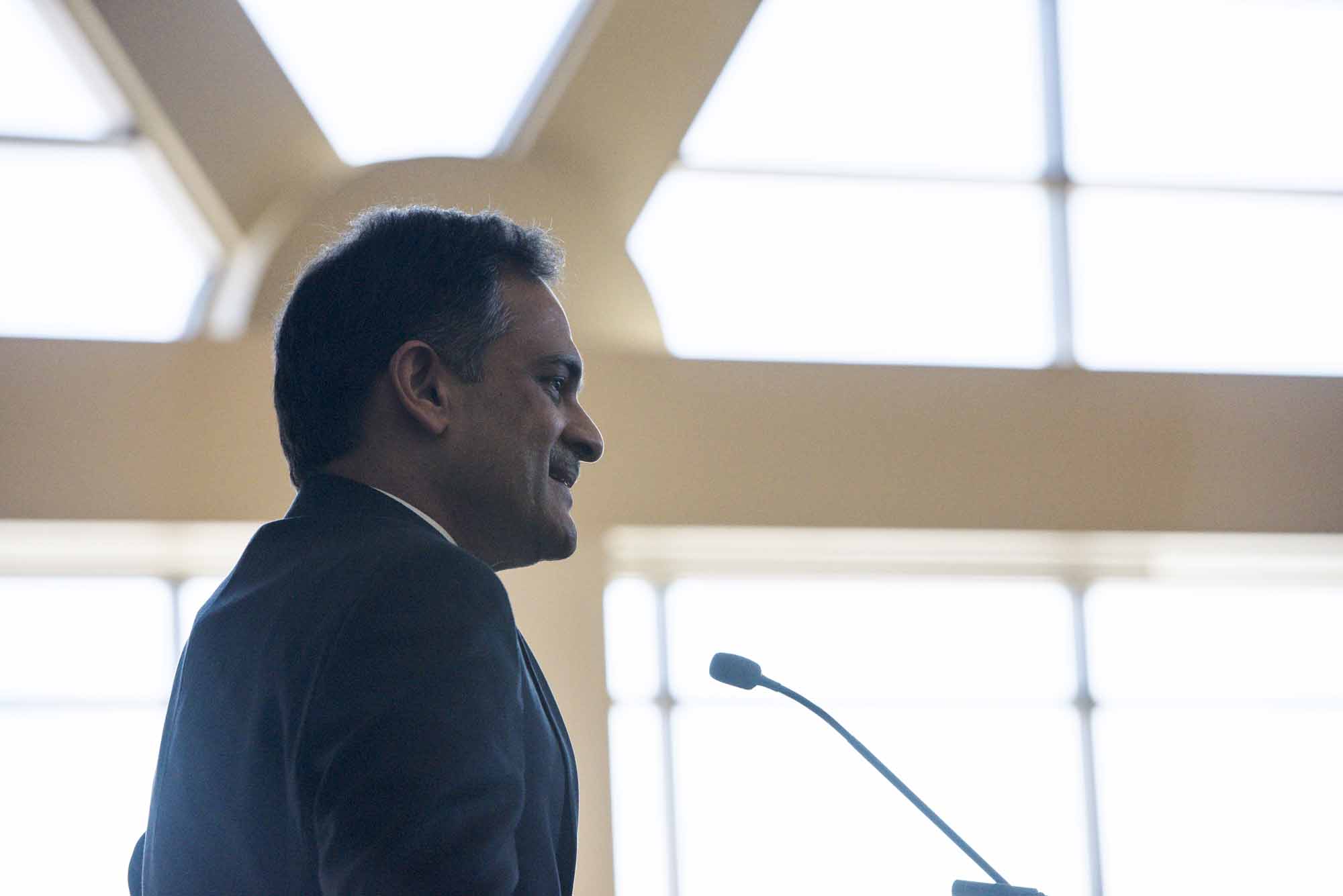
[U]nder the leadership of former Republican Indiana Gov. Mitch Daniels, Purdue University has garnered attention as a controversial leader in higher education innovation.
Daniels has been successful in freezing tuition at 2012 levels for undergraduates at Purdue’s flagship campus and increasing enrollment. But critics say he views the university as more of a business than a public good and has lead the university down a perilous path toward privatization.
The University of Vermont on Friday signed a contract with Suresh Garimella, Purdue’s executive vice president for research and partnerships, to serve as its next president. UVM’s board of trustees unanimously voted to hire him Feb. 15 to succeed Tom Sullivan, who announced last year he would step down June 30.
Under Garimella’s watch, Purdue has seen four consecutive years of record research funding, including establishing partnerships with some of the country’s largest companies, including Microsoft, Rolls Royce, Fiat Chrysler and Ford.
Garimella is part of Daniels’ “inner circle” at Purdue as one of the university’s highest-ranking administrators, and touted some of Purdue’s efforts during his recent visit to UVM.
Will Garimella bring some of Purdue’s initiatives to UVM? And should he?
Purdue under Daniels
Daniels is seen as a higher education reformer by some and as a threat to the mission of higher education by others. Proponents say that by limiting tuition costs, he has made Purdue more sustainable and accessible for students. Critics believe that he is diluting the mission of higher education, and privatizing a public university.
Purdue’s administration has shifted the way it views the institution since Daniels’ appointment, Natalie Carroll, a Purdue professor and the current faculty senate chair, said.
“We’re looking at it more as a business, and trying to position ourselves for a healthy financial future,” she said. “There are a lot of colleges in financial trouble, and I think Purdue is positioned pretty well.”
Richard Kuhn, a professor in the Department of Biological Sciences at Purdue, said that while Daniels’ approach to higher education is unconventional, it’s been working.
“We have continued to grow and blossom even though we’ve frozen tuition for seven or eight years,” he said.
But David Nalbone, a professor at Purdue University Northwest and the secretary of the Indiana Conference of the American Association of University Professors, said Daniels is pushing for the privatization of the university in a variety of ways, including the purchase of the for-profit online university Kaplan University.
“Privatization basically says, we are trying to sell a product to an individual, and it benefits no one but that individual,” he said. “It breaks down the understanding that higher education is not just an individual good, but a societal good.”
Purdue has touted its tuition freeze, and has received substantial media attention for it. The university has seen increased applications, enrollments and graduation rates.

Daniels told Inside Higher Education that there’s no special secret to the tuition freeze, which he said comes from cutting spending not related to the core education and research functions of the university.
“The fat is marbled through the animal — you look in vain for too many great big strokes,” he said in an interview with Inside Higher Education. “There may be a few … but mainly it’s the accumulation of small economies, and that comes just from putting our students and their families at the top of our list. It’s not more complicated than that.”
But the percentage of students from Indiana has fallen, while the number of out-of-state students, who pay significantly more in tuition, has increased.
The university has also had to trim its budget in other areas to keep tuition frozen. For example, revenue for instruction has decreased and some teaching assistant positions have been cut. Resident assistants have been forced to share rooms, which can make private interactions with residents seeking help more difficult.
Purdue Initiatives
Under Daniels, Purdue has pioneered income-share agreement programs as a means for students to pay for their educations. In the program, students agree to pay Purdue a set percentage of their income for a mutually agreed upon number of years.
The university has also launched competency-based bachelor’s degrees, as Inside Higher Education has reported.
The university’s increased partnerships with corporations, which Garimella oversaw, sparked a conversation among faculty.
David Sanders, a professor of biological science at Purdue and former faculty senate president, said that some faculty are concerned about what these corporate partnerships say about the future direction of the university.
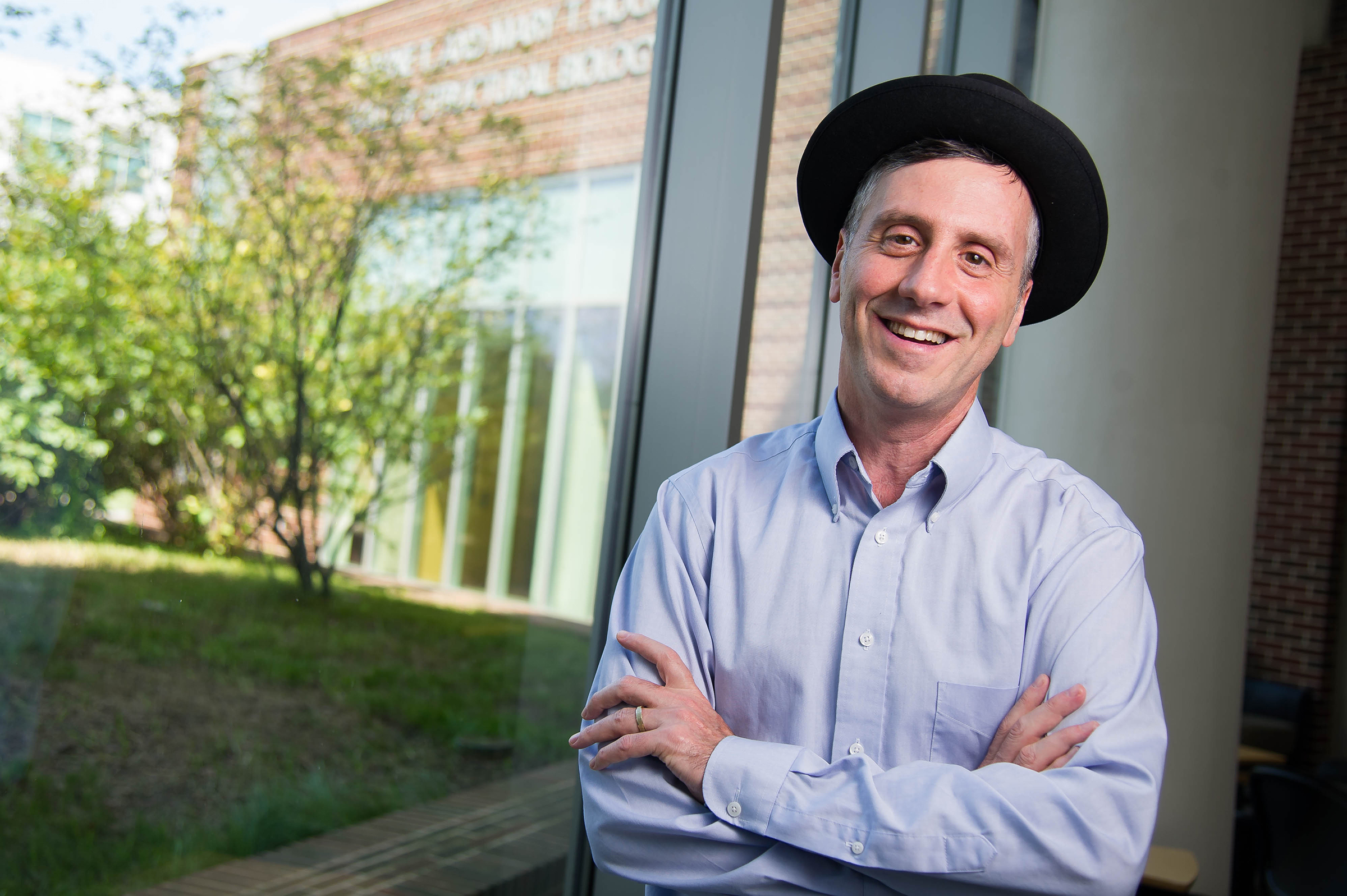
“The direction that the university seems to be going, based upon decisions being made at the top, is to direct us more to research and partnerships that favor corporate interests, and there are concerns about that direction,” he said.
During his visit to UVM, Garimella said that he views corporate partnerships a funding source that can provide students increased opportunities. He said the partnerships are mutually beneficial, and are not nefarious.
“Our partnerships in the corporate sector all emerged from faculty interest,” he said. “There’s no authority we are ceding to the corporations to somehow control our work — we are very, very careful about putting those controls in place.”
Garimella highlighted two Purdue initiatives he thought were particularly successful during his visit to UVM.
The university established Purdue Polytechnic High School in Indianapolis to reach low-income high school students, many who come from racial groups underrepresented in higher education. Garimella said that the high school has been successful and that the university plans to open a second high school.
“Our goal is to not just lament about the lack of a pipeline of students coming to Purdue, but to try and generate Purdue-ready students,” he said.
He also highlighted Purdue’s purchase of the formerly-for-profit online Kaplan University. Purdue renamed the venture “Purdue Global” after completing the controversial acquisition.
Garimella said that Purdue Global reaches a population that wouldn’t be able to go through the typical four-year college experience, instead taking online courses on their own schedules.
He said he views Purdue Global as an extension of the university’s land-grant mission and as a successful innovation in diversity and inclusion, which makes the university more accessible.

Nalbone said he views the venture as a predatory institution that preyed on its customers as a for-profit online college. Kaplan’s practices were examined by state and federal regulators, and Kaplan had to pay $1.3 million to settle a whistleblower lawsuit that the campus hired unqualified instructors.
Critics of the acquisition said that the for-profit company that used to own Kaplan’s ongoing role meant that the company would continue its troubling practices under the guise of a public institution. Purdue Global was exempted from the state’s open records law, and does not use state appropriations, instead being funded through tuition and fund-raising.
Garimella will come to UVM amid cuts in the College of Arts and Sciences, which have faculty and students on campus upset. He said during his visit that he wanted to get to know the situation better before proposing any solutions.
But he touted Purdue’s “Cornerstone” model of integrated arts as a possible model to follow. David Reingold, the dean of the College of Liberal Arts at Purdue, wrote in the Washington Post that the cornerstone model has provided STEM students an educational experience “shaped by the humanities” by having them take classes aligned with various themes.
During his campus visit, Garimella said that while he was proud of the work he had done at Purdue, he was coming to UVM with an open mind and a willingness to learn more about the institution before moving forward with any major initiatives.
He said that while many of the challenges in higher education are universal, there are no “cookie-cutter solutions” that work everywhere.
“It’s not as if my goal is to transfer a bunch of things we did at Purdue over to UVM,” he said. “I don’t come with a recipe book that has been tried elsewhere that would just apply here.”
He said that he thought Purdue’s “laser-focus” on making attendance affordable for a diverse population of students had been successful.
“I think there are experiences that I have learned from that will certainly enrich the conversation here,” he said. “But we will need to find solutions here that people with a lot of wisdom will need to come together around the table to contribute to.”
Garimella’s Purdue colleagues are confident that he will learn more about UVM and consult with faculty, students and staff before making any major decisions on campus.

“I think Suresh will bring some things that work well, but I think he would first assess, will they work well at Vermont?” Kuhn said.
Kuhn said that Garimella will not be a “Mitch Daniels clone” at UVM but will certainly take some advice from Daniels. He said that while Garimella is his own man with his own ideas, he’s been a team player at Purdue, and Garimella has substantially contributed to many of Daniels’ accomplishments.
Marietta Harrison, a special adviser for strategic initiatives in Garimella’s office, is also the associate director of Purdue’s center for cancer research and is a professor of medicinal chemistry.
She said Daniels’ focus on — and success in — freezing tuition has put Purdue on the map. But at the same time, the university has improved its international programs and research in serious ways, she said.
Harrison said that Garimella is a member of Daniels’ inner circle and has been a major part of Purdue’s transformation.
“Purdue has really transformed itself in a lot of ways, and Suresh has certainly been a member of the transformation team,” she said.
Thoughts on Garimella
Garimella has been an administrator at Purdue since 2011, when he became the associate vice president for engagement. He later served as the chief global affairs officer before moving into his current role in 2014.
Kuhn, a professor in the Department of Biological Sciences who has worked closely with Garimella, said he thinks deeply about challenges in a practical, straightforward manner.
While he and Garimella are in different disciplines, he said that Garimella always listens closely to him and asks good questions. Kuhn said Garimella has been able to engage with government and industry to successfully build the university’s research portfolio.
“He’s certainly transformed Purdue in terms of our research mission, and I think you would see this at a comprehensive level at Vermont,” he said.
Garimella has helped the university establish partnerships in Colombia and India.

In Colombia, the university is working with the government and other partners to plan for sustainable agriculture and tourism development in the country’s Orinoquia region. And in India, the university has connections with a number of universities and corporations.
Harrison said Garimella is a tireless worker, who is good at working out partnerships that will be mutually beneficial.
“I think he’s wise, he’s very inclusive, he sets a high bar for excellence,” she said. “He really wants the university to succeed, and has an uncanny knack for placing people in what they do well.”
Harrison said that Garimella was an inclusive leader who would often seek advice and input from multiple sources before making decisions.
Sanders said Garimella is well-respected among the faculty and made connections across campus.
“I think he’s a very effective collaborator and administrator who works well with other prominent officials,” he said. “I think he’s had a very successful tenure here. There are other things that are more controversial at the university, but I don’t think his role has been one of those issues.”
