


[A] boffo kick-off for Bernie Sanders presidential campaign.
Almost $6 million raised within 24 hours of his announcement Tuesday morning. Prominent coverage on the networks, the big newspapers, the trendy blogs. Some encouraging poll results (young voters really like him). Getting described here and there with a word never used for him when he ran in 2016: “frontrunner.”
Even the ridicule directed his way (“Hello I’m Bernie Sanders and I’m yelling for president of the United States,” Jimmy Fallon said on the “Tonight” show Tuesday) was a good sign. Inconsequential candidates don’t get made fun of by the network stars.
So far, then, so good. Unlike his 2016 run against Hillary Clinton, Sanders starts off this time with a large and fully-staffed organization headed by respected political operatives. He is likely to have more money than any of his several opponents, with the possible exception of former Vice President Joseph Biden.
And he has more of something else than any of the others, even Biden: a following, a devoted band of admirers whose enthusiasm is not just to a cause or a party, or an ideology, but to him. Their cause is Bernie. No doubt there are Democratic voters whose cause is Cory or Kamala or Amy. But combined, the devotees of Sens. Booker, Harris and Klobuchar don’t come close to the number of Berniecrats.
That’s the good news. Then come the problems and challenges, most of them the same all over the country: his age (77 now, 79 on Election Day 2020); the competitors who are as “progressive” (whatever that means) as he, but younger; his problems attracting minority voters; the fear among some Democrats that he wouldn’t be the strongest candidate against President Donald Trump; the reality that while avowed socialism isn’t the political suicide it once was, it’s still a disadvantage, even if the candidate who calls himself a socialist really isn’t one.
But Sanders also has a local, neighboring, challenge. It’s right across the Connecticut River. It’s called New Hampshire, which as ever will hold the nation’s first presidential primary. He has to win it.
Well, OK, it’s possible that Sanders could survive a second-place New Hampshire finish, but only because in politics any weird thing is possible. But it’s so unlikely that it’s as close to impossible as politics gets. After all, he didn’t just win that primary in 2016; he crushed Hillary Clinton by a 60-to-38 percent margin.
Plus, it’s right next door, and while residents of both New Hampshire and Vermont know that their states aren’t much alike, tell that to the talking heads in Washington and New York, where the lesson of a Sanders loss would be, “Sheesh, the guy couldn’t carry the neighboring state where he kicked butt four years earlier. What a humiliation.”
He has to avoid that humiliation.
And might were the primary held next week. A brand new poll shows Biden ahead of him 28 to 20 percent. But that’s not a big lead, 14 percent were undecided, and Biden might not run.
Anyway, the primary is not next week. It is next year (probably Feb. 11). It is, among other things, six days after the Iowa precinct caucuses, whose winner could ride his or her momentum to a strong finish in New Hampshire.
Besides, right now the political situation in New Hampshire is “fluid,” according to Dean Spiliotes, a political scientist at Southern New Hampshire University.
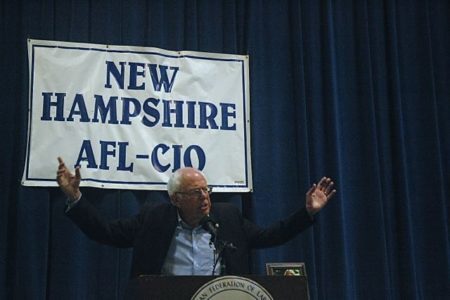
“There’s a real sense of enthusiasm because of so many choices,” he said, noting that Booker, Harris, and Klobuchar all drew good crowds at events in recent days.
So did South Bend, Indiana, Mayor Pete Buttigieg and self-help author Marianna Williamson, noted Democratic Party State Chair Raymond Buckley, to illustrate how much New Hampshire Democrats are “bursting for an alternative” to Trump.
Buckley said the next primary would offer “a completely different scenario” than the last one.
“This one will not be between two candidates,” he said, but among many, so it would “be grossly unfair to Senator Sanders” to expect another landslide majority victory. Sanders has “a very strong base” in the state, Buckley said. But he pointed out that “the world changes day by day these days,” often in what he called a “surreal” manner, making it impossible to predict what will happen in a year.
The New Hampshire Institute of Politics and St. Anselm College did take a recent poll, not of candidate preference, but of voter attitudes, and the results seem encouraging for Sanders, or at least for a candidate like Sanders.
The poll showed that 84 percent of Democrats don’t think Trump will be re-elected, so only 20 percent think it is most important to choose the nominee with the “best chance to win.” Most say they’ll opt instead for the candidate who “best represents my policy priorities” or “will best take the fight” to Trump.
Those policy preferences are higher taxes on the “ultra-wealthy,” stronger regulation of banks, Medicare for all and “A Green New Deal to reorient our economy to mitigate climate change.” The Green New Deal had the support of 89 percent of the Democrats in the sample.
Those are Bernie Sanders issues. Last time, they were only his. This time – to no small extent because of how well he did in 2016 – they are not.
“The key question is, what are they going to argue about?” said Neil Levesque, the executive director of the New Hampshire Institute of Politics. “Most agree with each other on key issues.”
They will find plenty to argue about. There’s too much at stake not to argue.
