


[E]arlier this month, a Lamoille County judge issued a six-month restraining order against Stuart Stevens, a Stowe-based writer and national political strategist. On Tuesday, Stevens appealed the decision to the Vermont Supreme Court.
The appeal is the latest twist in a complicated saga involving Inntopia, a local online reservation booking services company. The drama, centered in the high-brow New England burg of Stowe, includes the disgraced former COO of the company, Craig DeLuca, his wife, Paige Hinkson, Inntopia CEO and founder Trevor Crist, two job candidates and Stevens.
DeLuca is accused of sexually assaulting Lisa Senecal, Stevens’ girlfriend, and sexually harassing Alison Miley. Both women are single mothers living in Stowe who were looking for work.
The Miley and Senecal cases were widely publicized last year in national and local media, and Stevens believes the stalking order lawsuit, filed against him by DeLuca’s wife, Paige Hinkson, is retaliation for his role in supporting Senecal’s decision last year to go public with her allegations.
He flatly denies allegations that he stalked Hinkson in any way and says he never met Hinkson until the case went to trial last November.
His version of events, however, didn’t win over Megan Shafritz. The Lamoille County Superior Court judge ruled on Feb. 1 that Hinkson sufficiently proved that Stevens had caused her emotional distress.
Hinkson alleges that Stevens called her multiple times, stared at her for 20 minutes at a coffee shop and sent “disturbing books” about the impact of rape on women to her husband.
“As a result of this harassment, I can’t bring myself to go to the supermarket in town,” Hinkson said. “I have stopped going to the U.S. Post Office in town. I have panic attacks. At times I think that I am having a heart attack. I shake and do not sleep. I have lost weight. My hair is literally falling out due to stress.”
Stevens disputes all of Hinkson’s claims. His attorney, former federal prosecutor Craig Nolan, has appealed the decision on the grounds that Shafritz, who was recently named to the bench, made numerous factual and legal errors, and ignored and misapplied requirements of the stalking statute.
He agrees, though, that Hinkson was likely emotionally distressed in 2017 and 2018 — by her husband’s alleged misconduct, job loss and the publicity surrounding those events.

“Paige Hinkson has had a rough year,” Stevens said. “I’m sympathetic, but none of this is my fault. I didn’t make her husband come over and do what he did to Lisa. I didn’t make her husband lock Alison Miley in an office. I didn’t make her husband do whatever he did to make CEO Trevor Crist feel betrayed.”
Stevens believes the stalking lawsuit was part of a legal strategy to discredit him in the wake of publicity over DeLuca’s alleged sexual misconduct with two female job candidates, including Senecal and Miley, who DeLuca allegedly locked in an office and propositioned for sex.
Miley’s lawsuit filed in May 2018 was widely publicized. On June 4, 2018, the same day Senecal’s allegations were published in the Burlington Free Press, Crist, the founder and CEO of Inntopia, warned staff not to talk to Stevens.
Crist described Stevens as “a well-known political operative, who specializes in propaganda and disinformation campaigns” and is “well-versed in crafting stories for the media.” Crist urged employees to let him know if they were contacted by Stevens, any reporters or Scott Labby, Senecal’s attorney.
When the Free Press published a second story about DeLuca’s misconduct two days later, Crist called an “all hands on deck” meeting with Eagle Tree, the private equity firm that owns Northstar Travel Group, and their legal team, records show.
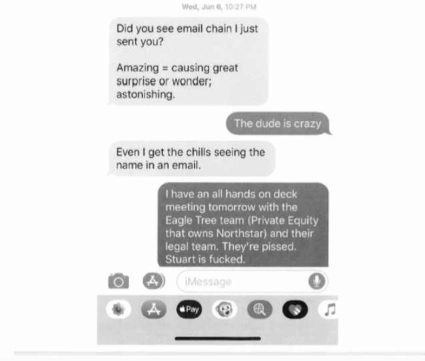
“They’re pissed,” he confided in a text to a consultant, referring to Northstar, which owns a majority share of Inntopia. “Stuart [Stevens] is fucked.”
Less than two weeks later, DeLuca’s wife, Paige Hinkson, sought a restraining order against Stevens, claiming that he was stalking her. Her attorney, Barbara Blackman, an insurance attorney, was also working for Inntopia as DeLuca’s defense counsel in the Miley case, which was filed just weeks before.
Typically, stalking complaints involve verbal or written threats. In Hinkson v. Stevens, no direct threats were cited, either in verbal or electronic communications.
Nolan, Stevens’ lawyer and a former prosecutor in the U.S. Attorney’s Office, immediately offered an agreement for all parties to sign agreeing no one would have contact with anyone.
“Paige Hinkson rejected that offer repeatedly,” Stevens said. “Why? The goal wasn’t to have an agreement not to have contact, it was to pressure me to pressure Alison Miley and Lisa Senecal. They failed.”
In the affidavit, Hinkson cites Miley’s lawsuit against Inntopia and a July 2018 article by Senecal in the Daily Beast outlining her allegations against DeLuca as proof that Stevens is harassing her.
“Stuart Stevens and Lisa Senecal are connected to this second lawsuit and I am afraid that his harassment of me will not only continue but it will escalate,” Hinkson said.
Nolan countered that the case “was designed to harm Stevens as a punishment for his support of the victims of Hinkson’s husband and to smear him in public.”
The stalking order was a form of revenge against Stevens, Nolan said, “for his support of women seeking to protect themselves from sexual predatory conduct by Hinkson’s husband, Craig Deluca.”
Inntopia lawyers from Gravel and Shea were present at the November trial. Shafritz was a partner at the firm for seven years before she became an assistant attorney general in 2009. Gov. Phil Scott named her to the judgeship last year after she fought an EB-5 investor lawsuit for the state.
CEO says he was ‘betrayed’
Trevor Crist, 48, is a highly successful tech entrepreneur with a passion for skiing. He graduated from Middlebury College in 1993, and later took his first job as the webmaster at Stowe Mountain Resort.

Crist designed an Internet booking service in 1998 that he sold to Unexplored.com, which failed when the dot.com bubble burst. The company shrank from 80 employees to two nearly overnight. The crisis forced Crist to start over. He and a small team put in 80-hour weeks rebuilding the software system. They dubbed the company Sterling Valley Systems, which later operated under the Inntopia moniker.
Over the course of a decade, Inntopia became the industry leader in online software for ski areas, golf resorts and other destinations. Their product ties together reservations for lodgings at a ski area, lift tickets, airline booking, rental cars and property management systems. Crist told Business People Vermont in 2009 that their clients “are selling a whole bunch of travel products, and we’re the glue that ties it together.”
Craig DeLuca, who moved from Boston to Stowe in 1998, was hired as COO of Inntopia just a few months before Northstar Travel Group acquired a majority share of the company in 2014. DeLuca, who had previously worked at several startups, was brought in to help manage the growing software business.
Today, the Inntopia platform is used by Vail Resorts, Intrawest Resorts Holdings Inc. and PGA Tour Experiences, and serves about 80 resorts worldwide.
Inntopia has more than 100 employees in Stowe, Burlington, Colorado and Portland, Maine. The company work culture has a distinct outdoorsy flair. Employees are reimbursed for ski passes and gym memberships. There are photos of Inntopia employees dressed in Patagonia chic on social media recreating — white river rafting, skiing, biking and hiking together.
On a company webpage labeled “key values,” Inntopia touts annual company ski days with a CEO who “regularly shows up at the office after a few morning runs at the mountain.”

When Stowe resident and marketing professional Lisa Senecal, 50, first heard Inntopia might be looking for a marketing manager in 2015, the mother of two teenage sons was told “personality was the key to being successful” at the company. An avid biker with a number of friends at Inntopia, Seneca understood that bonding over recreational activities was part of the company culture.
Eventually, Senecal got an interview in October 2016 with both DeLuca and Crist. There were a number of subsequent professional exchanges about the Inntopia marketing effort, and at one point DeLuca asked if she’d like to go on a hike to discuss the work further. She agreed.
DeLuca drove to her house on Feb. 8, 2017, ostensibly to pick her up for the hike. When he came to the door, Senecal was wearing outdoor gear. DeLuca, however, wasn’t dressed for a snowshoe trek, and he allegedly barged into the house and began making sexual overtures.
Senecal said she rebuffed his sexual advances. “I tried to get it to a point where I felt safe,” she said. “I thought I had been able to do that, then he became very physically and sexually aggressive.”
Senecal went to a doctor right away. She was afraid to go to the police.
In March, Senecal sued Inntopia for sex discrimination and sexual harassment. The company conducted an internal investigation and found that DeLuca’s behavior was an isolated incident, even though it later came out that another job candidate, Alison Miley, who interviewed with Crist and DeLuca for the same job during the same week in October 2016, had also been sexually harassed.
Records show that instead of putting DeLuca on administrative leave during the probe, which is standard operating procedure at most companies, the COO not only stayed on at the company for several months after the alleged assault, but he was also allowed to respond directly to Senecal’s complaint with what she describes as a “slut-shaming letter” claiming that she wanted to have sex with him.
DeLuca received stock options that March, records show. Inntopia insurance later paid for his legal defense fees.


Inntopia settled with Senecal in May 2017, and she and Stevens signed a non-disclosure agreement with the company. Neither party was allowed to disclose the terms, which included a requirement that the company fire DeLuca and investigate a potential pattern of sexual harassment. Crist says he fired DeLuca on his own — not in response to the agreement; DeLuca claims he “stepped down.”
A year later, Miley sued DeLuca and Inntopia for false imprisonment and sexual harassment. She engaged Labby, the attorney who also had represented Senecal, and Langrock Sperry and Wool. (Last month, she negotiated a public judgment against the company and a $60,000 payout, plus legal fees.)
Senecal kept silent until June 2018, after learning that Inntopia employees had spread rumors about her settlement in violation of the non-disclosure agreement. Local and national media outlets reported that DeLuca had harassed not one, but two local women, who both happened to be single mothers looking for work.
In an interview with the Free Press last June, Crist said he felt “betrayed” by DeLuca. Privately, he said in a text to a contractor helping with communications, “the dude is crazy.” He installed a security system at his house and bought pepper spray for his wife, records show.

While the MeToo# movement spurred exhaustive internal investigations, formal apologies and culture changes at tech, entertainment and media corporations around the country, at Inntopia, Crist fought the sexual harassment allegations in the courts and on the public relations front.
In a letter to employees, Crist said the company doesn’t tolerate sexual harassment. “We take all claims seriously, and we investigate them thoroughly,” Crist wrote. “And we won’t hesitate to terminate anyone who harasses fellow employees or anyone else. Craig is clearly an example of that.”
In that same letter to staff, however, Crist accused the alleged victim, Senecal, of violating her non-disclosure agreement and claimed there were a number of factual errors in her Daily Beast commentary.
Both Senecal and Miley have said slut-shaming was part of the company’s strategy. In formal legal exchanges, Inntopia lawyers said the fault lay with Senecal and Miley. Records show the attorneys alleged that the two women wanted to have sex with DeLuca — in an apparent attempt to undermine sexual harassment complaints.
While emails and texts detail DeLuca’s pursuit of Miley, Crist maintains that the company would have won at trial. In a statement, he said he made the decision to offer the judgment for financial reasons. The cost of the payout and legal fees versus a trial would be a wash, he said.
“From a strictly financial calculation, the amount we agreed to pay Ms. Miley is less than what it would have cost us to litigate the case,” Crist said. “Perhaps more importantly, we wanted to put the matter behind us for the sake of everyone involved, so we could focus on our business.”
Crist emphasized that Inntopia now has a “firm” commitment to the prevention of sexual harassment and “a workplace where we all treat one another with respect.”
“If he sincerely espouses such commitment to a safe workplace, he would not have trivialized this litigation as a mere ‘financial calculation’ and a matter ‘to put behind us,’” Miley said. “He might have, for starters, simply apologized.”
Miley, 46, a marketing professional in Stowe who is supporting two young sons, turned away tens of thousands of dollars offered by Inntopia in private settlements in order to ensure that the details of her harassment case would be public.
Senecal and Miley say they were stunned by Inntopia’s ham-fisted approach to their cases. Each has said they would have dropped their legal actions if the company leadership had taken their harassment claims seriously and apologized.
Through a communications firm, People Making Good, which was hired to manage the negative publicity, Crist said last month he had no intention of formally apologizing.
The stalking allegations
Paige Hinkson, 50, founded Transegy, a management consulting firm with her husband, Craig DeLuca, in 2001. They started dating when they both worked at Executive Perspectives, a management consulting firm based in Brookline, Massachusetts. The couple built a house together in Stowe in 1999.
Hinkson travels for work, advising companies on best management practices. When she’s home in Stowe she likes to play tennis at Topnotch. She and DeLuca have a teenage daughter the same age as one of Senecal’s sons and the two children were friends growing up.

DeLuca’s “infidelity” was “extremely painful for Hinkson and put incredible strain on her marriage,” according to court filings.
Unsolicited emails about divorce websites began mysteriously inundating Hinkson’s inbox in April 2017. She blamed Stevens for the messages but couldn’t provide any emails as proof. Court records show she signed a post-nuptial agreement with DeLuca that summer.
That’s just one of many disconnects that is characteristic of the Hinkson v. Stevens case. The parties disagreed on basic facts.
Most notably, Hinkson does not accept the idea that her husband allegedly sexually assaulted Senecal. She described the incident for the court as “an unwelcome sexual encounter” with her husband.
Stevens, in an interview, took umbrage with that characterization. “Referring to DeLuca’s assault as an ‘unwelcome sexual encounter’ is like calling a knife attack an ‘unwanted encounter with a sharp object,’” Stevens said.
In testimony to the court, Hinkson accused Stevens of staring at her at PK Coffee in Stowe for 20 minutes. She described him as tall and skinny. Stevens is 5’9” and 200 pounds. She says she met with a friend at the coffee shop in Stowe, but the friend didn’t testify for Hinkson confirming that she was freaked out about the encounter with Stevens.
Hinkson told the court that he followed her on Stagecoach Road in a black Audi. Stevens, who drives a Volvo SUV, has never owned an Audi, he says.
Shafritz said Hinkson appeared distraught at the hearings, and her “feelings of distress were heightened by her knowledge of Stevens’ reputation as an aggressive operator in his professional pursuits.”
She cited a quote from a Washington Post article in which Stevens is described as a ruthless political fighter, and another quote from “Feeding Frenzy,” the 1998 book Stevens wrote about a gastronomy tour of Europe, in which he jokes about wanting to strangle a female friend with a hose.

A commentary Stevens wrote in November 2017 about Harvey Weinstein’s sexual misconduct also became grist for the stalking complaint. Hinkson claims Stevens emailed her a link to the commentary and she felt directly threatened by the opinion piece, which made no reference to DeLuca’s misconduct. She did not produce the original email for the court, and Nolan, Steven’s attorney, questions the legitimacy of the email.
“In this hearing, I was attacked for my writings decades ago and even for an article I wrote for the Stowe Reporter and VTDigger on the #MeToo movement,” Stevens said. “If left to stand, this ruling could have a chilling effect on all writers.”
Contrary to Hinkson’s allegations, Stevens says he met Hinkson for the first time at a hearing in the case.
“Prior to this hearing, I had never met, spoken with, called or even seen Paige Hinkson,” Stevens said. “Her affidavit was written by Craig Deluca’s lawyer and was filed after Alison Miley’s lawsuit against Craig Deluca for sexual harassment and false imprisonment became public. The affidavit falsely claims I was involved in the Miley lawsuit. I believe it was part of a scorched earth legal defense of Craig Deluca. That effort failed, and shortly after this hearing, Craig Deluca abandoned his legal defense and accepted a judgment against him that will always be on record.”
In May 2017, a pre-prom party planned at Hinkson’s house became a battleground. Hinkson, who has a teenage daughter, invited Senecal to attend the party with her son. When she learned about the alleged assault, Hinkson asked a mutual friend to tell Senecal not to attend. In response, Stevens called DeLuca and asked him to cancel the party. He followed up with an email criticizing DeLuca’s lack of honesty with Hinkson and his alleged misconduct with Senecal.
Stevens then sent books from Amazon addressed to DeLuca that they discussed in their phone conversation about grief (DeLuca’s father had died several years before) and about the impact of rape on women, including Jon Krakauer’s “Missoula: Rape and the Justice System in a College Town,” “I Never Called it Rape” and a compilation of Ms. Magazine articles about sexual assault called “Rape is Rape.”
Hinkson said Stevens placed 151 phone calls and texts with the Hinkson/DeLuca cellphones in 2017, but did not provide records backing up that claim.
Records show Stevens called Deluca’s office 22 to 26 times over an 18-month period, and most of those calls were made in November 2017 when he was worried that DeLuca, whom he describes as unstable, was angry at Senecal. He wanted DeLuca to know that he and Senecal had nothing to do with Miley’s claim, which first surfaced in November 2017.
He says his last call to DeLuca was made six months before the stalking order was filed.
Stevens was not aware that his calls to Transegy, an executive consulting company run by DeLuca and Hinkson, were forwarded to her cellphone. The lawsuit alleges that Stevens called Hinkson’s cellphone several times a day, often after 10 p.m. and if she tried to answer, the caller would hang up. Records show the call times were listed in Greenwich Mean Time, not Eastern Standard Time.
Judge Shafritz did not find Stevens’ explanation for sending books about rape — as an act of sympathy for the man who allegedly sexually assaulted his girlfriend — to be credible. (Stevens says DeLuca asked for the books and believed if he read them they might make him less dangerous.)
She also found that Stevens illegally monitored Hinkson at the PK Coffee Shop and that he should have known he was reaching her when he heard her voicemail message on the Transegy phone line.
The judge said the emailed commentary about Weinstein disturbed Hinkson, as did an email forwarded from Stevens to a mutual acquaintance expressing disappointment that he remained friends with DeLuca even though he was a “master manipulator,” a “pathological liar” and a “predator.”
Nolan says neither of the emails in question were sent directly to Hinkson and did not constitute stalking.
Hinkson appeared distraught at the hearings, the judge wrote, and her “feelings of distress were heightened by her knowledge of Stevens’ reputation as an aggressive operator in his professional pursuits.”

In a press statement about her legal victory, Hinkson said Stevens’ “ugly and twisted behavior came when I was most vulnerable, suffering emotionally, struggling to assess my marriage and manage my feelings of sadness, betrayal and bewilderment.”
Blackman, Hinkson’s attorney, accused Stevens of using legal maneuvering that “only served to victimize my client further.” She complained that Nolan deposed her client for more than six hours, and “caused her to have a panic attack on the record.”
“It is one of the more outrageous things I have seen in the practice of law here in Vermont,” Blackman said in a statement.
“It is disappointing that Stuart Stevens refuses to accept responsibility for his own conduct and instead tries to shift responsibility on others,” Blackman said.
Nolan said Blackman agreed to full-day depositions in advance.
“The theatrics of Hinkson during her deposition are among the worst I’ve seen in over 20 years of private practice and two stints as a prosecutor,” Nolan said. “The similar theatrics of her counsel were just plain unprofessional, as was the misleading affidavit she drafted for her client.”
It is telling, Nolan said, that Blackman did not call DeLuca at trial “to support her story.” Because the communications and attempted communications in question were between DeLuca and Stevens, the proper plaintiff or co-plaintiff would have been DeLuca.
“But this would have diluted the narrative they desired about my client, a narrative Mr. DeLuca and Ms. Hinkson valued more than protection,” Nolan said.
After allegations about DeLuca’s serial acts of sexual harassment surfaced, Nolan said, “[DeLuca] could not have credibly supported the narrative about Stevens fabricated by his wife and him, and his presence in the courtroom would have been shameful.”
Unanswered phone calls and “the lawful act of sitting in a restaurant” don’t constitute monitoring under the state stalking statute, Nolan said. The books Stevens sent were addressed to DeLuca – not Hinkson – and therefore can’t be construed as stalking, the defense attorney says.
There is no evidence to support Hinkson’s claims that Stevens inundated her with calls, according to Nolan.
“Among the errors … were the court’s legal conclusions that the alleged single instance of lawfully sitting at a restaurant and the act of making unanswered telephone calls to DeLuca both constituted “monitor[ing]” of Hinkson),” Nolan wrote. “The court failed to explain its rationale with regard to either and cited no case law to support its legal conclusions.”
Because Shafritz “ignored and misapplied multiple requirements of the civil stalking statute,” Nolan writes, “Hinkson achieved her goal of harming Stevens as punishment for his support of the victims of her husband and smearing Stevens in the press to counter the negative publicity resulting from her husband’s sexual misconduct.”
Small-town fallout
Stuart Stevens is a writer, athlete and Republican political operative on the national scene who lives in Stowe.
Over the past 30 years, he has authored seven books and wrote the first episode of Northern Exposure. He has also helped more GOP governors and members of Congress win elections than any other political strategist of his generation.
Most notably, he was a strategist for Mitt Romney’s 2012 presidential campaign and worked on the campaigns of President George W. Bush and Sen. Chuck Grassley, R-Iowa. But has made no bones about his disdain for President Donald Trump and has described the new era of Republican politics as a “GOP apocalypse.”

The 66-year-old native of Mississippi grew up playing football and rugby, and he is an old hand at political fights, but the personal battle raging around him the past two years has left him feeling perplexed and, at times, helpless.
After Senecal was allegedly sexually assaulted, Stevens says, for the first time in his life, he went into therapy. He sought to come terms with his own grief and tried to understand how a woman experiences rape by reading a number of books on the subject.
That personal battle took a bizarre twist last year when Hinkson filed a stalking complaint that led to depositions and a full trial.
Hinkson said the court’s ruling showed that “Stevens had, in fact, been stalking and harassing me as part of a malicious campaign to inflict fear and pain upon me because my husband was unfaithful.”
There is plenty of pain to go around. The trauma from DeLuca’s alleged assault has been difficult for Senecal to reckon with, and Stevens has said in interviews that he has found it excruciating to watch her suffer. Miley, likewise, has found moving on, even after winning her case last month, difficult.
The two women have also been subjected to small-town snubbing. Stowe residents have picked sides, and many blame Senecal and Miley for bringing shame on this highbrow ski town in northern Vermont. Others, who work at Inntopia, are faced with the economic reality that they could face dismissal should they choose to side with the victims.
Stevens said in an interview he was caught off-guard by Hinkson’s lawsuit and the way people in the Stowe community he once thought of as friends have turned on him and Senecal.
Reliving the alleged sexual assault through the stalking case has been difficult for Stevens, who says he broke down when he described DeLuca’s attack on Senecal for a deposition in the case.
“We’ve recently seen many examples of women reacting to their husbands accused of multiple acts of sexual harassment,” Stevens said. “It cannot be easy. But lashing out at survivors and their supporters does nothing to heal the pain caused by sexual harassers.”
