

[V]ermont Supreme Court justices pressed an attorney for Jody Herring why he believed the judge who sentenced her to life in prison without parole for four killings didn’t properly account for the possibility of rehabilitation behind bars.
Herring was sentenced in November 2017 by Washington County Judge John Pacht for killing her aunt and two cousins before lying in wait in a downtown Barre parking lot to fatally shoot Lara Sobel, a state social worker, in 2015.
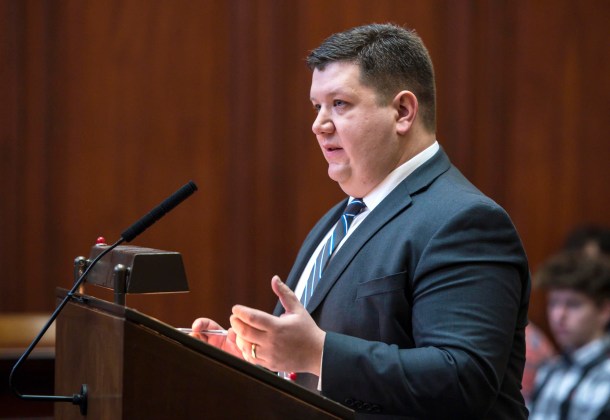
“In Vermont, we sentence people, not crimes,” Joshua O’Hara, an appellate public defender representing Herring, told the five members of the state’s highest court in seeking to overturn that life-without-parole sentence his client received.
“We sentence not only the offense that the person committed,” O’Hara said, “we also look at the history, the character of the defendant, their need for treatment, and also their risk to society.”
He then added, “Jody Herring is not irredeemable.”
“Does that mean the seriousness of the crime would never be enough to justify” a sentence of life in prison without the possibility of parole? asked Justice Harold Eaton.
O’Hara replied there could be a case where such a serious crime could be committed and the person convicted lacked any mitigating evidence. However, he said, his client suffered from a lifetime of trauma that needed to be given more weight when considering a sentence.
“The court seemed to reject that as mitigating evidence,” Justice Karen Carroll said to O’Hara, “and found that her mental state was more of anger or rage.”
O’Hara argued in his appeal for a new sentence for his client that Judge Pacht went too far in sentencing Herring to life without parole, and instead should have imposed a prison term that would have allowed at least the chance of release.
The appellate attorney told the justices Tuesday that such a sentence would not guarantee his client would be released after a minimum prison term, but only after she proved to the parole board that she had been rehabilitated while behind bars.
“It seems to me, that you’re arguing that because of that availability, no one can ever get sentenced to life without parole,” Justice Carroll said to O’Hara.
He replied that’s not necessarily true, and each case has been viewed on his own.
“I think you have to look at the way the judge exercised his discretion in this case,” O’Hara said. “He could have said, ‘No chance, Jody you are an irredeemable person, there’s no chance you can be rehabilitated.’ He didn’t do that.”
Vermont Solicitor General Benjamin Battles of the Attorney General’s Office, representing the prosecution, defended the sentence handed down by Judge Pacht. He said the judge properly considered all factors when he imposed the sentence after a three-day hearing.
Battles called the killings committed by Herring an assault on “law and order,” with the effects still being felt in the state’s child protection services.
“The sentence reflects the enormity of the defendant’s crime,” he added.
Also, according to Battles, the sentence imposed was within the “boundaries” of the plea agreement reached between Herring and the prosecution which avoided a mandatory life sentence without parole and allowed her attorney to argue for a lesser prison term.
He also talked of the “absolute lack of remorse” Herring showed up until a statement she gave just prior to the imposition of the sentence when she said she was sorry. Then, Battles added, she went on to blame others.
“Given her crime, the effect it had on the justice system, and her prospects for treatment, the judge acted reasonably by sentencing her to life without parole,” Battles said.
Herring pleaded guilty to the four murder charges in July 2017, admitting to killing Sobel on August 7, 2015. Sobel, 48, of East Montpelier, worked for the state Department for Children and Families and helped oversee Herring’s child custody case.
Herring also admitted to killing her cousins Regina Herring and Rhonda Herring, as well as her aunt Julie Falzarano, at their Berlin home, hours earlier, upset because she believed they all played a role in her losing custody of her 9-year-old daughter.
The plea agreement called for Herring to receive concurrent 20-year-to-life sentences for the murders of her aunt and two cousins.
No specific agreement was reached in Sobel’s murder, leading to a contested sentencing hearing and the judge ultimately imposing life in prison without the possibility of parole.

During the sentencing hearing in November 2017, David Sleigh, her attorney at that time, argued that his client had endured a lifetime of trauma and suffered from severe anxiety.
According to Sleigh, she was not able to get the proper care she needed, coming to a head following her “reckless” and “negligent” release in late May 2015 from Rutland Regional Medical Center after suffering a breakdown.
Sleigh did not request a specific sentence, but asked the judge to impose one that allowed a chance at parole after a “reasonable” amount of prison time.
In sentencing Herring, Pacht said “she helped destroy a community,” adding, “There were four murders. They were well-planned.”
Herring, 44, is currently incarcerated in the Chittenden Regional Correctional Facility in South Burlington, and did not attend the hearing Tuesday.
Among those in the packed courtroom Tuesday was Alex Sobel, Lara Sobel’s father. He said after the hearing that the sentence of life without parole “must” be upheld because it involved a witness, his daughter, who had testified in a child-custody case involving Herring.
The crime was “system threatening,” Alex Sobel said. “It was the murder of a witness because she had testified. Without the system there is no society. Judges, prosecutors, witnesses, jurors can’t be murdered, it’s as plain and simple as that.”
He added, “The Supreme Court here has the responsibility, if not the obligation, to protect that group.”
The Vermont Supreme Court took the arguments Tuesday under advisement and will issue a written ruling, which isn’t expected for several months.
