


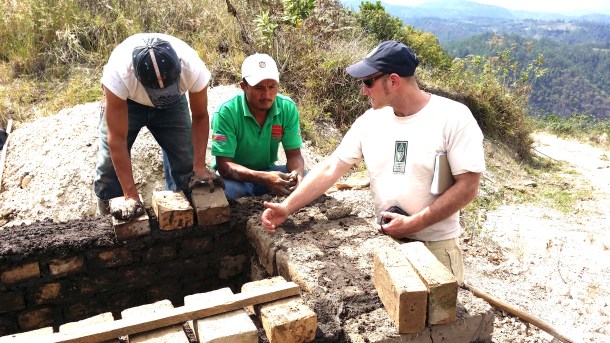
[A]s the sap starts to flow this month, Daniel Baker will be tapping 400 maple trees on his Starksboro spread. He spends a lot of time in those woods, when not busy with his day job as a University of Vermont associate professor of community and international development.
Baker is also president of the Vermont Partners of the Americas, a volunteer nonprofit organization founded in 1966 as the Vermont-Honduras Partners.
But in 2000, he merged his three pursuits to launch the Ecological Sugar Project, which has adapted maple technology to bolster sugarcane farmers in a country overwhelmed by poverty, violence and corruption. The majority of migrant asylum seekers in the so-called caravans approaching the U.S. border are from Honduras, now plagued by the world’s highest homicide rate, according to a United Nations report.
The sugarcane strategy stalled for Baker in 2013, when UVM decided that students — many of whom regularly accompanied him and his colleagues on various development projects — could no longer go there.
To compensate for that loss, “the university is expanding the Partners program to all of Latin America, specifically Peru,” he explained.
Baker’s previous work on a Honduran coffee harvest was eclipsed by his syrup-making skills in 2000, when was asked to assess the sugarcane farmers burning old tires for fuel. “Wood is scarce because the forests there are so depleted.”
In addition, these producers relied on equipment that was inefficient to create panela, an unrefined brown “block sugar.”
The challenge led Baker to a eureka moment: Why not reconfigure the more effective evaporators that Vermonters use to turn sap into syrup? It took a few years to design a modified flue pan and improved oven that would would be right for sugar-makers in the Comayagua region.
Addison blacksmith John Baker (no relation) came aboard for the evaporator’s fabrication process. “We needed to know what the capacity was to manufacture them down there and to devise a method appropriate to their technology,” he explained. “I took three trips with Dan and, on one, saw a sign for the Instituto Technico. Serendipity!”
Their good fortune did not end there. John Baker spent many hours at the technical public school and a private metal shop, overcoming any hurdles in the operation.
“We wanted the evaporators to be built and repaired in Honduras,” Dan Baker said. “Once the farmers saw our prototypes, they quickly took to them.”
He said the Partners initially trained 200 people in Taulabe. Cooperatives were formed for sharing evaporators, about 300 of which have now been used by an estimated 3,500 farmers. Local banks agreed to offer micro-loans that help cover the purchase price for low-income families. A sustainable panela business model emerged.
And rubber tires were replaced by the less hazardous bagasse, waste fiber that remains after cane is crushed.
“They’re getting better at more productive ways to squeeze the juice from cane stalks,” John Baker noted. “The days of donkeys walking around in circles are over.”
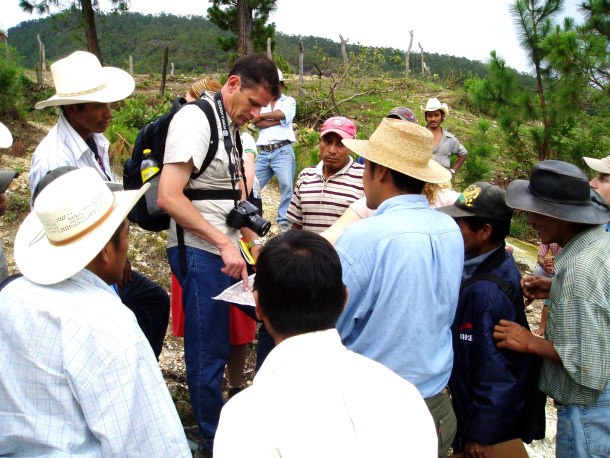
Donkey-powered cane crushers may have been the norm when Honduras first partnered with Vermont, a relationship established after President John F. Kennedy proposed matching each state with a developing country in Latin America or the Caribbean.
During the 1980s and ‘90s, people-to-people initiatives were numerous. Vermont mechanics, welders, cooks, hand-crafters, tailors, foresters and firefighters met with their Honduran counterparts in both places, exchanging information and ideas.
Carolyn Cruikshank of Rochester thought Honduras might benefit from her expertise in education and her concern about the lack of opportunities for girls.
“Someone suggested that if poor Honduran girls could stay in school through the ninth grade it would transform their country,” Cruikshank said. “That was our objective.”
In conjunction with Partners and the U.S. Agency for International Development, she coordinated a pilot program in Valle, an especially indigent area. With permission from parents, one second or third grader with an interest in learning was selected from each of 31 village schools. The number eventually rose to 76.
“Some of the girls didn’t even know how to turn the pages of a book,” Cruikshank lamented. “They had no books there, only printed pages. The teachers themselves had only been to high school.”
For every child, Cruikshank recruited a sponsor in Vermont or elsewhere who could provide $100 a year to purchase uniforms, shoes, pencils and paper.
“One of our sponsors was a Vermont farmer’s wife from Cabot who gave us whatever she earned selling eggs,” Cruikshank recalled. “We were only individuals helping other individuals.”
Betty Clendenning, another sponsor, first arrived in Honduras with chamber music as her calling card. She was a violinist with the Vermont Symphony Orchestra, which wanted to fulfill a Partners’ request for a string ensemble that could perform some concerts.
Clendenning’s Alcott Trio was chosen for the gig, requiring an almost 4,000 mile trek from her home in Hanover, New Hampshire. “I had to get out an atlas to find Honduras on map.”
They played in an assortment of venues, like a movie theater and a furniture factory. Clendenning also met with officials to discuss the idea of a Honduran national symphony.
But the Partners soon persuaded her to coach fledgling instrumentalists at two-week camps in the mountain town of Siguatepeque, which she did for four years.
A 1990 Fulbright Scholarship sent her back to Honduras to instruct students at a national music school. Among them: fellow violinist Sergio Rodriguez, later an invited guest of the Clendenning family in Hanover. He sharpened his English language skills on the Colchester campus of St. Michael’s College before perfecting his craft in other states. Atlanta’s Georgia Piedmont Youth Orchestra hired him last year as its conductor.
In the late 1990s, Clendenning began sponsoring a Valle girl named Milsae Diaz, who transcended destitution to attend medical school in Tegucigalpa, the capital city, and graduate as a physician/surgeon.
“Milsae plans to someday build a clinic in her village, where there’s still no healthcare, and have it become a hospital,” Cruikshank said.
Other young Valle women, many able to study beyond ninth grade, are still with the sponsorship program, trying to thrive and survive in an increasingly treacherous society.
“A girl from the first village group of 31 recently told me that, within one week, 10 people were murdered on her Tegucigalpa street alone,” Cruikshank said.
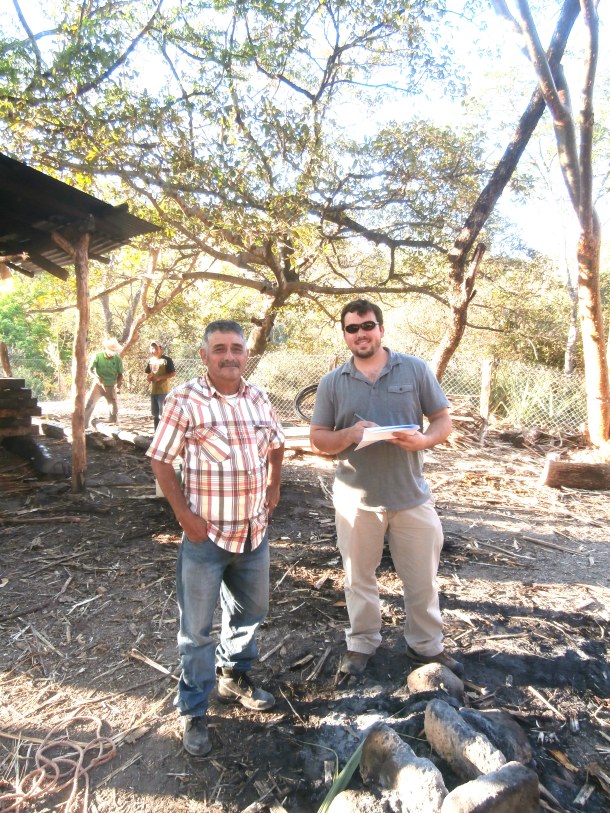
During Dave Chappelle’s frequent travels to Honduras, the peril normally had been “paying five or ten bucks at every checkpoint to get where you’re going. Now, there are certain areas completely controlled by gangs.”
But a strong kinship continues. In the late 1990s, the Barre resident met his wife, Ana Cortez, in Honduras. It’s also where he found himself.
“After Hurricane Mitch in 1998, the Partners wanted young people to build houses,” he said. “I was a UVM sophomore-year biology major, totally unfocused but in a woodworking class. The student government association helped fund 12 of us with plane tickets.”
Chappelle’s assignment? “We were building latrines in Choluteca. There are few things that significantly changed my life but that was one of them. I asked the Partners in Burlington: ‘How can I do that again?’”
He was advised to switch to a community development major “I went back the following year and every year for the next 17, some for a month at a time. UVM eventually hired me to help run the program.”

Chappelle left latrines behind to concentrate on village water systems, with tasks such as testing for E.coli bacteria.
Water has also been key in civil engineer Peter DeGraff’s Honduran sojourn. A 1985 UVM grad from North Ferrisburg, he started volunteering with the Partners almost two decades ago, after meeting Dan Baker.
DeGraff went to Honduras with some students in 2002, “then every other year since, until 2013.”
His fulcrum was training the local water commission to install and maintain filtration systems in rural communities like Jaitique. “I’d love to go back,” DeGraff said. “But now just getting to the same areas is risky.”
Jaitique was Jessica Buckley’s Partner destination, as well, for one week during her sophomore year at UVM in 2009. Although shocked by the “extreme poverty” among a populace of about 1,700, she discovered “they were some of the most generous, thoughtful and friendly people I’ve ever met.”
Buckley returned to Honduras once in 2010 and twice in 2011, thanks to a UVM mini-grant. Accommodations for volunteers — bunk beds in a dormitory — were not a deterrent. In a photo of herself, she’s wielding an enormous wrench with a sort of Rosie the Riveter can-do pose.
She’s now a Vermont Department of Agriculture engineer, administering water quality on farms and in orchards throughout a state that’s quite bountiful.
But Buckley would love to revisit a land that is not. “The simplicity of life there infuses the human connection. My heart swells when I think about Honduras.“
Dan Baker thinks that, although sidelined now, the Partners’ half-century of commitment to Hondurans is unbreakable. “Our long history together gives me confidence that, when things change, we will be there for them.”
