

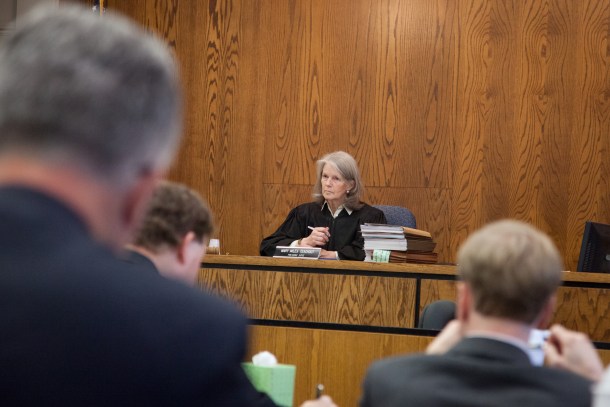
[C]enter stage in the first hearing Tuesday on a constitutional challenge to Vermont’s ban of high-capacity gun magazines is the Legislature’s responsibility in drafting the law — and a Supreme Court decision handed down 115 years ago.
Attorneys with ties to the National Rifle Association argued in Washington County Superior Court that the ban violates the right of individuals to bear arms under the Vermont Constitution. The Attorney General’s office says the state has legitimately imposed a ban on high capacity magazines.
Last year, the Legislature passed a provision that prohibits the use of magazines for rifles with more than 10 rounds and magazines for handguns with more than 15 rounds. Congressional Democrats in Washington, D.C., proposed a similar limit on magazine rounds yesterday.
The Vermont Attorney General’s office says high capacity magazines make it possible for a single shooter to kill dozens of people within a matter of minutes. Recent examples include school shootings at a high school in Parkland, Florida, on Valentine’s Day a year ago and the 2012 Sandy Hook, Connecticut, shooting that left 20 elementary school students dead.
A day after the Parkland shooting in which 17 students were killed, police arrested a 19-year-old man who was accused of a plot to shoot students at Fair Haven Union School. In response, Gov. Phil Scott and the Legislature agreed to a gun restrictions package that included the magazine limit.

The lawsuit backed by the NRA was filed shortly after the law was enacted last spring. The ban of magazine sales went into effect on Oct. 1.
Lawyers for plaintiffs in the lawsuit, including the Vermont Federation of Sports Clubs, the Vermont State Rifle and Pistol Association, Locust Creek Outfitters and Powderhorn Outdoor Sports Center, say the ban violates the right of businesses to sell high capacity magazines and the rights of Vermonters who can no longer purchase magazines with 10 or more rounds. The attorneys have asked for a summary judgment, or immediate decision in the case.
The Attorney General’s office, which argues that the limit is in the public interest, has urged Washington County Superior Court Judge Mary Miles Teachout to dismiss the case. The defendants include Vermont Attorney General TJ Donovan, Director of the Vermont State Police Matthew Birmingham, Chittenden County State’s Attorney Sarah George, Windsor County State’s Attorney David Cahill, and Orange County State’s Attorney William Poreter.
Whatever Teachout’s decision, both sides agree the case will ultimately go to the Vermont Supreme Court.
In the hearing Tuesday, Benjamin Battles, the solicitor general for the Vermont Attorney General’s office, argued that the court should dismiss the case because the plaintiffs – two businesses that had sold high capacity magazines and three individual gun owners – lacked legal standing.
The solicitor general said Max Misch, a white nationalist Army veteran who has been charged for violating the magazine ban, would have standing to challenge the law — which he expects him to do at some point.
Battles also asked Teachout to give deference to lawmakers who spent months vetting the constitutionality of the new law. Battles pointed to a federal ban from 1994 to 2004 and similar state laws in eight other states as examples of reasonable regulatory standards for gun restrictions.

Battles said the ban on high capacity magazines balances public safety with the right to self-defense under the Vermont Constitution.
“The Legislature passed and the governor enacted the law because the state has a compelling interest in protecting its citizens,” Battles said.
There is nothing to prohibit Vermonters from buying a particular type of gun or ammunition, he said. The law merely places a limit on the number of shells in a magazine that can be purchased, Battles said.
Attorneys from conservative Washington, D.C., law firm Cooper & Kirk said lawmakers did not do their due diligence in drafting the statute. David Thompson, the firm’s managing partner, told the judge that the magazine ban would not stop a murderer from purchasing high capacity magazines in neighboring New Hampshire.
In point of fact, Thompson said magazines available for purchase in New Hampshire would most likely be manufactured by Century Arms, a Vermont company.
Thompson cited a 1903 court decision in State v. Rosenthal, which prohibited the possession of handguns. That decision, which gave Rutland authorities absolute discretion to deny permits for carrying a concealed weapon, was overturned.
The Rosenthal decision did not apply a reasonable regulatory standard, Thompson said.
Battles said “it was difficult to read much” into the Rosenthal decision, which offers little in the way of legal analysis.
The lawyer for the gun rights groups also cited testimony from the Vermont Attorney General’s office at a legislative hearing last spring in which officials said of the ban, “we just don’t see it serving a purpose.”
In addition, Thompson said the law gave Century Arms, a firearm and ammunition manufacturer, an exemption to continue manufacturing high-capacity magazines. Brady Toensing, who is local counsel in the case against the state, lobbied the Legislature for the exemption.

The lawyers representing gun rights groups are now citing that same exemption as a loophole that undermines the constitutionality of the state law. Toensing declined comment on his role in both lobbying for and suing over the exemption.
If the judge denies the state’s motion to dismiss, Battles urged Teachout to allow the state to conduct discovery before a summary judgment decision moves forward.
Battles said the defense had made inadmissible assertions about magazine limits in the proposed summary judgment that the state would like to counter.
“So, you’re saying if they relied on inadmissible hearsay, you would like permission to submit your own inadmissible hearsay,” Teachout said.
Thompson argued that the state already had a chance to make arguments in briefings and should not need to pursue discovery if the court denies the motion to dismiss.
Battles said other states have upheld similar bans and that a consideration of summary judgment would be a rehash of the legislative debate and “in states that upheld these bans.”
Every state in New England, apart from Massachusetts, has adopted a reasonable regulation standard, Battles said. “If you apply that standard in this case,” he added, “there is no question that the law survives.”
