


[L]egislators must decide over the next several months how the state should administer Vermont’s health insurance mandate, which takes effect next year. The state mandate does not include a tax penalty.
The Trump administration and Republicans in Congress reversed a federal tax on uninsured Americans in 2017. Under the original Obamacare law, the annual penalty was $695 for adults and $347.50 for children. That penalty goes away in the 2019 tax year.
A Vermont individual mandate was enacted last year in response to that federal change. The state law, however, did not include a penalty or enforcement mechanism.
Gov. Phil Scott signed the so-called “individual mandate” statute into law last May. But he staunchly opposes a state tax on Vermonters who don’t buy health insurance. He wants to institute reforms to the insurance market instead and offer lower premiums for young people. Reform details, however, have not been released.
Ena Backus, health care reform director at the Agency of Human Services, told the House Health Care Committee Friday that the administration remains strongly opposed to an income tax-based penalty to enforce the law.
“The penalty that we’re talking about today would impact younger and lower-income Vermonters and does not align with our objectives to address demographic challenges and to protect the most vulnerable in our state,” Backus said.
The Scott administration doesn’t believe the uninsured rate is a cause for concern because at 3.2 percent, it is among the lowest rate in the nation, according to a recent survey. The average uninsured rate in the U.S. was about 9 percent in 2018, the United Health Foundation reports.
“We’re proud of this accomplishment,” Backus told lawmakers. “We believe we can continue to improve. We know that health care coverage is essential for Vermonters’ health, and we know that Vermonters who do not have health insurance are forgoing routine care due to costs.
“We will not support a financial penalty as a mechanism to induce health care coverage,” Backus said.
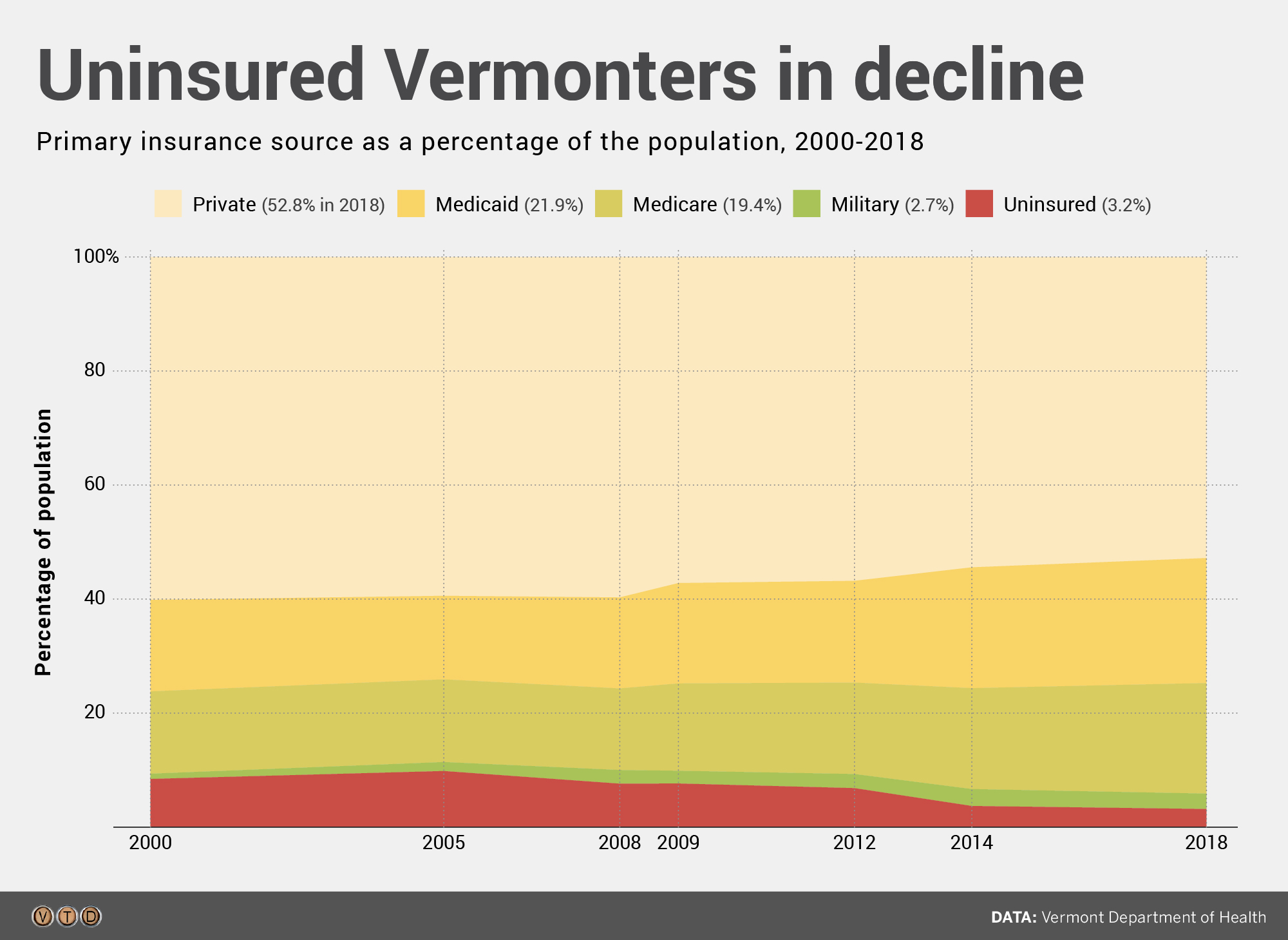
Experts say the end of the federal penalty means many young, relatively healthy people will drop their insurance, leading to increased premiums for those who retain coverage.
Insurance rates have already gone up as a result of the federal repeal of the penalty. State regulators allowed both MVP Health Care and Blue Cross and Blue Shield of Vermont to increase premiums by 1.6 percent this year. That hike is directly attributable to the elimination of the penalty.
Vermont’s individual mandate is supposed to help keep the insurance market stable, but it doesn’t kick in until Jan. 1, 2020. That means state officials need to figure out the details of implementation this legislative session.
On Friday, members of a working group that examined the issue over the summer ran through their findings and recommendations with the House Health Care Committee.
But there is no clear guidance for lawmakers on how to enforce the mandate. The working group was unable to agree. Some members favored a state income tax penalty similar to the now-expired federal penalty, while Scott administration representatives lobbied for “enhanced outreach and monitoring of the uninsured.”
There are pros and cons for each approach, Green Mountain Care Board member Robin Lunge told committee members. While a penalty “may disproportionately impact economically vulnerable Vermonters,” Lunge said, the elimination of the penalty undermines the state mandate.
“There are actuaries who will tell you that they predict that not having a penalty will create more uninsured,” Lunge said.
The board has taken a neutral position on the penalty question.
It’s not yet clear which way legislators are leaning, and no bills have been proposed on the issue. Rep. Bill Lippert, D-Hinesburg and chair of House Health Care, suggested creation of a committee bill based on the working group’s recommendations in order to “give us a structure from which to work.”
There’s concern that the penalty would fall disproportionately on the young and lower-income. Backus said Vermonters in the 25-34 age group are three times more likely to be uninsured than those who are age 45-64, and she said uninsured rates are highest among households where income is 151 percent to 250 percent of the federal poverty level.
There is no proof that the federal mandate alone helped to reduce uninsured rates, she said. Other changes, including increased subsidies and Medicaid expansion, played a role, Backus said.
“The impact of the financial penalty on health care coverage cannot be clearly isolated from other policy initiatives that were created by the Affordable Care Act,” Backus said.
And there are state tax implications. Doug Farnham, the Vermont Tax Department’s economist and director of policy, outreach and legislative affairs, told lawmakers a penalty could complicate the state’s income tax filing process.
“We’ve pushed very hard over the last couple of years at the Tax Department to simplify that. In our opinion, the simpler it is, the more likely we are to have compliance with personal income tax,” Farnham said. “If we complicate it with this, then we might suffer on our personal income tax compliance, and that’s not what we want at the Tax Department.”
