

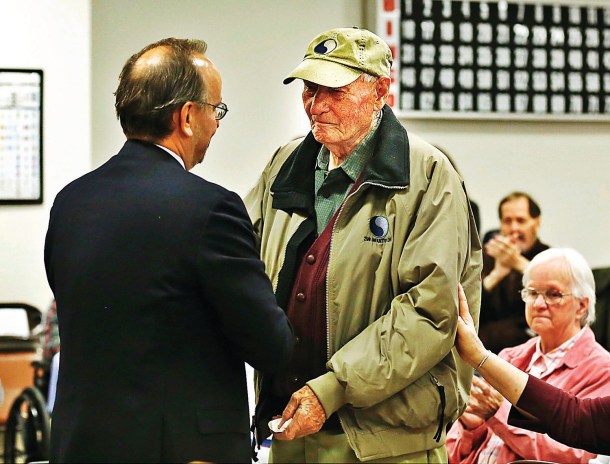
Photo by Holly Pelczynski/Bennington Banner
The Vermont Veterans’ Home is due for a major security upgrade.
Chief Executive Officer Melissa Jackson told legislators this week that the Bennington facility, which houses 138 Vermont veterans and their spouses, needs $2.6 million in security improvements including new doors, a swipe card entry system and exterior lighting.
The U.S. Department of Veterans Affairs is expected to pick up 65 percent of the tab, with the remainder coming from state money.
Jackson said the project is her highest priority due to increasing safety concerns. But in a follow-up statement to VTDigger.org, Jackson said she believes Veterans Home residents are safe due to a 24-hour staff presence and a new security contract with the Bennington County sheriff.
“Our main goal with the security project is to bring the Vets Home up to par with the security systems already in place at other state buildings such as Bennington and Waterbury,” Jackson said.
The Veterans Home is a state-run facility that also receives support from the federal government. Jackson said the home maintains an annual budget of about $24 million, with $4 million coming from the state’s general fund; public and private health insurers; and Veterans Affairs.
The home has “quite the footprint,” Jackson said, with a 140,000-square-foot building situated on more than 80 acres that are partially wooded.
That layout, along with outdated infrastructure, presents security challenges. Jackson told the House Corrections and Institutions Committee that each of the home’s 28 exterior doors has to be locked manually, which makes it a challenge to quickly respond to any security related emergencies.
There’s also inadequate outdoor lighting. Jackson said staff have reported suspicious individuals on site overnight, and she was concerned enough that “we immediately entered into a contract with the local sheriff.”
The home has no security personnel on staff, Jackson said.
Planning for the proposed security upgrade already is under way. The Legislature last year put $100,000 into the fiscal year 2019 capital bill for design work, and Jackson said Veterans’ Home administrators have been working with the state Department of Buildings and General Services to come up with a wish list.
The projected $2.6 million cost would buy new doors with a “single lock point,” Jackson said. “My big concern is making sure that we have the ability to know that all of our doors are secured and can be locked in a single motion,” she said.
The project also would include replacing windows, improving parking lot lighting and installing “swipe card access, so we know who’s in the building and when they’re in the building,” Jackson said.
Jackson said she believes the safety and security project will be a priority for Veterans Affairs.
The state money is more complex. There is $500,000 in the fiscal year 2020 capital bill, but there is also a little over $1 million available from a Medicaid waiver settlement agreement involving the Agency of Human Services.
Rep. Alice Emmons, D-Springfield and chair of House Corrections and Institutions, said she anticipated some flexibility between those two pots of money so that lawmakers can find sufficient funding for Veterans’ Home upgrades.
But she also wants to see where the initiative fits with other state capital needs. “I don’t want to make a decision on this immediately,” Emmons said.
The available state funding would appear to easily cover Vermont’s portion of the security project. But there’s another project in play that could boost the overall price tag.
Jackson said Veterans’ Home administrators want to replace an aging oil boiler with a new biomass-fueled system. That system would heat the facility’s water, as well as a small portion of the building that’s not served by a geothermal heating and cooling system.
The project carries an estimated $1.8 million price tag, which would be subject to the same funding formula as the security upgrade – 65 percent federal and 35 percent state.
But it also would bring annual savings, as Jackson expects a 50 percent cost reduction by switching from oil to wood chips. That’s no small thing for a facility that has a $430,000 annual oil bill.
The biomass project likely won’t happen until fiscal 2021. Jackson said it should take a backseat to the security project, which could begin later this year pending the availability of state funding.
“I am hoping it would start late fall or early winter, but that will all depend on the bid process and the availability of the vendors selected to do the work,” she said.
