

The Deeper Dig is a weekly podcast from the VTDigger newsroom. Listen below, and subscribe on Apple Podcasts, Google Play, Spotify or anywhere you listen to podcasts.
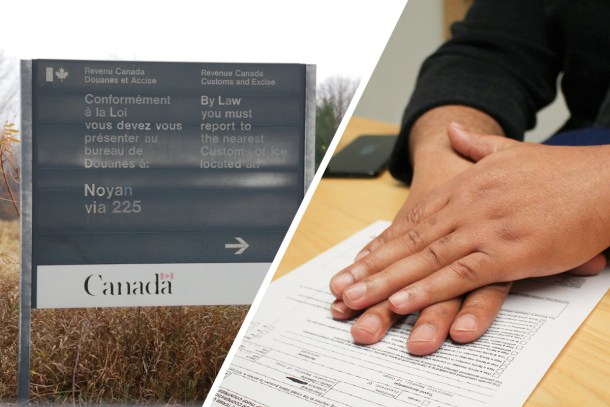
[L]ast fall, a Congolese asylum seeker named Bienfait fled death threats in his home country. But his journey to Canada was cut off at the border crossing in Derby Line, Vermont.
Bienfait came from the Democratic Republic of Congo, where he was targeted by violent gangs for being Hutu. A French speaker, he hoped to reach Montreal. But Canadian border agents sent him back to the U.S. side of the northern border, in accordance with a 15-year-old policy called the Safe Third Country Agreement.
Under the agreement, Canada and the U.S. require asylum seekers to stay in the country where they first arrive, essentially recognizing each other as “safe” for refugees. Since Bienfait had first traveled through the United States, he was turned back to U.S. immigration authorities, then detained in an ICE facility in New Hampshire.
Arriving just after a wave of national news about the “migrant caravan,” Bienfait knew that getting asylum in the U.S. wouldn’t be easy. “I saw my chances shrink,” he said.
But Bienfait is not alone. Attorneys from the New Hampshire ACLU, who are helping with his case, say they’re representing several clients who have been blocked by the Safe Third Country Agreement. And in light of the Trump administration’s immigration enforcement policies, some Canadian politicians are wondering whether the Safe Third Country Agreement is sending refugees into a hostile U.S. immigration system.
On this week’s podcast, Bienfait tells VTDigger’s Elizabeth Hewitt and Lola Duffort about why he fled to North America, and why he hopes he’ll be allowed to remain.
[showhide type=”pressrelease” more_text=”Read full transcript” less_text=”Hide full transcript” hidden=”yes”]
Elizabeth Hewitt: So do we want to just start with a little bit of the backstory?
Bienfait: I was living like a quiet citizen, like everyone else. But because of my ethnic identity, we’ve always been intimidated, followed, robbed and sometimes psychologically tortured. And so we had a life that was not very stable. We did not live like others who felt at home. We always felt like foreigners, even though it is our country.
This is a man named Bienfait. We’re only using his first name to protect his identity. Bienfait is from the Democratic Republic of Congo. And up until a few weeks ago, he was being held in an ICE detention facility in New Hampshire after being turned away from Canada at the border crossing in Derby Line, Vermont. Our reporter Lola Duffort is translating.
Bienfait: When I saw that I was really, very seriously threatened, that I no longer had a choice, I decided to leave. I could not stay as the head of my family, always afraid. At a certain moment, I realized I could not protect my children. That hurt me deeply. That’s why I decided to look elsewhere, to see if I could save them. This is my first attempt.
Hewitt: Among all of the various threats around immigration policy that have been coming up over the last few years, one of the policies that has come up in conversation and the news from time to time is this Safe Third Country Agreement.
Elizabeth Hewitt has been reporting on Bienfait’s case.
Hewitt: This is an agreement that took effect in 2004. It’s an agreement between Canada and the United States. And it’s a policy that the two countries agreed on for dealing with people seeking asylum at the land border between the two countries. Essentially, it’s saying that each country recognizes the other country as a safe place. So in practice, what this means is that people who are trying to seek asylum in the U.S. or Canada must do so in the country they first arrive.
So if somebody arrives from another part of the world and is trying to seek asylum if they’re coming from, in this particular case, the Democratic Republic of Congo, that under this, this arrangement, they must seek asylum in the first country that they arrive in. In this particular case Bienfait arrived to the United States first. He had the eventual intention of seeking asylum, but he wanted to do so in Canada for, for several reasons.
After arriving in Washington, D.C., he made his way north, eventually getting to Derby Line with the intention of crossing to Canada and asking for asylum. But the thing is that because of this Safe Third Country Agreement, only in very few circumstances can people cross the border from the United States to Canada and go speak to a Canadian border official and say, ‘I’d like to seek asylum here.’ In most cases, you’ll be rejected right away, which is what happens in this case.
So how did you come to meet Bienfait?
Hewitt: Well, Lola, our wonderful on-staff French-speaker and I braved a icy and snowy day and drove across over to New Hampshire. Bienfait had been detained until a few weeks ago. He was held in a facility but in mid-December, they were able to raise enough money for bail for him and he’s been staying with a homestay since that time.
Lola Duffort: We drove to Concord from Vermont for a 10 a.m. meeting. He was in the room when we arrived. He was sitting down. He had a Patriots hat, I think, that was on the table in front of him.
There were real moments of distress when we were talking when he was worried about whether or not he could be identified, whether or not his family could be retaliated against, but otherwise, he was extremely open, extremely kind and willing to talk to us about really traumatic things.
Bienfait: In the Congo, I had a lot of problems with my family. There were always gangs after us, or not gangs, armed men. And they even succeeded in killing certain members of my family. They succeeded in entering my house more than three times, with weapons. There were gangs that were very, very well-organized that threatened me, that wanted to kill me. And the last time they came, they were very serious. They wanted to kill me. And I don’t know, by the grace of God, they gave me another month to collect more money. If not, they would come back to kill me.
Duffort: I kept looking for kind of specific reasons why his family was targeted. You know, he worked at a bank, so I was asking him like, was it because you had access to money? Or were you an activist in the community? And he kept going back to ‘it’s just an ethnic problem. And the reasons are ultimately arbitrary.’
Bienfait: It’s an ethnic problem, an ethnic problem. So when you start to raise your head, like they say, when you start being talked about, you are no longer tolerated as a Hutu. There is no good reason why. It is not because of money, it is not because you did anything. It is just because you are Hutu. And once you become a target, you remain a target. And eventually, they kill you.
So his outlook, if he had stayed, was pretty grim. He just felt like there was really no other option.
Duffort: Right. He talked about how, you know, several members of his family had either been kidnapped or killed or shot at.
Bienfait: There was also my cousins’ big brother, my cousin, they shot at him. We actually thought he was dead. People came to us at our house and told us he was dead. But we discovered that he was still breathing we went to get him, we brought him to the hospital, and he survived. There was my uncle who was kidnapped, still today, all we can do is cry. He never came back. His friend was also kidnapped. Even today, there’s no trace of him.
Duffort: It was pretty surreal when we were talking about his experience. And later we were talking to his attorney, and his attorney was mentioning getting paperwork about proof that his son had been kidnapped. And I went back to him. And I was like, I’m so sorry, did I miss this? And he was like, Oh, no, I just, you know, it just hadn’t come up because there were so many horrific incidents that that was almost quotidian. Right? It’s like, Oh, that’s right. My son was kidnapped for two days. We paid the ransom.
And the straw that broke the camel’s back was when men came to his house to extort some money from him. And they had this conversation in front of him in his bedroom with his wife where they were going back and forth about whether or not they should just kill him right now, or let him get the money.
Bienfait: They asked for such a large sum of money that I couldn’t have paid it, but I had also understood from their last conversation that even if I paid it, they would kill me. Because between them, there was an exchange. There were some who said they’d had enough, that it was time to kill me, and the other that was talking about money. So I understood that even if I paid this money, they would end up killing me anyway. I understood that even money couldn’t save me anymore. That’s how I left.
What did he tell you about why he wanted to come to Canada specifically?
Duffort: He thought that if he came to North America, he would have two options: the United States or Canada, that one could kind of be his safety, and he wanted to come to Canada because he’s a French speaker so he thought he could go to Montreal, integrate himself there rather easily.
And it’s interesting how asylum seekers from different places of the world have gotten sucked into this politics around the southern border.
Bienfait: I came here with several options. There was the United States, there was Canada. When I arrived in the United States, I saw my chances shrink with the problems with the refugees from Honduras.
Newscaster: Hundreds of Honduran immigrants just crossed into Guatemala.
Newscaster: They are on a long and difficult trek, thousands of Central American migrants making their way, as a group, to the United States.
Newscaster: Vowing to continue their march to the U.S. border, even though President Trump wants to turn them away.
President Donald Trump: A percentage, a fairly big percentage, of those people are criminals. And they want to come into our country. And they’re criminals.
Newscaster: At one point, migrants retreating after reports of border agents throwing tear gas canisters.
Bienfait: The new politics at that period, which was still here, was a politics of border security. They didn’t really let people enter into the United States. So with that, I thought my chances of getting asylum in the United States were diminished. I speak French, there’s also Montreal, which is a Canadian city where people speak French. I can integrate myself easily in Montreal. And I read on the internet, while I was still at home, that with an American visa you can also go to Canada without a problem. So I told myself OK, I can try first with Canada, and if it doesn’t work, I still have a card to play with the United States.
I knew that Canada, the United States, that these are countries of rights. These are countries that can hear me, they can help me.
Duffort: The process for seeking asylum is very complicated and sometimes arbitrary. And I could imagine that it would be difficult to go through if you, you know, had received extremely thorough legal advice beforehand. But talking to him drove home the fact that people that are seeking asylum are, by definition, in desperate situations. They do not have the time or the resources or access to this kind of legal help. Right? And so we are expecting people in desperate situations to go through an extremely complicated and bureaucratic process, and to expect them to make no mistakes.
For example, he, I think, like most people, didn’t know about the Safe Third Country Agreement. He didn’t know that if he landed in America before seeking asylum in Canada, that that would preclude him seeking asylum in Canada. He thought exactly the opposite. He thought that, you know, he would have both countries as an option.
Hewitt: There’s a lot of confusion around this policy. It’s not very clear what is and isn’t allowed when folks are are trying to seek asylum right now. And actually, the attorney at the ACLU in New Hampshire, who’s working with Bienfait on this case, said that that’s something that he’s he’s noticed quite a lot. He actually has had it as a different client who was under the impression that you couldn’t seek asylum in the United States anymore, that that wasn’t an option. There’s just a lot of confusion around how these different systems work. This particular policy is a pretty common policy that comes up at the northern border between the U.S. and Canada.
And then what happens to them in those cases? Are they detained here in the U.S., like once they’re rejected at the border, where do they go?
Hewitt: In this particular case, Bienfait was detained. He was detained on an immigration violation with Border Patrol saying that, well when he had initially gotten his visa to come to the United States, he said that he was coming for tourist purposes, when in fact he was coming to this area to try to seek asylum. That is currently in the courts, and he’s going through several different processes around that. But it’s a complicated system that results in people who are trying to seek asylum being confused by what menu of options are available. And then sometimes ending up in custody and in a country that they were not trying to be in.
They’re just kind of in limbo.
Hewitt: Yeah.
Bienfait: I also have a lot of feelings about that. Sometimes I think it was the worst decision I ever made in my life to leave my children, because it weighs too heavily on my conscience today, but also I say that maybe it was the right path. Maybe the light will come from this. And I had to try, because it’s always better to try than not.
What got you interested in Bienfait’s case?
Hewitt: The Safe Third Country Agreement has been coming up from time to time, especially since President Trump took office. And there’s been a number of changes on the immigration policy front. And there’s not a huge amount of discussion about it in the United States. But it is something that is discussed in Canada, and particularly around immigration advocates who are concerned that Canada, by acknowledging the United States as a safe third country, and therefore turning away people at the border who are seeking asylum, that actually the United States might not qualify as a safe third country in some people’s eyes.
MP Jenny Kwan: Under the Safe Third Country Agreement, refugees cannot apply for asylum in Canada if they’re already in the U.S. Many refugees are crossing the border illegally, risking life and limb, because they have no other option. Things will only get worse. So will this prime minister finally act? And will he suspend the unfair agreement and support border communities and help those desperate refugees?
Prime Minister Justin Trudeau: Canada is an open and welcoming country. One of the reasons we are able to continue to be open and welcoming is that Canadians have confidence in the integrity of our borders and the integrity of our immigration system. We will continue to ensure that laws are enforced and followed, and that we remain demonstrating the strength and the integrity of our immigration system. We will be welcoming, but we need to make sure that it’s done properly at the same time by all officials in Canada.
Hewitt: Particularly after the border separations policy took effect, there was a lot of question in Canada from critics of this policy about whether the two countries do share values when it comes to asylum and refugees
What is your understanding of what the paths forward here might be? What do his options seem to be?
Hewitt: So from here, he’s no longer being held in a detention center, although there still are active removal proceedings against him. So it’s not that there’s been a deportation order put out at this point. But that is what the way that one case could go. And he separately is also going to be starting the process of filing for asylum in the United States, which is, you know, a totally separate track.
What about in terms of the broader question of this relationship between Canada and the U.S.? Do you have any ideas as to what might happen next with this wave of criticism about that relationship?
Hewitt: For the moment, the Trudeau administration has been standing by this agreement. I find it interesting as somebody that follows border politics because I think the conversations around the Safe Third Country Agreement in Canada really provide an interesting perspective on how people outside of the United States view particularly immigration policies in the United States. Whether things will change, it’s hard to tell. You know, this is ultimately this agreement, is a between two countries acknowledging that they regard each other as safe for asylum seekers and refugees and sort of acknowledging that they share a basic set of human rights and, and policies around that. And it doesn’t seem like a change in it is on the horizon. But I do think that it’s interesting that this is being discussed at all right now.
Thanks, Elizabeth.
Hewitt: Thank you.
[/showhide]


