

A legislative effort to “safeguard the right to abortion in Vermont” is encountering increasing headwinds as opponents question the bill’s necessity, language and intent.
Eight days after H.57 was introduced, the House Human Services Committee heard more opposition than support during two hours of testimony on Wednesday. Committee members have delayed a vote on the bill and scheduled a public hearing for Feb. 6 at the Statehouse.
Also, Gov. Phil Scott declined to support the bill as it’s currently written, though he did say he is “supportive of a woman’s right to choose.”
The abortion legislation has “a long way to go to get through the Legislature, so we’ll see where it all comes out,” Scott told reporters during his weekly press conference.
But Rep. Ann Pugh, D-South Burlington and House Human Services chair, said there is “still forward movement” on H.57. She expects a committee vote after next week’s public hearing.
“My understanding is that the majority of Vermonters support what is current practice in Vermont. And what this law does is to codify, or put in statute, what is current practice,” Pugh said. “If we need to make changes, that is what the legislative process is about.”
H.57 – along with another bill in the Senate, S.25 – was drafted in response to political and judicial changes at the federal level that some say could jeopardize the landmark Roe v. Wade U.S. Supreme Court decision that legalized abortion in 1973.
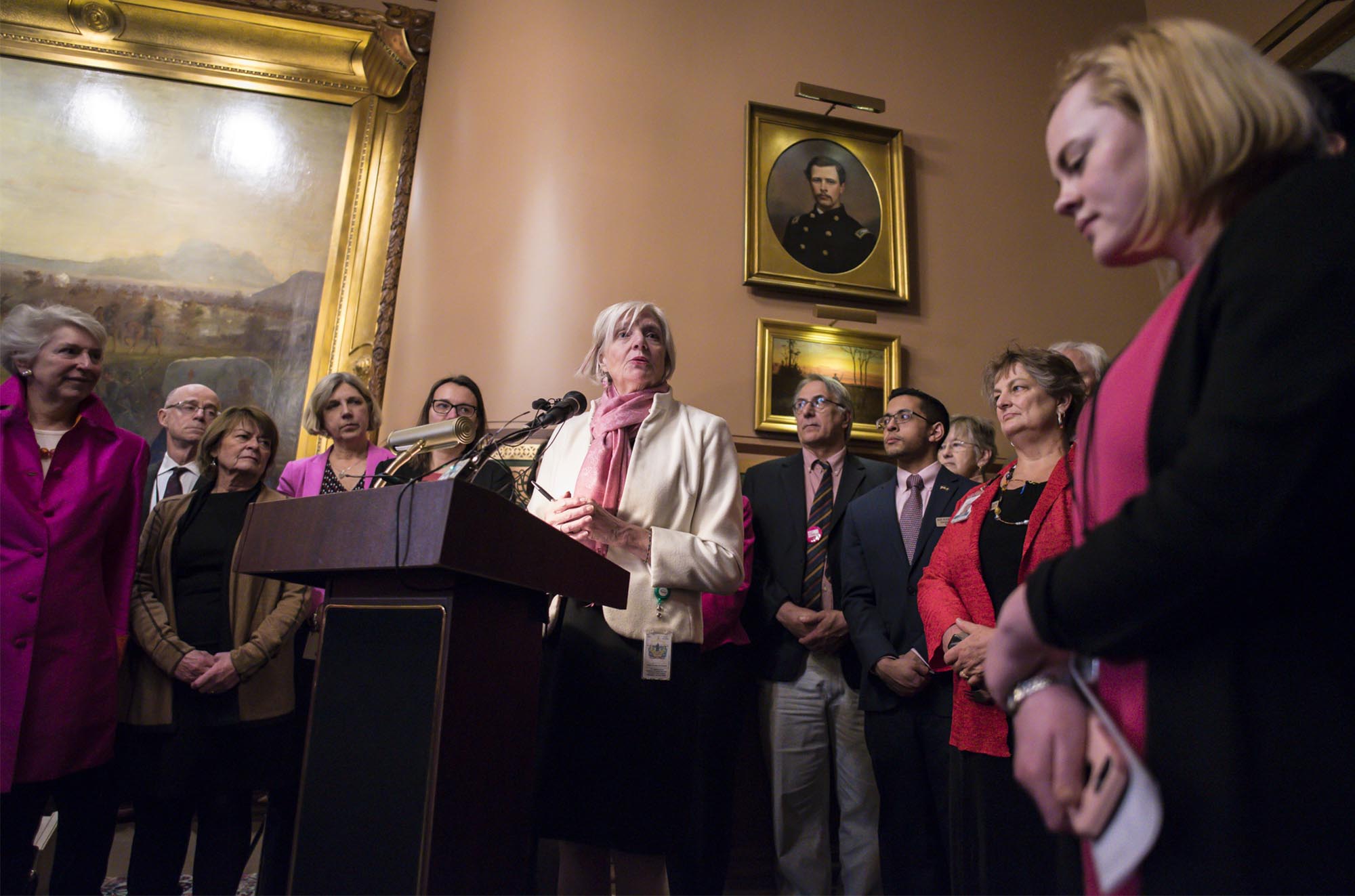
The House bill was introduced last week with a Statehouse press conference and backing from 90 sponsors.
While the rate of abortion is falling nationally and in Vermont, advocates say it’s important – according to the bill’s introductory language – “to recognize as a fundamental right the freedom of reproductive choice.”
On Wednesday, however, five witnesses in Pugh’s committee raised questions about the legislation. Among the points of contention were the bill’s declaration that “every individual” has the right to an abortion with no specified age limitation, as well as language saying “a fertilized egg, embryo or fetus shall not have independent rights under Vermont law.”

That doesn’t sit well with Patricia Blair. The Bennington woman was pregnant with twins and lost both fetuses when another driver slammed into her vehicle in 2010, and she said “open-ended abortion laws” like H.57 do nothing to address what she believes should be the legal rights of the unborn.
“This bill isn’t protecting all women’s rights,” Blair said. “It’s only protecting the rights of women who choose death for their children.”
Pete Gummere of St. Johnsbury raised a variety of concerns, including the fact that H.57 doesn’t address situations in which a woman may be coerced into abortion by an abusive partner.
“If we are going to protect a legal right to an abortion, should we not also do something to protect women from coercion?” Gummere told the committee. “Particularly when they may be in internal conflict and distress to start with?”
Sharon Toborg of the Vermont Right to Life Committee called into question the bill’s lack of any restriction on later-term abortions. While federal statistics show that such abortions are rare, the issue has come up repeatedly in debates about H.57.
“While most Vermonters do consider themselves pro-choice, that does not mean that they support unrestricted abortion throughout all nine months of pregnancy for individuals of any age as H.57 proposes,” Toborg said.
She also raised concern about the bill’s prohibition against any public entity interfering with a woman’s right to obtain an abortion. “Such terms as ‘interfere with’ or ‘deprive’ or ‘restrict’ are undefined in the bill, so it is unclear what the true impact of this legislation might be,” Toborg said.
Others urged the committee to support the bill as written.
Dr. Erica Gibson, speaking as a member of the American Academy of Pediatrics Vermont Chapter and the Vermont Medical Society, said “access to safe and confidential abortion services” has been part of her work as a specialist in adolescent medicine.
Most minors “involve a trusted parent, guardian or adult in sexual and reproductive health care decisions,” Gibson said. But some cannot, and maintaining their confidentiality is critical, she said.
“The majority of young women are capable of understanding the consequences of abortion and do not need state-mandated parental involvement or judicial (authorization) to make the decisions that are right for them,” Gibson told the committee.

Other advocates argued that unrestricted access to abortion rights is important for victims of domestic violence and sexual abuse and is a big factor in a woman’s economic well-being.
“Women’s access to birth control, including abortion, is tied to increased labor force participation, higher earnings, more advanced careers and better financial conditions for their children and families,” said Cary Brown, executive director of the Vermont Commission on Women.
With opponents and proponents offering detailed arguments on H.57, a memo from Brynn Hare of the Office of Legislative Council sought to clarify for committee members what the bill does and does not do.
For instance, the bill “does not impose any duty on a private practitioner to participate in any abortion,” Hare’s memo said. “Nor does it interfere with the operation of crisis pregnancy centers, which are organizations established to counsel pregnant individuals against having an abortion.”
Hare also told the committee that, currently, “Vermont law doesn’t require that a minor obtain a parent or guardian’s permission in order to get an abortion.”
But it was clear that several members of the committee had questions and concerns about H.57.
And, separately from committee deliberations, one of the bill’s original sponsors – Rep. Patrick Seymour, R-Sutton – said he has withdrawn his support. That’s in part because he’d like to see limits on later-term abortions, but it’s also because he doesn’t believe the bill is necessary given current law that legalizes abortions.
While Seymour said he has received some pushback for his decision, “I’ve gotten significantly more people congratulating (me) for my switch,” he said.
It remains to be seen whether additional supporters will defect. Lawmakers will get more feedback on Feb. 6, when the public hearing is scheduled in the House chamber from 4:30 p.m. to 6:30 p.m.
The hearing will be held jointly by the House Judiciary and Human Services committees.
“My goal, as a chair, is to make sure that all perspectives on this issue have an opportunity to be heard,” Pugh said. “I would rather have the debate be on the issues in the bill, rather than, ‘We didn’t get a chance to have our voice heard.’”
Colin Meyn contributed to this report.
