

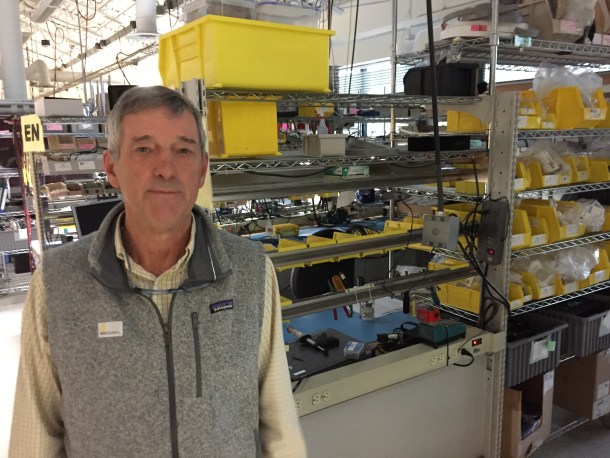
[J]ustin Wheating is president of NRG Systems, Inc., a Hinesburg company that designs and manufactures technology for the wind and solar industry. One of the company’s latest innovations is a bat deterrent system that it tested with Texas State University last year at a wind energy facility in Texas. The result was a 54 percent reduction in bat mortality, the test partners said.
Wheating, who is from England, has been with NRG for nine years, and helped the company through its transition after it was sold to co-founder Jan Blittersdorf in 2010. Blittersdorf sold the company to Esco Technologies, a publicly traded company in St. Louis, Missouri, in May 2017.
The company has annual revenues of about $40 million and about 100 employees who work in research and manufacturing in Hinesburg. NRG’s first building, completed in 2004, was the first LEED gold manufacturing building in the U.S., Wheating said. The company put up a second building under the same guidelines in 2008. The buildings are heated with wood pellets, but all of the electricity comes from solar panels on site.
Wheating spent some time talking to VTDigger about NRG’s work now and in the future and about ever-changing solar and wind energy policy and tax incentives. The interview has been edited for length and clarity.
VTDigger: You previously worked at Burton Snowboards and at Simon Pearce. Was there a learning curve coming into this industry?
Justin Wheating: This is a company with a lot of engineering expertise. Engineers thrive on detail, and they thrive on perfection, so managing the business so that we can get products developed in a timely manner and get them to market when we say we are going to get them to market is a constant challenge.
VTD: Did the sale to Esco change things at NRG?
JW: Esco didn’t come in and dramatically change what we are trying to do or our vision or goal. But they did insist on us adapting to a financial reporting structure that as private company we didn’t have to pay attention to. There is a bureaucracy piece associated with that.
The other piece is, as a business, we’ve always worked on developing our products organically. In the Esco environment, they can provide us the people to acquire that expertise as well as develop it ourselves. For example, we’re pushing out into the solar industry, and if there is a company that has developed something for the solar market we would like to develop ourselves, we could buy that company and have it become part of our organization instead of developing it ourselves.
Staffing has increased. We went through a reorganization and layoffs in 2012 and 2013; the industry shrunk significantly. And then we built up the business consistently in the years since then, so in 2013 onwards the business stabilized, we paid off debt, we grew, and we got a stronger presence in international markets.
VTD: What’s happening in the industry that affects NRG?
JW: The renewable energy industry is maturing. Our two biggest markets are the U.S. and China, and with the current administration in the U.S. that’s not terribly helpful to renewable energy.
The policies they are putting in place to try and foster reinvestment in fossil fuels don’t help the renewable energy industry or utilities in decision-making. There is an aggressive policy to actually hurt the renewable energy industry, to actually use funds to support coal or nuclear, which is what the government has tried to do.
In the U.S., there’s an acknowledgement that the utilities will have to change the way they generate energy to incorporate renewable energy and it makes their lives more complicated. If they have fossil fuel plants they can just switch them on and and push the energy down their own lines… when they have mixture of fossil fuel plants and renewable energy plants their lives are more complicated. They have to manage the load depending on how and where it is being generated. They are an extraordinarily conservative industry, so changing processes doesn’t happen quickly.
So from a reinvestment perspective, if the government says we’ll support you retrofitting a fossil fuel plant, they might consider that as a financially smart option as opposed to building a renewable energy plant while they get the logistics of managing a more complicated energy generation mix.
VTD: What can renewable energy companies do to thrive in this political climate?
JW: Part of it is what we have done in past: Focus more of our business in the international market, where there is a macro need for energy generation. We’ve spent the last few years building our presence in southeast Asia, where there is half of the world’s population. They have a macro need for more energy.
In the U.S., I’d like to see a level playing field where there isn’t any interference by government policy. We’re happy not to have incentive programs for renewable energy; just take them away from the oil and gas guys.
Our business is built on the wind industry, but we got into solar about three years ago. The cost of solar development has come down very quickly; the cost of the panels has come down because of the mass production in China. Our expertise in assessment and analysis has drawn us into that space.
VTD: What about product innovations?
JW: In the U.S., wildlife is a big issue associated with wind farm development and siting. We were asked by one of the major industry developers and also one of the NGOs associated with the conservation of bats — the American Wind and Wildlife Institute — to help find a solution. The institute is where industry members and NGO members meet in order to see how they can help wind get developed, because a wind farm isn’t necessarily the best thing in terms of the animals in a particular location.
We have worked to develop the acoustic technology that will deter bats from going near turbines.
The other thing that’s a big development opportunity for us is Light Detecting and Ranging, or Lidar, a technology that is relatively new to the wind industry. It’s used for forestry management. They use Lidars in autonomous cars. Our is a different Lidar technology.
Esco gave us the ability to acquire things, so last summer we acquired the technology of a bankrupt company in Israel that had a patent on a particular type of Lidar that they had been working on for the wind industry. We’ve now acquired that patent and technology and will continue to develop it. We are developing it for the wind industry, including doing wind resource assessment with towers. The developer wants to know what the wind is doing at the full sweep of the rotor blades to make predictions as to how much energy he can produce. This technology doesn’t have the constraint of the height of the tower; it can do atmospheric assessment at much greater heights.
VTD: What is stable in your industry right now?
JW: We’re in a situation where our market is growing and the demand is growing, and we can have a big impact by helping our customers. It’s more about us being able to execute and do the things we know we need to do, rather than influencing the market to buy our staff rather than our competitor’s stuff.
VTD: What do you expect to happen for NRG in the next year or so?
JW: I think it’s going to be a difficult year for us. The U.S. market I don’t see changing much; there is still uncertainty, which is a challenge. We also have challenges in the Chinese market.
The Chinese are absolutely committed to putting more renewable energy in; they need energy and they need it quickly, without pollution. Wind and solar solve that problem for them. They’ve done a lot of wind installations in the last five years, and the solar industry is growing very quickly over there, because solar panel costs have come down so much. We have solar products now that we sell, and we’d like to develop more products and be a bigger player in that space.
The other piece that’s a challenge is a global change in the way renewable energy plants are financed, so instead of just having the government do it they’re looking for it to become more self-sustaining. The cost of producing renewable energy has come down, so governments are looking to get out of supporting it. As you go through that change there is some slowdown. We’re a very small piece of it.
