

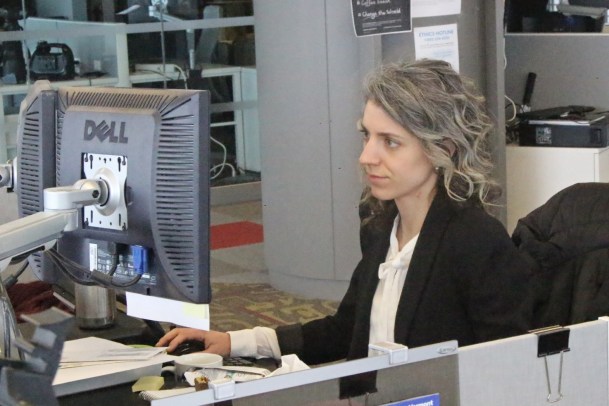
[W]hen Emilie Stigliani arrived at the Burlington Free Press in July 2013, there were 32 journalists working in the newsroom on College Street. Within a month, she learned she had been laid off along with five colleagues — chosen by virtue of the company’s “last in, first out” policy.
Another editor who had become a quick friend called and said she was planning to leave journalism anyway, so she offered to resign and open her spot for Stigliani to stick around.
“It was all kind of a blur at the time because there was just like, you know, I was thrown right into editing so it was like copy coming, copy going,” she said of her first months at the paper, during an interview last week after being named the paper’s executive editor.
The whirlwind hasn’t stopped. The newsroom moved from its longtime College Street home to 100 Bank St. a few months after Stigliani arrived. She’s the fourth top editor in as many years (and the second woman to hold the position in the paper’s 190-year history). A crop of what she called “kind of legendary” journos from another era have mostly left, replaced by people closer in age to Stigliani, who is 33.
And the newsroom staff has been cut in half, mostly due to layoffs and buyouts; the count is currently at 15. Just this month the Free Press cut two more editor positions and dropped three longtime columnists.
“We’ve become smaller — that has been reported about,” Stigliani says, quickly moving the conversation to what might be an even more significant change for a newspaper that once
had a circulation of some 50,000-60,000 copies daily (the current count is closer to 10,000-20,000).
“We have evolved tremendously in terms of our approach to digital and and delivering the best news we possibly can for the digital audience,” she says.
Stigliani, who was digital director for a few months before another promotion, openly admits that the print product is an afterthought.
“My focus is on growing digital. I mean, that’s where the industry’s headed,” she said. “Our conversations are centered around digital.”

How long does she think the print newspaper will be around? Ask the circulation department, she said. (Pat McDonough, the newspaper’s circulation manager, said he “couldn’t help” when contacted Tuesday then hung up the phone.)
The Valley News, the print standard-bearer on the other side of the state, also just promoted its former web editor, 30-year-old Maggie Cassidy, to run the newsroom. But Cassidy and her predecessor, Martin Frank, said in November that they still see the print product as a priority.
For all the turmoil at the Free Press, things could soon get even worse.
News broke this month that Digital First Media, a subsidiary of the hedge fund Alden Global, had offered $1.4 billion for Gannett, a publicly traded company that owns the Free Press, USA Today and more than 100 local dailies spread across the country.
If the sale goes through, wrote Joe Nocera for Bloomberg, Digital First will “cut till it bleeds, and then cut some more. And they’ll keep cutting until the day arrives when there’s nothing left.”
Asked about that prospect, Stigliani looked out from the conference room where we were speaking and pointed to about a dozen journalists in the newsroom who were typing, talking about stories, editing photographs and video — doing their jobs and appearing to enjoy it.
“At the end of the day, my purview is those people out there working, and I’m proud of my staff, and … we’ve been through a lot together, and I can’t imagine a group of people that I would rather be doing this work with. So … that’s all I can really say about that,” she said.
Stigliani didn’t have plans of being an editor — or working at a major news organization — when she was studying at the Missouri School of Journalism and reporting part-time at the Columbia Missourian.
“I had always kind of pieced together jobs like part time here, part time there, and so I thought that … freelancing would be my schtick,” she said.
But then she found herself recovering from foot surgery shortly after graduating from journalism school and realizing she would soon be kicked off her parents’ health insurance plan.
She had seen an ad for the Free Press editing job, and thought it might be interesting but didn’t plan to apply. Then her mom said, “I’d really like to not watch you struggle so hard, like hustle and pull all this stuff together,” she said. So she sent in an application.
“And five days later, they flew me out,” she said. “I came to my first interview on crutches.”
Aki Soga has been witness to it all — the layoffs, hires and shift to digital. He arrived at the Free Press in the summer of 1991 after a few years working as a financial journalist in Japan.
At that time, the newspaper was still striving to be Vermont’s “newspaper of record,” covering everything from the major statewide political news of the day to the minutiae of city meetings.
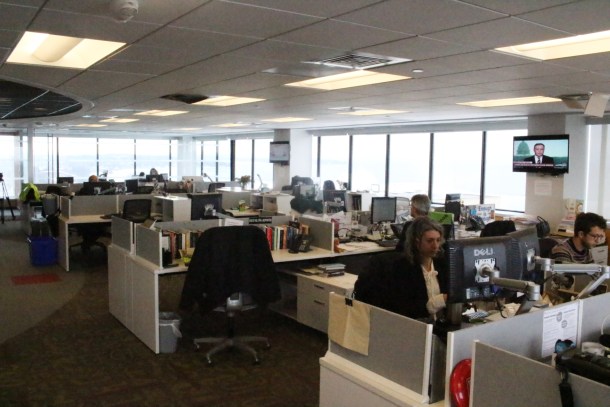
Soga is now the “Insights Editor,” after the editorial pages he oversaw, and where his series on open government made him a finalist for a Pulitzer Prize in 2012, were cut. He sits in one cluster with a few other editors and reporters. Stigliani sits in another cluster a couple rows over.
Muted cable stays on the TVs positioned between the walls of glass windows looking out on Lake Champlain from seven floors up. But it’s half empty, clearly purchased with a more robust staffing situation in mind.
There’s a glassed-off corner office with a gorgeous view of the lake out one side and downtown Burlington out the other. It’s for the editor, Stigliani said, but she prefers to sit with her team. “Part of my leadership strategy,” she said in a text message. The other side of the building faces a giant hole in the ground, where the CityPlace Burlington development has been stalled for months.
Soga says he and other editors are being more strategic about story selection these days. They are watching audience metrics closely — what stories are attracting readers and how long people stick around on the site. The competition is not only the other online news outlets covering the city — Seven Days, VPR, VTDigger — but everything else on the internet, Soga said.

Standing out sometimes means writing stories as easy-to-digest “listicles” or “chunked” content — “What you need to know” appears often in headlines these days. But the Free Press is still doing hard-hitting reporting — digging deep into issues like domestic abuse, homelessness, child sexual abuse and racial harassment.
“We still rely on our sense of what’s critical,” Soga said, “and try to hit those in a way that readers will care. I mean, you know, you can do the best work in the world. And if nobody reads it, it’s just kind of, you know, shouting into the wind.”
While Stigliani is a millennial by age, she’s not a “digital native” like some of her reporters who are just a few years younger. She wasn’t even allowed to watch TV growing up in Iowa, she said, and until fourth grade was homeschooled by her mom, who she described as an “earth mother” who would buy whole wheat kernels to grind at home before baking bread.
Whatever the platform, Stigliani still sees the Free Press as serving a traditional role of fostering a more informed and engaged electorate. But as the legislative session drew to a close last year, the Free Press was among the outlets without anyone present for the late-night legislative marathon. So is state politics still a priority?
“I haven’t figured out exactly the hierarchy of priorities, if that’s what you’re asking, because I’m so new on the job,” Stigliani said.
She tries to get the most out of her staff, but is also mindful of the need to have some semblance of work-life balance. “Because we all actually want to have lives in the community,” she said, noting that the previous night she had gone indoor rock climbing for the first time in five weeks.
“I was like, I’ve got to go get some exercise and like, see some friends,” she said. “Yeah, so that’s the balance.”
Stigliani is not entirely new to the job. She briefly ran the newsroom after then-executive editor Denis Finley was fired for tweets critical of a proposal to create a third gender option for government identification.
Michael Kilian, who was an editor at the paper from 2010 to 2013, was brought back to run the paper. “Whenever there’s a controversy and someone is forced to leave under a cloud, you know, it rocks the newsroom,” Soga said. “So, it was good to have someone that people trusted.”
Soga said Stigliani was also in a great position to lead the paper now that Kilian is gone.
“I think we’ve thrown a lot at her and she’s always managed to handle that, you know, she’s strong presence. I think she’s a very empathetic leader,” he said. “She’s got the right chops. She’s got the right skills. She’s got the right focus.”
Correction: Michael Kilian’s name was misspelled in a previous version of this article

