

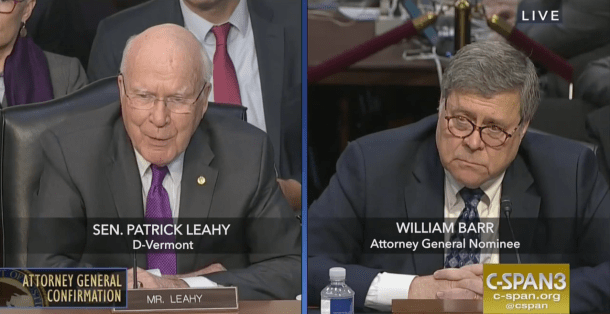
[I]n William Barr’s confirmation hearing for attorney general, Sen. Patrick Leahy pressed the longtime conservative lawyer on whether he believes the president could take non-appropriated funds to build a wall, if he would block the special counsel’s investigation into the 2016 election, and if he believes there was Russian involvement in the election process.
Leahy, who last month voiced concern that Barr would block special counsel Robert Mueller’s investigation, repeatedly asked the nominee for attorney general about his view of Mueller and the independent investigation during his two rounds of questioning on Tuesday.
“Bob Mueller could only be terminated for good cause and frankly, it’s unimaginable to me that Bob would ever do anything that gave rise for good cause,” Barr said. “I believe right now, the overarching public interest is to allow him to finish.”
Barr, President Trump’s attorney general nominee, appeared before the Senate Judiciary Committee, and faced questions from senators on his legal record and to explain a memo he wrote that was critical of Mueller’s investigation.
“So you would be in favor of releasing the investigative report when it’s completed?” Leahy pressed Barr, during his nearly 12 minutes of questioning.
Barr said he has not been critical of the investigation into Russian interference and that he is “in favor of as much transparency as there can be consistent with the rules and the law.”
“I believe the Russians interfered or attempted to interfere with the election and I think we have to get to the bottom of it,” Barr said.
Leahy also asked Barr about his view on executive privilege and if Trump could “put his own spin” on the investigative report and “correct it before it’s released.”
Barr responded by saying that if confirmed he would commit to that not happening.
Leahy asked a pointed question about Barr’s stint as attorney general under former President George H.W. Bush, who died last month, and his involvement in the Iran-Contra scandal.
“You encouraged the President George H.W. Bush to pardon all six individuals targeted in Iran-Contra,” Leahy said. “Do you believe a president could lawfully issue a pardon in exchange for the recipient’s promise to not incriminate him?”
Barr responded that if the the president did this it “would be a crime.”
Barr served as attorney general to former President George H.W. Bush from 1991-1993.
Bush would give clemency to people who had been officials in President Ronald Reagan’s administration, including former Defense Secretary Caspar Weinberger, who had been set to go on trial to face charges about lying to Congress.
Leahy did not let his questioning time expire without asking Barr about Trump’s demand for $5.7 billion for a border wall to be included in funding bills — the key disagreement between the president and Democrats which has led to the 25-day government shutdown.
“Do you believe the president can ignore Congress appropriations, allocation conditions and restrictions, just ignore them and take the money?” Leahy said. “For example could the president just build a wall along the southern border because he wanted to and just take the money whether appropriated or not?”
Barr did not give the Vermont senator a complete answer, saying he would have to look at the the laws involving the individual case and could not answer the question “in the abstract.”
However, in later questioning Barr said that he agrees with the president about the need to change the country’s immigration policy, including a border wall.
“We need money right now for border security, including barriers and walls and slats and other things,” Mr. Barr said. “Anything that makes sense in different areas of the border.”
Barr also said he would not be opposed to imprisoning journalists if he is confirmed as attorney general.
Sen. Amy Klobuchar, D-Minn., referenced the murdered Washington Post journalist Jamal Khashoggi in her questioning of Barr.
Klobuchar asked Barr if he would be in favor of jailing journalists for doing their jobs, to which he responded that he could only conceive of those situations “as a last resort.”
“I can conceive of situations where, you know, as a last resort and where a news organization has run through a red flag or something like that, knows that they’re putting out stuff that will hurt the country,” Barr said, “there could be a situation where someone could be held in contempt.”
While Democratic Senate Judiciary Committee members use Barr’s confirmation hearing to make sure Mueller’s probe into the president and the 2016 election continues without interference, it is unlikely any questions raised about Barr’s record will stop him from becoming the nation’s next top law enforcement official.
In his opening remarks, Barr stressed he would uphold the rule of law and would keep politics out of the Department of Justice, even as the president has repeatedly said he views the department as an extension of his administration.
“Nothing could be more destructive of our system of government, of the rule of law, or the Department of Justice as an institution, then any toleration of political interference with the enforcement of the law,” Barr said. “My allegiance will be to the rule of law, the Constitution, and the America people.”
If Barr is confirmed he will take the place of the acting attorney general, Matt Whitaker, who took the job after Trump fired former Attorney General Jeff Sessions in November.

