

The Deeper Dig is a weekly podcast from the VTDigger newsroom. Listen below, and subscribe on Apple Podcasts, Google Play, Spotify or anywhere you listen to podcasts.
[W]hen Rep. Becca White, D-Hartford, heard Gov. Phil Scott this week pitch a strategy to attract millennial homebuyers to Vermont, she looked around at the audience in the House chamber and noticed a disparity.
“There’s a handful of us who actually sit in the chairs for the House or the Senate who fit the demographic he’s trying to reach.”
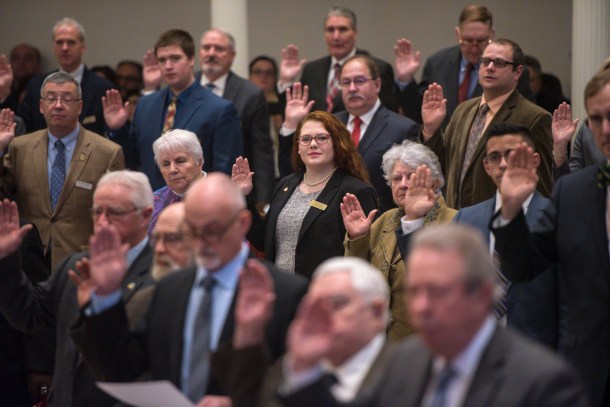
White, who is 24, says it’s necessary to have young people at the table if state government wants to address Vermont’s demographic decline. The new House roster takes a step in that direction: White is one of four legislators under the age of 25 who were sworn in this week.
Rep. Felisha Leffler, R-Enosburg, says her experience growing up in Vermont more recently makes her well-suited for current policy discussions. “The Vermont I grew up in is very much the same Vermont that we’re dealing with,” she says.
Leffler says she understands 20-somethings who leave the state for better work opportunities: until last year, she was one. Now back in her hometown, she faces the same affordability issues as many other young Vermonters: “I have to pay rent and bills and utilities, and I’m just getting started on my student loans.”
Rep. Lucy Rogers, whose campaign got national attention for a bipartisan musical performance at a debate last year, says older legislators discussing education issues are more likely to make faulty assumptions about students’ needs.
“I’ve so recently gone through the public education system in Vermont,” Rogers says. “I think it’s really different to have a from-the-inside look on public education, versus from the outside looking in.”
Rep. Patrick Seymour, R-Sutton, works on his family’s dairy farm. Seymour considers himself a fiscal conservative, and says he wants older generations to understand that young people have a diversity of political opinions. “They’re not all this progressive vision you see on TV,” he says.
“There are many young people who are libertarian. Many of them are Progressive, many of them are Republicans, Democrat,” Seymour says. “They’re all manner of folk. And the more of them there are, the more representative of the country in general.”
The four freshmen join two other young representatives, both from Randolph, who are starting their second terms: Ben Jickling, 24, and Jay Hooper, 25. Jickling is an Independent; Hooper is a Democrat.
Jickling says earning the respect of older lawmakers during his first term wasn’t as hard as he expected. “Obviously there’s the initial visceral thing: ‘A lot of these people are my grandparents’ age.’” He spent his first term on detailed policy work in order to show his commitment.
“I’ve found that if you prove yourself as a serious legislator, you are regarded as a serious legislator,” Jickling says. “But I think it probably is harder than it would be if I was 40.”
[showhide type=”pressrelease” more_text=”Read full transcript” less_text=”Hide full transcript” hidden=”yes”]
I’m gonna start from the top. Are you the only legislator with a nose ring?
Becca White: No, I’m not. There’s a group of us with nose rings. But actually Maxine Grad, when I was on the Vermont Commission on Women, I went to her committee, and I was sitting in it as just a witness to the committee. And I realized she had a nose ring. I had taken out my nose ring before the committee meeting because I didn’t think it was a good idea to have a nose ring in. So when the chair of the committee has a nose ring, I knew that I could wear one today.
I actually told her that. I saw her the other day. And I was like, I want you to know, you’re the reason I felt comfortable having my nose ring here.
What’d she say?
Becca White: I think she was a little surprised. But she took it really well.
Becca White just got sworn in to represent Hartford in the Vermont House. And while she’s not the only legislator with a nose piercing, it does send a signal that she’s one of the younger members of the chamber. Becca is starting her term at 24 years old.
Gov. Phil Scott: Consider this. In 2017, the top towns for millennial homebuyers were not New York City, Boston or San Francisco. They were Williston, North Dakota, Athens, Ohio, and Aberdeen, South Dakota.
This is Governor Phil Scott, during his second inaugural address on Thursday.
Gov. Phil Scott: Millennials appear willing to put affordability and quality of life over the conveniences and attractions of our biggest cities when buying a home. I believe Vermont can offer what they’re looking for. And in many instances we already do.
Becca White: It was very interesting to hear Phil Scott’s speech because he was talking a lot about millennials. And I’m looking around the room, and there’s a handful of us who actually sit in the chairs for the House or for the Senate who fit the demographic of people he’s trying to reach. So I think that’s very important, to actually have people who fit the demographic you’re trying to get into the state making policy, rather than what I hate to see — my like, my biggest pet peeve is when folks who are either older or even substantially older who try to explain why millennials do X, Y, or Z. And I’m like, that has nothing to do with why I anecdotally know my friends do X, Y, or Z.
What do you feel like they’re missing? Like, what do you feel like they don’t understand about the experience that people your age are having?
Becca White: I think they don’t get that we’re not a monolith. Like, we’re not one big body. My husband is 14 years older than me. We are the bookends of the millennial generation. I’m 24. He’s 38. So we have vastly different life experiences. But we’re just kind of clumped in this same kind of: ‘you must like this, and social media is a bad thing.’ So I wish that when we made policy, we really thought about not a single group of people as an age group all being the same, but that there’s unique things about each each group of millennials, how they impact their community.
House Speaker Mitzi Johnson: And now this is the part that you’ve all been waiting for. Will you please rise to receive the oath of office from the clerk of the house.
Forty new members of the House were seated this week: more freshman legislators than Vermont has seen in decades. Four of them, including Becca, are under 25. And they’re not a monolith either. In fact, two of them are Republicans. But they all feel like their perspective hasn’t always been heard.
Patrick Seymour: We talk more, we want people to be more inclusive. You know, the thing I always hear about is, ‘Well it’s all full of old white men.’ And frankly, you look around and in a lot of cases, that’s true. In my hometown, I’ve been asked to be on the development board. And there’s about an age difference between me and the next youngest person of about 50 years.
This is Patrick Seymour. He represents Lyndon, Sutton and Burke, up in the Northeast Kingdom. And even though he ran as a Democrat in 2016, he’s serving now as a Republican.
Patrick Seymour: Frankly, I shouldn’t call myself a farmer. I work on the family farm. The person who sits to my right is Rodney Graham, who is a full time dairy farmer. And I wouldn’t want to compare us in any way because I certainly don’t do nearly as much work as he does.
What does your family’s farm do?
Patrick Seymour: We’re also a dairy farm. It’s just that during the session, I won’t be doing any milking, or any sort of work. If they really need me, I’ll be able to fill in for a milking or something like that. But I’m not regularly doing anything. I’ll pick up more work after the session ends and return to that work.
You said everybody’s always saying that they want to get more young people involved in government. From your perspective, why do you think that is?
Patrick Seymour: Well, I think a lot of it is that they are underrepresented. My experience with young folks is that they are not all this progressive vision that you see on TV. One of the things that I always hate to hear is the term millennial used disparagingly, as it so often is, because there are all kinds of young folks that are all different in all sorts of different ways. And to group us all together is foolish, because, you know, I’m a fiscally conservative Republican. I don’t identify with a lot of the people you see on the news, but I don’t think most people identify with them. I think it’s taking a small section of the people and saying, well, this is what they all think. So I want to see more young people because right now I feel that only one voice of the young, younger community is actually being expressed.
There are many young people who are libertarian. Many of them are progressive, many of them are Republicans, Democrat. They’re all manner of folk. And the more of them there are, the more representative of the country in general.
Felicia Leffler: It really brings a perspective of what the Vermont I grew up in, in the Vermont I’m living in, is like, without perhaps the color of what Vermont used to be.
This is Felicia Leffler. Felicia represents Enosburg and Montgomery, up in Franklin County. She’s the second youngest member of the Legislature.
Felicia Leffler: The Vermont I grew up in is still very much the same Vermont that we’re dealing with. So I’m looking for ways to improve upon that for my generation. And my siblings, the youngest being 10. What is she going to come up into? And what can we do to make it better?
What was it about 2018 that made you say, now’s the time, this is the office, I’m going to run for the House? What was that?
Felicia Leffler: A big leap of faith. I was really looking, initially, to help whoever was going to run and manage their campaign, and see what I could do. And focus on the issues, the opioid epidemic being at the top of that list for me. The more I dug into the issues and who could possibly run for this back in my home district, there were just — there really wasn’t a forthcoming of candidates, people that either had the time, or were interested in serving. And the more I kept pushing at it, a lot of people started asking, if you’re so interested in it, do it yourself. Do you want to run? Is this something you can do? A big leap of faith comes in.
I talked quite a bit with my family and my friends. Running for office was always that kind of pipe dream of maybe, eventually, someday. And to see the opportunity, and knowing the issues, and being so passionate about Vermont, it kind of became the right opportunity at the right time to run.
Lucy Rogers: I’ve had my eye on doing this for a few years now. I think the most difficult time to be a representative, I think, is actually a little older than I am. As people kind of dive deeper into careers and start families. And I think that’s a voice that’s really lacking. You see that in issues like a lack of focus on childcare as a central issue. And I think it’s because childcare is such a big issue that people with small children really don’t have even the possibility of being in the Legislature.
Lucy Rogers represents Waterville and Cambridge in Lamoille County. Her campaign last year made national news after she and her opponent Zack Mayo played a duet after a live debate.
CBS News: Democrat and Republican united in perfect harmony. There weren’t enough tissues go round.
Typically overlooked was the fact that Lucy would also bring the perspective of one of the youngest people to serve in the chamber.
Lucy Rogers: I went to Waterville Elementary School, which is a public school with about 12 kids in each grade. And then I went to Lamoille Union High School, and then I traveled for a bit, I took some time off before college. Then I started off at Harvard, and I transferred to UVM for the end of college. So I’ve always been kind of around Vermont, or at least seen Vermont as a home and really wanted to return to the district I grew up in.
I’ve seen many of my friends from elementary school and high school are no longer in our district. So I actually think it’s a particularly important voice to have, being someone who is figuring out how to make my life as an early 20s person in rural Vermont, and really living every day — both the amazing experience of that, and also some of the challenges, with finding employment that I feel like is a stepping stone to further employment.
I have a great community of younger people. But it definitely is different than the community I had before many of the people I grew up with moved out of the state. So I think it actually is a really important for us to have.
Felisha Leffler: I think job opportunity is a real issue for a lot of Vermonters, and that just based on our industry and some of our policies towards business. We are not as opportunistic as we could be. And that, in many ways, hurts the young population that does leave for jobs out of state. I know I was one of those for a time. So that’s something I bring with me as well.
Do you feel like there are aspects of that, that the older members of the Legislature or even older members of the public might not quite understand the same way as you?
Felisha Leffler: I think it’s not about understanding, but it’s more about prevalence. Being in the workforce. As a realtor, I sometimes have more of an understanding of: all right, I have to pay rent and bills and utilities. I’m just getting started, and I have my student loans as well. And looking at those expenses, at my career and my service here, there’s more of an interconnection than perhaps somebody who’s retired, who has had more time to manage those liabilities.
There’s just a difference in perspective, somebody who’s in the workforce and somebody who’s retired from the workforce, and we need them both. But that certainly shapes kind of the policy I’m looking at and the perspective that I hope to be able to bring to the conversation.
Lucy Rogers: At least on paper, I think there is quite a bit of awareness about trends of young people leaving the state and the difficulty of being my age in a rural area. I think the perspective that sometimes gets lost is, I’ve so recently gone through the public education system in Vermont. And I think it’s really different to have a from-the-inside look on public education versus from the outside looking in.
Many of the members here went to public school in Vermont a very long time ago, or went to public school out of Vermont, and then moved into Vermont. So I think it’s important to make sure that we’re having voices from people who have recently gone through this exact system.
I’ve heard over and over again, the idea that small schools don’t prepare you for college and don’t prepare you for careers, and that children who go to small schools, usually speaking, elementary schools, are missing opportunities. And I’ve never had that experience of speaking to someone who went to a small school and felt like they missed opportunities. And in fact, I think, particularly in towns with higher poverty rates, which many of the small schools are, it can actually be a really great opportunity for someone who may not have the most stable home environment to have adults who know them personally, and who really provide them with kind of a rich, safe place to go each day. I think that’s just one example where I feel like having recently gone through that system gives me a little bit of a different perspective on what’s going on in small schools.
Becca White: I mean, I grew up in a low income family. So I come from the group of people that are typically the most vulnerable of the educated population. So when I was in elementary school, middle school, high school, it was the free lunch program. I was the person who VSAC had special meetings about. So I definitely come from that perspective of what actually was a benefit to me during that time. And what programs I felt were a complete waste. So I can come from that personal experience.
Patrick Seymour: It is growing up in a different time. Unfortunately, you know, when you’re set in your ways — in simple things, too. People will say things like, ‘well, as you know, most people have a TV at home. Well, they can’t all be poor, then can they?’ But a TV costs significantly less to someone like me than it did to a lot of these people in the building when they were a kid. A TV was a real luxury. And nowadays, I mean, people give them away for free on the street. So it’s little things like that, that make the difference.
It’s also, the cost of living has increased tremendously since a lot of these folks were younger. And opportunities have changed. I don’t think there’s anyone from this age, but you know, the day when you could come in at four on the factory floor and rise to owning the building. The idea of going into a small business and rising up through the ranks is not as accessible as it was when a lot of these folks were my age.
Ben Jickling: Obviously, there is the initial visceral thing: ‘you know, a lot of these people are my grandparents age.’ But I found that if you prove yourself as a serious legislator, you are regarded as a serious legislator. But I think it probably is harder than it would be as if I was forty.
Ben Jickling is 24. But he’s already sort of an elder statesman in Vermont’s youth caucus. Ben just started his second term representing the Randolph area, alongside Jay Hooper, who’s 25.
Ben Jickling: There’s definitely differences in generations. We value different things. We’re looking for different things as we consider where we want to live, how do we want to work? What type of environment do we want to have?
I think the most pressing and the most obvious answer is high speed internet. Even as I go across the district, even as I talk to legislators, and older people in general, they don’t realize how important access to high speed internet and good cell phone coverage is. If you talk to any young person my age, it’s a no brainer. It’s a necessity, and we’re not doing enough in that area. So issues like that, I think, prove how it helps to have younger people at the table, actively making policy.
Much of our job here is not spent making Vermont for the next year, it’s making Vermont in 10 years, 20 years, 50 years. We’ll still be around, and hopefully still living.
I asked Ben what advice he’s giving to the incoming young legislators.
Ben Jickling: Listen. Keep your head down. Really focus on the policy of it. That’s where you’re gonna most make the most impact is in committee. People respect all legislators. What I really appreciate about this building is the culture is one of collaboration. But you know, what I found to be most successful is really buttoning down, looking at policy and, not being afraid to really dive into committee discussions.
Becca White: The big advice that I’ve gotten from just the last few days and over the period of time between orientation and now was you have two ears, and you have one mouth. And that’s kind of my go-to quote now, which is, I need to do a lot more listening. Just building up a base of allies and people who trust my judgment. Trying to speak less, but build those relationships and that trust. So when I do start to put things out there, bills out there, or I support certain legislation, that that has weight to it. And it’s not just a signature or me initialing a piece of paper. It actually says, ‘Oh, she supports that this is important. I too am going to support it.’
Lucy Rogers: My immediate first priority right now is just to listen and learn as much as I can. I have some pretty strong policy goals. But I also am not coming in with the idea that they all need to be accomplished in the first week. And so I think, probably the way I can be the strongest politician would be to spend as much time as I can making sure that I’m speaking from an informed place.
Felisha Leffler: I think the biggest use of my time here is two eyes, two ears, one mouth. Advocacy is certainly a very important part of being a representative. But advocating for the right things at the right time will be crucial to making my voice heard among among the 149 others that are out there. So it’s it’s looking at the issues and relaying them back to my district, and seeing what they’re most passionate about, and how I can best use the time and space that I’m given.
Patrick Seymour: As the youngest member of this session, I I am sure I’ve I’ve already received the nickname ‘the baby of the house’ from someone, which… I am hoping that’ll all go away.
Are you worried about that? The perception that people might not take you seriously, because you’re the youngest member here? Is that something you’ve you’ve encountered?
Patrick Seymour: If people aren’t going to take me seriously, because I’m the youngest, there are some folks I don’t feel need to be taken seriously because they’re the oldest, if that makes sense. I don’t think anyone’s going to treat me too badly. And as long as I present myself well, I should be listened to in this house.
[/showhide]
Subscribe to The Deeper Dig on Apple Podcasts, Google Play, Spotify or anywhere you listen to podcasts. Music by Blue Dot Sessions and Joe Bagale.
This post was corrected to reflect Rep. Ben Jickling’s party affiliation as an Independent.
