


Senate leadership for the next two years looks a lot like it did for the last two.
Only two of the 11 committees will have new chairs, a contrast to the House, where seven of 14 committees have new legislators taking the lead.
Sen. Joe Benning, R-Caledonia, is the sole Republican committee chair, taking over from Peg Flory, R-Rutland, who retired, as chair of the Senate Committee on Institutions.
“Every committee has to have a chair and they try to spread the wealth around,” Benning said Thursday. “The numbers are such that the wealth is appropriately spread under the circumstances.”
The other committee chair change sees Sen. Ginny Lyons, D-Chittenden, replace Claire Ayer, D-Addison, as chair of the Senate Committee on Health and Welfare. Ayer did not run for re-election, and her seat in the Senate will be filled by Sen. Ruth Hardy, D-Addison.
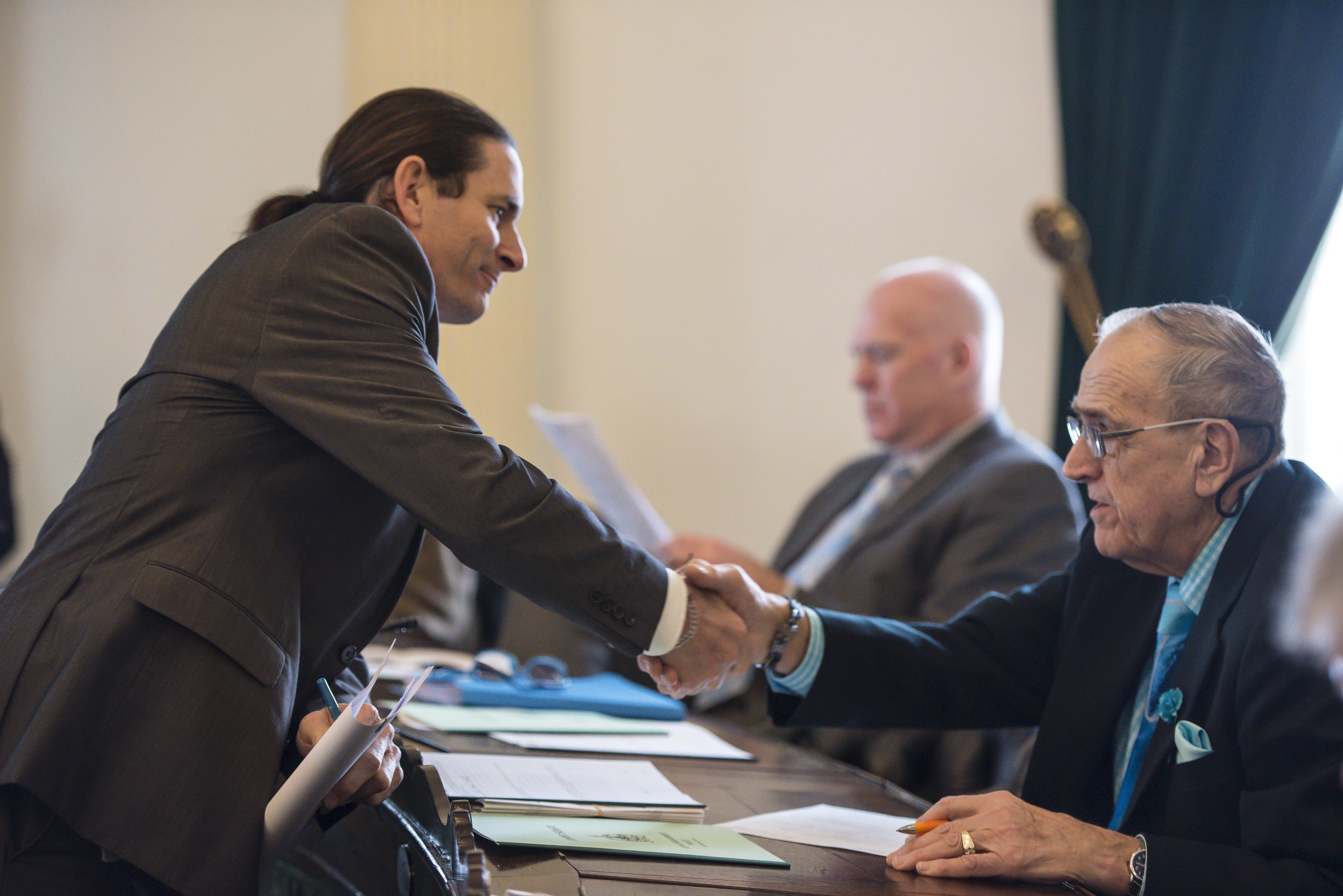
The Senate’s Committee on Committees — composed of Senate President Pro Tem Tim Ashe, D/P-Chittenden; Lt. Gov. David Zuckerman, P/D; and Sen. Dick Mazza, D-Grand Isle — made some changes in committee makeup and had to fit five new senators in the mix.
The Senate Education Committee is still headed by Sen. Phil Baruth, D-Chittenden, but includes four of the new senators. Baruth, who has been a leading champion of gun control in the Statehouse, was also assigned to the Senate Judiciary Committee, which is the gatekeeper for legal changes, and has historically been hesitant to embrace new gun control measures.
Sen. Tim Ashe, D-Chittenden, the Senate president pro tem, will move from the judiciary committee to transportation, which is chaired by Sen. Dick Mazza, D-Grand Isle, one of the most conservative members of the Democratic caucus.
House Speaker Mitzi Johnson, D-South Hero, shifted the leadership of the House Transportation Committee from a Republican to a Democrat this session as part of what she said was a push to expand public transportation. Ashe told Seven Days that he expected the Senate committee to grapple with reducing carbon emissions.
Ashe also remains on Senate Appropriations, which is led by Sen. Jane Kitchel, D-Caledonia, and made up of what is easily the most experienced bunch of legislators on any committee in the Statehouse.
Sen. Robert Starr, D-Essex/Orleans, another conservative Democrat, kept the chair of the Senate Agriculture Committee but is matched up with three senators on the opposite end of the political spectrum in Sens. Anthony Pollina, P/D-Washington; Chris Pearson, P/D-Chittenden; and Hardy.
Other committee chairs remaining in their seats are:
• Sen. Jane Kitchel, D-Caledonia, chair of Senate Appropriations
• Sen. Michael Sirotkin, D-Chittenden, chair of Senate Economic Development, Housing and General Affairs
• Sen. Ann Cummings, D-Washington, chair of Senate Finance
• Sen. Jeanette White, D-Windham, chair of Senate Government Operations
• Sen. Dick Sears, D-Bennington, chair of Senate Judiciary
• Sen. Chris Bray, D-Addison, chair of Senate Natural Resources and Energy
Benning who previously served as vice chair on the Senate Judiciary Committee, said that he plans on taking his cue from the lower chamber on how he will lead the Committee on Institutions.
“It literally will be a situation where we take our schedule from what their schedule was, learn about it as quickly as we can, so that when they deliver the bill to us we’re up to speed on what they’ve heard,” Benning said.
“That’s really the game plan right now and I don’t anticipate that there will be any fireworks or anything else like that in this particular committee.”
Lyons was vice chair of health and welfare last year and previously chaired the natural resources committee. She said her committee had a tremendous amount of work ahead, not the least of which is trying to help people struggling with opioid addiction.
She said other priorities would include improvements of the mental health system, expanding quality child care, creating greater equity in health care access and making sure that federal changes in programs like food stamps did not hurt Vermonters.

During a morning meeting of the Senate, Zuckerman, who presides over the chamber, gave a speech that, like Gov. Phil Scott’s inaugural address later in the day, called for a focus on affordability, but veered far from the governor in how to achieve that.
Zuckerman said, “The most tangible way we can improve affordability for working Vermonters is by raising the minimum wage and enacting universal health care,” both policies that Scott has opposed.
Zuckerman also touched on building broadband internet infrastructure for rural Vermonters, making sure the state funds clean water initiatives, and policies to combat or protect against climate change.
Committees will get to work next week.
