

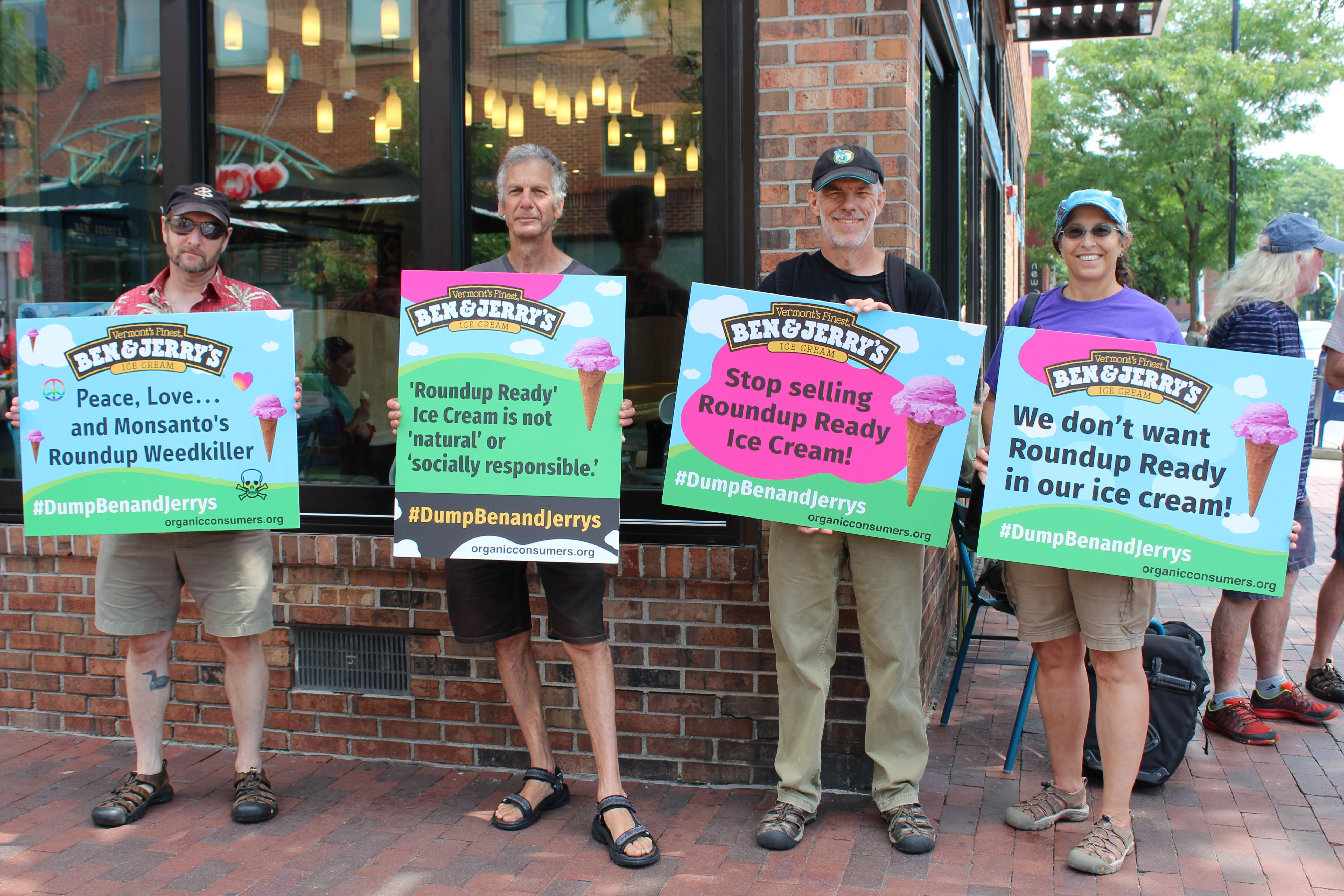
[A] federal judge has ruled against Ben & Jerry’s and allowed a lawsuit alleging that the company doesn’t live up to its environmentally friendly messaging to move forward.
The Organic Consumers Association (OCA) filed suit in Washington in July arguing that the Vermont-based ice cream maker misled consumers to think its product is more environmentally friendly than it really is, in violation of consumer protection laws. On Monday, Judge Neal Kravitz foiled Ben & Jerry’s efforts to get the case dismissed.
The OCA argued that while Ben & Jerry’s frames itself as an environmental leader, in reality, the company’s products include ingredients sourced from inhumane dairy farms and include traces of glyphosate, a herbicide.
Ben & Jerry’s, which is owned by Unilever, had argued that no reasonable customer would conclude that the company’s advertising about “happy cows” meant that none of the cows lived on ordinary farms.
Kravitz found that the allegations raised by the association were “sufficient to advance a plausible claim that consumers would be misled by Ben & Jerry’s labeling and marketing regarding the sourcing of its ingredients.”
“A reasonable consumer could plausibly interpret Ben & Jerry’s labeling and marketing as affirmatively (and inaccurately) communicating that the company’s ice cream products are sourced exclusively from Caring Dairies and/or other humane source,” he wrote.
The OCA had also contended that ice cream company’s advertising would lead consumers to believe that the company did not use any chemicals that harmed the environment. The organization had found traces of glyphosate — though far below federal limits — in Ben & Jerry’s ice cream in 2017.
Ben & Jerry’s announced plans following that report to start a 100 percent organic line and that the company would stop using ingredients from crops dried with glyphosate. In its motion, Ben & Jerry’s argued that it had not made any misleading or false claims about glyphosate.
But Kravitz sided with the OCA on this issue as well.
“The court concludes that the facts alleged in the complaint are sufficient to support a plausible claim that consumers would be misled by Ben & Jerry’s statements into believing the company’s ice cream products contain no traces of chemicals like glyphosate,” Kravitz ruled.
Katherine Paul, the associate director of the OCA, said that while the ruling on the motion to dismiss was just the first step in the lawsuit, the group was encouraged by the ruling.
“We filed this suit on behalf of consumers because we believe Ben & Jerry’s marketing and advertising is deceptive in a variety of ways,” she said. “The ruling was very clear in the fact that consumer expectations just don’t align with the type of marketing claims Ben & Jerry’s was making.”
Ben & Jerry’s does not comment on pending litigation, Laura Peterson, the company’s public relations manager, said. But she said in a statement that the company is committed to building a “resilient, regenerative dairy supply.”
“While we cannot comment on a pending lawsuit, we can say we are proud of the work we have done with Vermont’s family farmers over the past 35 years, and we realize our effort is not yet finished,” she said.
Peterson said the company’s vision for the future is that all dairy products used by the company will come from farms that provide “thriving livelihoods” for farmers and farm workers, the best possible care for cows, feed grown without harmful chemicals and reduced greenhouse gases.
“We are committed to maintaining a transparent dialogue, and we invite all stakeholders to work together as we strive to make the vision of a vibrant dairy industry in Vermont a reality,” she said.
Paul said the OCA would like to see Ben & Jerry’s fully convert its milk and dairy supply to organic sources and not be from farms that use genetically modified corn.
“We believe Ben & Jerry’s has the market power and financial power to make a real difference here by living up to its claims,” she said. “It could be a market leader, it could make a big difference in the dairy industry for dairy farmers, for consumers and, above all, for the environment.”
