

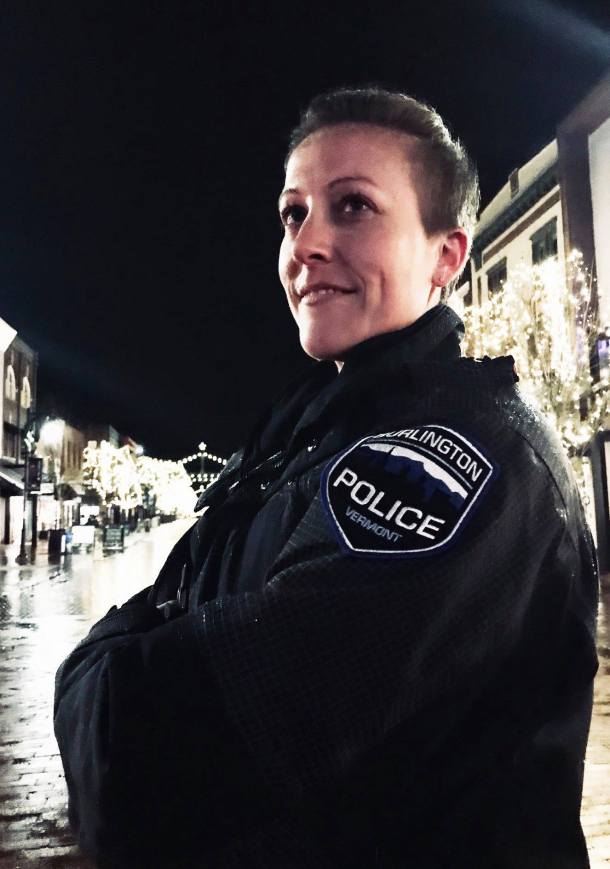
An outside investigation is underway after a complaint was filed by Burlington Chief Brandon del Pozo. In June, the Vermont Criminal Justice Training Council, which oversees the academy, declined to conduct a full investigation into the injuries, only agreeing to review the exercise protocol. In October, the council agreed to a full, independent investigation after del Pozo warned that the credibility of all law enforcement would be questioned without a “comprehensive, transparent internal investigation” of what happened.
The training exercise — the “Hitchhiker Scenario” — was in place for about 18 months before being modified last year to include “less physical” force. The head of the police academy, located in Pittsford, defended striking trainees in the head during the drill — part of the required 16-week basic training for all Vermont police officers. He questioned whether the new version, which has been used by only one class of recruits since it was changed, was as effective.
In the “Hitchhiker Scenario,” the trainee played a police officer seeking identification from a possibly intoxicated hitchhiker on a highway, played by a trainer. When the recruit looked down as they reached for the “hitchhiker’s” ID, the trainer would strike them in the head with their fist, sometimes repeatedly. Recruits and the trainers wore full protective body gear, including padded headgear, sometimes caged. However, according to the lawsuit, trainers were sometimes “overzealous” and appeared to take “pleasure in delivering extremely hard force blows to the heads of trainees as a means of punishing trainees.” One trainer was described as a martial arts expert with two years of competitive fighting experience.
The objective of the “Hitchhiker Scenario” was for the recruit to employ “use of force” skills they had just learned to fend off the trainer’s assault and subdue the “hitchhiker.” The drill typically lasted several minutes in a room at the academy with padded mats on the floor.
An internal Burlington Police Department investigation found numerous officers sustained head and other injuries from the drill, including a report of three police recruits being sent to the hospital on the same day last March, two with head injuries and a third with a knee injury. The BPD internal investigation included interviews with 11 officers who described being hit with “round-house” or “sucker” punches, being knocked to their knees, suffering concussions, and experiencing hearing loss. One officer who successfully subdued the “hitchhiker” described the test as an “all-out brawl.”
In an interview Friday, del Pozo, at times shaking his head, dumbfounded and outraged, said a training program should never include heavy blows to the head.
“I searched high and low across the country for another academy that deliberately punched unsuspecting recruits hard in the head, in fact causing concussions, with a belief that was a necessary and acceptable way to teach police officers to pay attention,” the Burlington chief said. “There were none I could find. The reaction among police leaders was the opposite: they were shocked this was happening. Many simply didn’t believe it.”
He said an investigation was needed to provide accountability about how the injuries occurred, to determine whether other officers were hurt and why the program was put into place.

Richard Gauthier, the Vermont Police Academy executive director, defended the exercise, including striking the trainee in the head. In an interview, Gauthier said the academy goes to great lengths to protect recruits during the drills, which are designed to recreate real-life situations police will face. He said a third-party evaluator was always present during the scenarios. Sometimes, he said, it is the trainers who “take a beating” during the role-playing exercises. Gauthier said the Burlington Police Department was the only law enforcement agency that had filed a complaint.
Gauthier questioned whether the exercise was as effective since it was modified to not include blows to the head. The modifications were made for the last class of recruits, he said, and more time would be needed to determine if the modified program was still as effective. A trainer interviewed in the BPD internal investigation said the drill was now less effective, but also said that the academy had previously lacked adequate protective equipment.
Regarding the appropriateness of the “Hitchhiker Scenario” exercise, including striking the trainee, Gauthier said the academy thought it was appropriate.
“Obviously we did or we wouldn’t have used it,” Gauthier said.
“You’d be amazed at the lengths we go to keep recruits safe,” Gauthier said. Trainers, he said, “are very judicious in their use of force with the recruits.”
Gauthier rejected claims the program wasn’t properly supervised and the academy had been negligent, including claims recruits should have received better medical attention.The third-party evaluator during the drills is there, Gauthier said, to “ensure the practices are safe and the goals of the scenario are met to the (greatest) extent possible.”
He added: “The scenarios are not conducted in private. They are not conducted in secret. They’re not conducted behind closed doors. Our staff walks around the building and monitors everything all the time.”
During the four months of basic training at the academy, recruits are presented with several real-life training scenarios, such as searching a building, as well as other programs including community policing, investigative procedures and crisis intervention.
According to a lawsuit filed by Burlington Police Officer Erin Bartle, she was struck repeatedly in the head and almost blacked out during three attempts to pass the “Hitchhiker Scenario” in early 2017. Two of those tests were on the same day. The third came one week later.

According to her suit, in the first attempt, when Bartle looked down after the trainer handed her the ID, he punched her in the side of the head “with great force with his fist, immediately inducing a traumatic brain injury — a concussion.” Bartle tried to subdue the trainer with a simulated baton and her hands and failed the test when she had to draw a simulated firearm to gain control.
Bartle took the test again that same day. Again, she was struck so hard she fell to her knees, causing her to “nearly lose consciousness and immediately inducing a second brain injury, a further concussion,” according to her lawsuit. She failed the test after requesting to stop.
In a third attempt the following week, which she passed, Bartle was struck in the head repeatedly again, according to the suit and the internal BPD investigation.
Bartle, 35, is still on the force — she rejoined the force last year after leaving for a month, according to the department’s Facebook page — but her suit said she has ongoing medical problems. Her lawyer, Jerome O’Neill, declined to specify her injuries. The names of the officers interviewed in the internal BPD report were blacked out, but in a description that matches Bartle’s case, the report said she had “a headache, nausea and a persistent ringing in her ear” for weeks after the academy training and was later assigned to light duty when she returned to the police force in Burlington because of a “hearing loss condition.”
Bartle went to the police academy in February 2017 after her well-publicized hiring.
According to the internal BPD report conducted by Deputy Chief Shawn Burke, which was completed last April, Burlington officers said they received differing degrees of blows during the “Hitchhiker Scenario.” In the report, they said they experienced or saw other recruits vomiting and being “knocked out.” An unidentified St. Albans officer interviewed by Burke reported being dizzy, experiencing vertigo symptoms and a prolonged headache following the exercise.
Del Pozo said he knew of at least three Burlington officers who had been seriously injured. O’Neill said he believed there may be “many more.” According to the internal report, one of the three recruits who went to the hospital on the same day last March was from the Vermont State Police. Col. Matthew Birmingham, the head of the state police, could not be reached for comment.
O’Neill said one reason he delayed filing the Bartle suit was in hopes of incorporating the results of an anticipated internal investigation at the academy.
In June, after del Pozo had asked for an investigation, Gauthier wrote that the council approved only a limited review of the training scenarios and that the council “chose not to conduct an internal review into the contents of your complaint.”
Del Pozo suffered a serious bicycle injury in June — including a concussion — around the same time as the council’s rejection of his request for a full probe. He did not return to work until mid-August.
In early October, del Pozo protested to the entire council its decision not to conduct an internal investigation. The chief said he had lost faith and questioned how he could continue to “trust” sending recruits to the academy.
“The academy’s refusal to thoroughly investigate these incidents, after we have reported potentially serious injuries to our employees, has shaken our faith in the Academy,” del Pozo wrote to the academy leaders and the Burlington Police Commission on Oct. 2.
The chief warned the council that at least one lawsuit was expected and that “accountability through litigation” would be a poor way to handle the concerns he raised. Del Pozo requested not only a training review, but a full investigation.
“We trust men and women to the VPA’s care and some have had their lives and careers altered in irrevocable ways. As leaders of the police profession, we owe it to those officers and the people we serve to account for that,” del Pozo wrote. Declining to do a proper investigation historically “has proven to have troublesome public outcomes in American policing,” he said.

Without a “comprehensive, transparent, internal investigation,” del Pozo said that the public would likely view the training exercise as “a form of hazing.”
“Such conclusions would reduce the perceived legitimacy of all institutions associated with Vermont policing, particularly if a case is made that the scenario had elements of recklessness and negligence,” the chief wrote, adding “It may well be that some of the conclusions of an internal investigation are uncomfortable or unfortunate or may involve imposing discipline, but that is also our job as leaders.”
Ten days after del Pozo’s letter, the council changed its mind after calling a special meeting. In a two-paragraph Oct. 12 email to del Pozo, Brandon Police Chief Christopher Brickell, the chair of the Vermont Criminal Justice Training Council, wrote the council had voted unanimously to “request an outside, independent investigation regarding your concerns, in addition to their previous decision to have the Use of Force Curriculum and scenarios evaluated by an individual with expertise.”
Attorney General TJ Donovan, who holds a seat on the council, said he advocated for a full investigation at the October meeting.
“In the end, I think the council got it right,” Donovan said Sunday. He acknowledged “litigation concerns” was one of the reasons the council voted down an investigation in June, where a proxy attended on Donovan’s behalf.
Donovan said he supported ending the striking of officers in the scenario. He called del Pozo’s concerns about the exercise “legitimate.”
“I didn’t really understand it at first. I needed more information. I was kind of confused by it. Trainees were being injured but I also wanted to support and defer to a certain degree to the council,” Donovan said in an interview Sunday.
According to del Pozo’s letter to Brickell, one of the trainers where officers were injured works for the Attorney General’s Office. He said an outside investigation should look into whether that “potential conflict of interest” played a part in the June rejection of del Pozo’s request for a full investigation.
Gauthier acknowledged there were delays in setting up the review of the training programs, as approved by the council in June, but he said those delays were not intentional.
“It proved fairly involved so we’re finally getting a contract in place and that person will be conducting the review and then reporting back to the council,” Gauthier said Friday.
As for the scope of the wider investigation, which he said had just begun, Gauthier said: “We’re going to respond to the (BPD internal) report and a review of training practices to make sure we’re using best practices.” He would not discuss details of who would conduct the investigation. Gauthier said the timeline was open-ended and the length of the investigation would depend on how quickly interviews could be scheduled over the next several weeks. He stressed the investigation was not criminal in nature.
Gauthier said the outside independent investigation would, in part, look into why the cases reported by Burlington Police “didn’t match up” with injuries reported to the academy. However, the internal BPD report noted that recruits might be unwilling to speak up. Two injured recruits, according to the BPD internal review, didn’t report their injuries because “they did not want to jeopardize their police employment.”
A Baltimore training expert who raised “serious concerns” about the exercise, as well as a Vermont academy trainer interviewed independently by Burke, both recommended trainees be required to wear mouthguards to lessen the effect of the blows to the head.
In Burke’s report, that same academy trainer said injuries in the “Hitchhiker Scenario” typically resulted from candidates “letting their guard down, taking their eyes off of the role player, and not using effective officer safety skills (distance, stance and preparedness).” The instructor, whose identity was masked like many other police officers’ names in Burke’s report, told Burke “the scenario would lose effectiveness if a blow to the head was not used, citing that it would simply not have the same effect.”
However, the training instructor also told Burke the equipment at the academy had not been “sufficient to keep recruited officers and role players safe.” The instructor suggested better headgear and other equipment changes. Gauthier said the academy recently purchased new equipment including more up-to-date, modern headgear.
In 2007, two officers, including the Orange County sheriff, sued the academy for “punitive physical exercise” that in one officer’s case resulted in kidney failure.

