


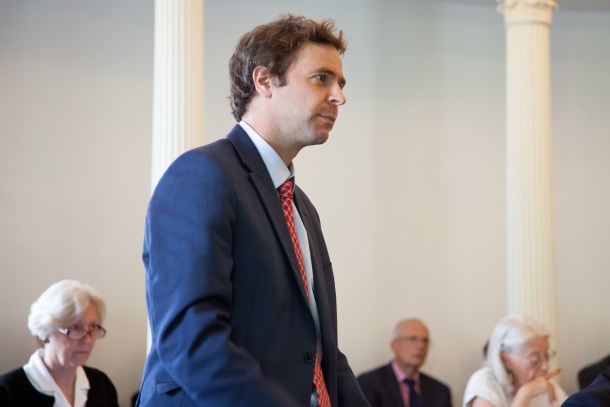
[S]en. President Pro Tem Tim Ashe wants to change Vermont’s Constitution.
Among the Democratic Senate leader’s top priorities in upcoming legislative session is a push to pass four constitutional amendments.
Ashe and other senators say they want to add an amendment expanding gubernatorial terms from two to four years and other amendments that would protect abortion access and guarantee equal protections under the law for minority groups, LGBTQ citizens, and others. A final amendment would remove all mentions of slavery from the state’s central governing document.
Vermont and New Hampshire are the only two states that still have two-year gubernatorial terms, and for years, politicians have argued that they should be extended.
Ashe, a Democrat/Progressive representing Chittenden County, said the short time period leaves governors “hamstrung” between election cycles.
“Any governor struggles to offer bold solutions and to work well with the legislature on big things because there is such a tight window between taking office and then having to face the voters again,” Ashe said during an interview at his Statehouse office earlier this month.
Changing the amendments will take years, if it happens at all. After receiving a two thirds majority vote in the Senate, they must also pass with a majority in the House. Then, they would have to pass both chambers again in the following legislative biennium, before voters decide whether to approve them on an election ballot.
House Speaker Mitzi Johnson said she plans on supporting amendments relating to slavery, abortion, and equal rights, but is still considering the amendment that would lengthen terms for governors.
Constitutional amendments are far from the only major policy proposals Ashe and his 29 fellow senators will consider in 2019.
The Senate is expected to quickly pass a bill that would legalize a taxed and regulated market for cannabis, at a time when many a pushing to expand the state’s marijuana legalization laws. Such measures have previously passed in the Senate only to die in the House.

Ashe said the Senate is also gearing up for major debates about education finance, and is hoping the legislature will be able to strike compromise with Gov. Phil Scott to enact legislation to raise the minimum wage, establish a paid family leave program, and find a long term funding source for state water clean up (All of which are priorities shared by Johnson).
The senate leader pointed to an act of bipartisan collaboration dubbed the “grand bargain” between Democratic lawmakers and Republican Gov. Charlie Baker in Massachusetts earlier this year as inspiration going into the 2019 session.
In June, Baker agreed to sign a piece of legislation raising the Bay State’s minimum wage to $15 and establishing a paid leave program, after negotiating the terms of the policies with lawmakers.
Last year, Gov. Phil Scott vetoed both proposals in Vermont. He opposed the payroll tax that would have funded the proposed paid leave program, and feared a minimum wage increase would hurt small businesses and lead to increased prices for goods and services in Vermont.
But Ashe is hoping that this year, the governor will be willing to come to the table and, like Baker, negotiate with legislators on the conditions of the paid leave and minimum wage proposals so that he can support them.
“What I would like is the governor to sign all these things into law and not have them be acrimonious,” he said.
During the November election, Democrats picked up seats in the House, securing a slight “supermajority” when combined with Progressives. Scott will no longer be able to rely on Republicans to automatically sustain his vetoes, meaning proposals like paid family, leave and the minimum wage may have a better shot at becoming law, even without the governor’s support.
But Ashe and other Democrats don’t think they can expect the House to categorically vote to oppose the governor’s veto pen.
“No wise person puts money on, bets on that,” he said.
Legislators’ views on issues shift, and the caucus’ political views fall across a broad spectrum, legislative leaders say, which can make consistently rallying veto override votes difficult.
Ashe also expects that the state’s ongoing debate over how to fund Vermont’s schools will continue to play out in 2019. But he thinks that the discussion will focus on a different aspect of schools budgets: human services spending.
In recent years, human services expenses have become one of the fastest growing segments of the education budgets every year, according to Ashe. Hiring staff members to work with children with behavioral issues or additional needs make up a large portion of this expense.
Increased human services expenses add pressure on the property tax, and Ashe said many senators are wondering if there’s a better way to manage them.
“The question is should the state picking up some of it, should the schools still pay for it or should there be a combination,” he said. “I don’t know what the answer is but that is an area that has been rather uninvestigated.”
A continuing priority for Ashe is boosting funding for the state’s mental health system to improve access to treatment for patients, and increase compensation for mental health workers.
In recent years, the state’s budget writers have advocated for hiking mental health clinicians’ pay as the industry struggles to attract and retain a robust workforce. The budget lawmakers passed this year included $4.3 million to increase compensation for mental health clinicians and other staff at Vermont’s network of local mental health nonprofits.
Ashe said that the state’s larger mental health facilities such as the Howard Center in Burlington and Washington County Mental Health Services are often training grounds for workers, who move on to jobs in other states.
“We’ve only made partial strides in dealing with their retention issues. They often can’t pay anywhere close to what their larger medical providers can pay for the exact same types of positions,” Ashe said. “It’s a system being neglected so long financially that there’s no shortage of ways we can improve it.”
