


Editor’s note: Mark Bushnell is a Vermont journalist and historian. He is the author of “Hidden History of Vermont” and “It Happened in Vermont.”
[R]oy Spear grabbed for his machine gun as he climbed from the cab of his truck. He wasn’t taking any chances. That day in November 1935, Spear had driven into the midst of a labor strike that would divide a community.
Perhaps the conflict was inevitable. The Great Depression had hit the state’s granite and marble industries hard. Orders plummeted and the companies passed the pain on to workers, who fought back with a series of strikes. The first started in Barre in April 1933 after granite companies cut wages and began laying off workers. Granite union members responded by walking off the job. Six of Barre’s seven granite companies were soon shuttered.
Striking workers drew strong community backing. Three thousand people marched through the streets of Barre for the strikers. They were led by Mayor William Lapoint.
For all the community support, however, the situation soon grew ugly. Granite companies hired strikebreakers in hopes of reopening their operations, which sparked violent clashes. Gov. Stanley Wilson responded in early May by calling out the Vermont National Guard, over the objections of Barre’s city council, mayor and merchants. More than 100 deputies were also dispatched to the scene.
Within weeks, both sides agreed to have the dispute settled by an arbitration board. It took until August to reach a deal that called for granite companies to pay nonunion workers union-level wages. The union dropped its demand to return to the higher wages established in the previous contract. Both sides could argue that they had won concessions.
Barre’s labor unrest soon spread south to the Vermont Marble Company, whose operations sprawled across several Rutland County towns. Trouble started after workers pushed to join the American Federation of Labor (AFL) and the Vermont Marble Company refused to recognize the union.
Workers had still other issues with management. Since the start of the Depression, roughly 1,000 workers had been laid off. Those still employed complained about low wages. Scant pay was particularly evident to workers who lived in company housing in Proctor. After deducting for rent, utilities, insurance and medical care, workers had little left in their pay envelopes. If work hours were scarce, the worker could even end the month owing the company money.
In October 1935, the marble company announced that due to a decline in orders, it would cut payroll at the quarry in Danby by 25 percent. Rather than lay anyone off, company managers decided to have workers take every fourth week off. Workers couldn’t stomach the 25 percent cut in pay and voted to strike. Quarry workers in West Rutland walked off the job in solidarity.
Things threatened to turn violent on Nov. 4, the first day of the West Rutland strike. A truck driver arrived at the West Rutland quarry to pick up a load of lime. Angry strikers blocked the truck and persuaded the driver to turn around. Soon afterward, a convoy of three trucks approached the quarry. Roy Spear, owner of the trucking company, rode in the lead truck, machine gun in hand. When they reached the strikers, Spear hopped out and stood in the midst of the angry group of strikers, determined not to be the one bullied. Spear kept his gun pointed at the ground, but the threat was clear. He told strikers to let him through, but they wouldn’t budge. One of them grabbed the gun from Spear and emptied its cartridge on the ground, before handing it back. Spear had no choice but to drive away. He later said he would respect the picket line.
Within days, the strike had spread to quarries and mills in Center Rutland and Florence. In Proctor, however, only 42 of the 360 workers at plants there joined the strike. Hoping to keep the situation in control, the marble company hired 85 sheriffs and deputies from nearby counties.
Strikers looked for ways to intimidate strikebreakers and the marble company. They occasionally stoned the cars of replacement workers. And one day a group of strikers stopped a marble delivery truck, pulled the driver from the vehicle and vandalized the marble. The next day, a group of about 400 strikers stopped another marble truck, smashing its windows and pouring oil onto the stone to destroy it. Sheriff’s deputies responded to the scene and arrested three people. About a dozen had been injured in the scuffle.
Strikebreakers feared for their safety and asked for police protection. A large crowd gathered outside the West Rutland home of one of the strikebreakers, Patrick Kelley, waiting for him to return from work. When he did, members of the crowd cursed and kicked at him. The 40 deputies on hand used their batons to subdue the throng and arrested seven people. A 75-year-old rag picker named Dennis Oransky was injured in the fighting. The Rutland Herald ran a photo of Oransky, lying with a bandaged head in his hospital bed.
A crowd of hundreds, perhaps as many as 1,000, walked through the streets of West Rutland yelling at strikebreakers and hurling rocks at their homes. A week later, on Thanksgiving, striking workers paraded peacefully, though noisily, through Proctor, past the home of Vermont Marble Company president Redfield Proctor.
As the strike moved into winter, small-scale riots continued to erupt, each leaving a handful of people injured. Strikers used stones to take out their frustration on the homes and cars of dozens of strikebreakers. Vandals dynamited train tracks and power lines running to the marble works.
Strikers sent telegrams to federal officials, urging them to stop buying marble from the company until it paid a fair wage, but got no reply. Some local officials sided with the marble company. Several officials were dragged into state court and convicted of failing to provide public assistance to the children and families of destitute marble workers.
As winter wore on, workers slowly began to return to their jobs. They found they couldn’t afford to live without wages. By the end of January, the company reported, replacement workers and returning strikers brought employment at the quarries and mills to 68 percent of its pre-strike levels.
A group of out-of-state supporters conducted hearings in West Rutland to draw public attention to the strikers’ plight. Led by famed artist and activist Rockwell Kent, the committee planned to organize protests at the company’s New York offices and claimed that the company had recently issued generous dividends to investors while crying poor. Company officials disputed the claims.
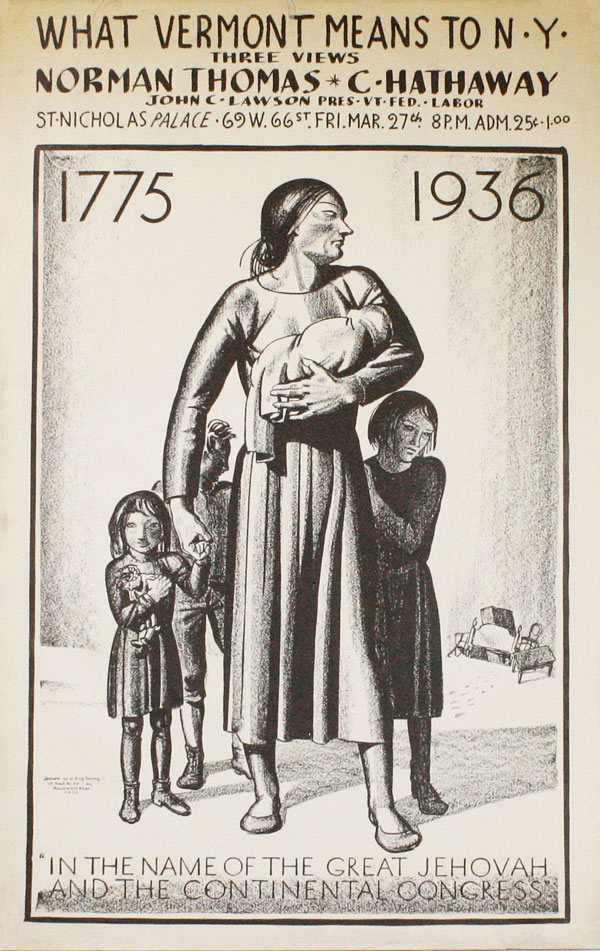
The company got tough on the strikers, announcing that anyone who failed to pay their monthly pension premiums for six months might forfeit their pensions. It also moved to evict strikers who were behind on their rent. The company also declared that strikebreakers could keep their jobs permanently and that it wouldn’t increase its pre-strike employment level. Strikers began to stray back to work, fearing all the jobs would be gone before they returned.
The strike finally ended on July 26, 1936. A federal mediator helped iron out an agreement, which was approved by 86 percent of the strikers. Under the deal, the company said that in returning to pre-strike employment levels, it was willing to rehire union supporters, but also reiterated that it would not fire strikebreakers to create a vacancy for a striker. The company agreed to give workers a year to pay any overdue rent or utility bills. Workers, who had been making 38 to 49 cents per hour, also won a two and a half cent per hour raise.
The conflict that had pitted neighbor against neighbor was over. But for families that had lost eight months’ wages to fight the battle, it was small change.
