

[F]ormer gubernatorial candidate Matt Dunne has found his campaign finances under scrutiny over what appears to be a few thousand dollars worth of improper double donations from a handful of contributors, including some Silicon Valley powerbrokers.
Dunne, a former state senator and representative from Windsor County, raised more than $1 million for his campaign for governor in 2016, finishing second in a Democratic primary won by Sue Minter. In the home stretch of that race, he broke his own pledge not to self-finance and lent his campaign $95,000.
In an effort to pay down that debt, Dunne established a 2018 campaign for governor and raised $33,167, despite not running for office. According to his latest filings with the secretary of state, $21,000 of the funds raised during this year’s cycle were used to pay back the personal loan from 2016.
It’s not unheard of for candidates to lend to themselves during campaigns and then raise money the next cycle to pay themselves back — former Gov. Peter Shumlin’s campaign returned a $275,000 loan to him three years after the fact.
Dunne also ran against Shumlin in that 2010 race, finishing fourth in a five-way primary. He also lost in the race for lieutenant governor in 2006.
Nick Charyk, Dunne’s former campaign manager, said he spoke with elections officers in 2016 to make sure their plan didn’t run afoul of campaign finance laws, which say that campaign funds can’t be used for personal use “other than to reduce personal campaign debts or as otherwise provided in this chapter.”
The issue now is that Dunne, who previously worked for Google, tapped into some of the same donors for his 2018 only-on-paper campaign as he did in 2016.
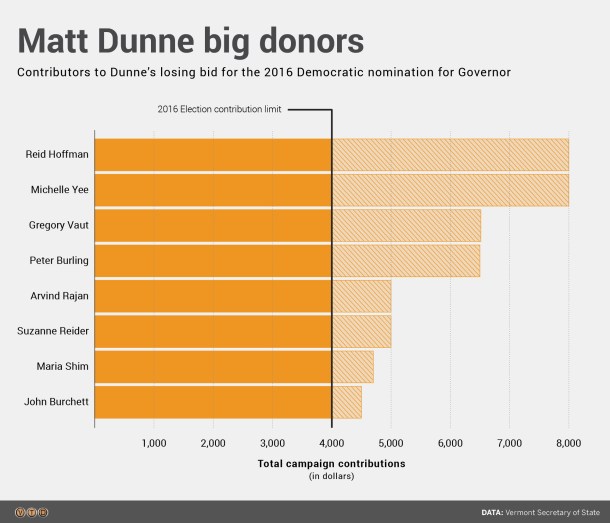
Reid Hoffman, the founder of professional networking site LinkedIn, for example, gave the $4,000 maximum in both 2016 and 2018, as did his wife, Michelle Yee. Google executive Suzanne Reider has given $5,000 over the two cycles, a few hundred more than Google lobbyist John Burchett and Google corporate development officer Maria Shim. Others over $4,000 include Vermont businessman Gregory Vaut and former New Hampshire state senator Peter Burling.
A total of eight donors to Dunne’s campaign are above $4,000 when their 2016 and 2018 contributions are combined, with donations totaling more than $16,000. However, because Dunne has only used $21,000 of the $33,167 he raised in 2018 to pay himself back, just a few thousand dollars are seemingly at issue. The rest of the contributions came from donors whose combined contributions were under the $4,000 individual donor limit for each election cycle.
Charyk said that he and Dunne — who could not be reached for comment Thursday and Friday — believed all of the money raised for the 2018 campaign fund would be counted in a separate cycle, effectively clearing the slate for new contributions. However, an article in Seven Days this week pointed out another statute in the elections law that complicates the matter.
The law says: “A candidate’s expenditures related to a previous campaign and contributions used to retire a debt of a previous campaign shall be attributed to the earlier campaign.”
Charyk said that he only became aware of that provision after seeing it in Seven Days, and was now trying to get clarity from elections officials.
“My reading is that it’s complicated and we need to work with the Secretary of State to figure out the intention of the state and figure out the best way to comply,” he said.
“The statute is fairly clear you can carry campaign debt into a new cycle,” Charyk added. “I think this is an unprecedented particular situation, which is why the statute is confusing.”
Will Senning, director of campaign finance and elections at the secretary of state’s office, confirmed that his office had spoken with Charyk about carrying over the debt to 2018, but said the question of repaying it with some of the same donors hadn’t come up.
If a donor did reach the contribution limit in one cycle and then gives additional money to a candidate to pay back a debt from that same cycle, “that would in theory be a problem,” he said.
Senning said this was the first time the issue had come up, to his knowledge, adding that the office would include a warning about double donations when advising candidates about similar debt repayment plans in the future. He referred specific questions about Dunne’s campaign filings to the attorney general’s office, which enforces campaign regulations.
Natalie Silver, spokesperson for Attorney General TJ Donovan, said the office had not received any complaints about Dunne’s campaign finances, having first become aware of the situation from the Seven Days article.
“That being said, our attorneys are reviewing the law and the finance filing but have not reached a conclusion yet,” Silver said, adding that she would provide an update when a decision was made on how to proceed.
Anthony Iarrapino, a Vermont attorney familiar with campaign finance law, said he hadn’t been aware of the provision at issue for Dunne, but upon reading it, added: “I can definitely concur that it seems like his campaign got on the wrong side of that one.”
And while the situation may be without precedent, he said the Legislature clearly accounted for the possibility of such a scenario, and decided they didn’t want it happening.
“You can see situation where candidate with the wealthiest donor pool … decides to go into debt because they’re confident they can retire the debt as soon as the cycle flips over, because they have that pool of wealthy donors,” Iarrapino said.

