


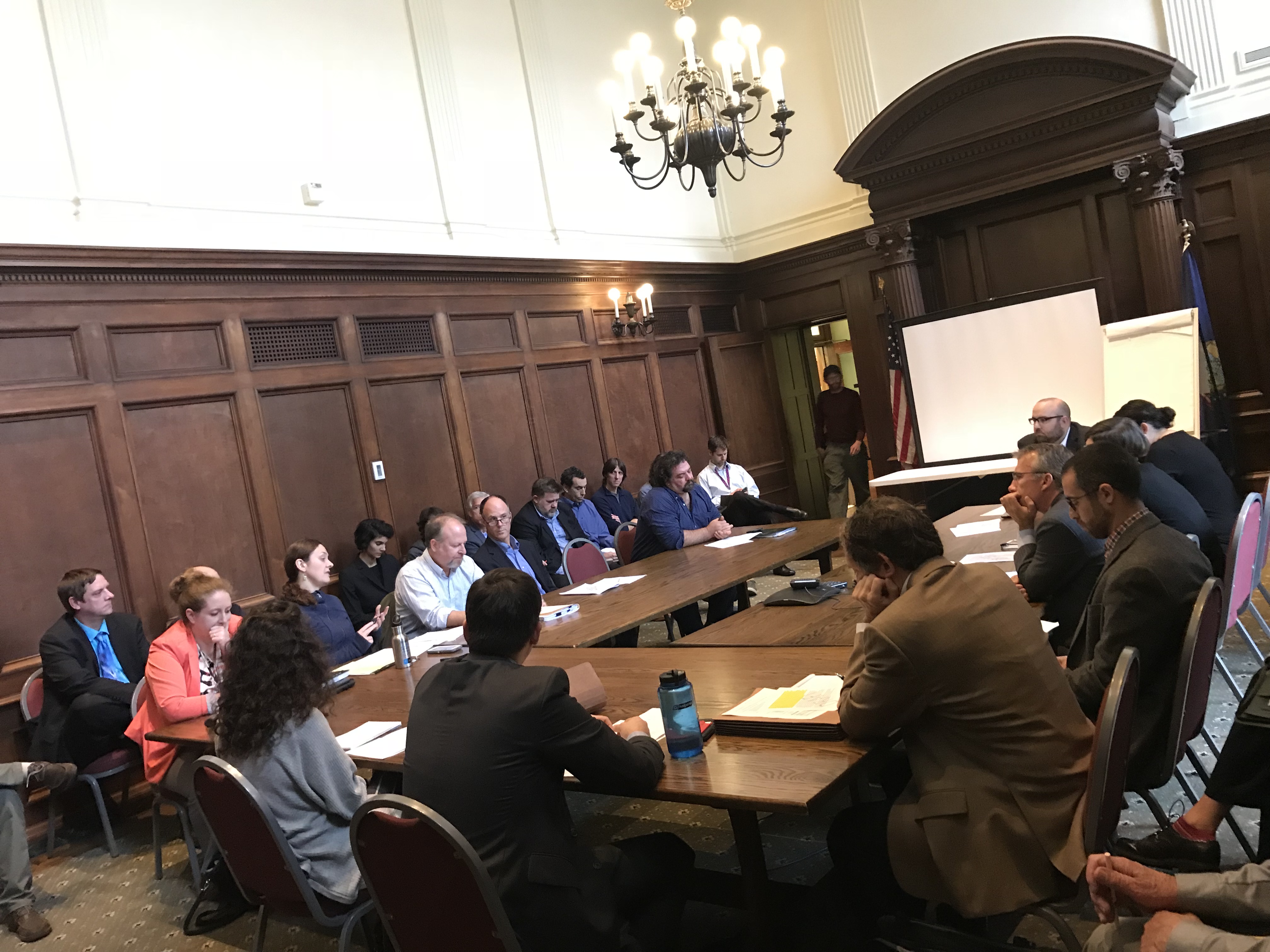
[A]fter months of subcommittee meetings, the full Marijuana Advisory Commission held its final in-person meeting on Wednesday, with the 10 members debating whether edibles — food products with infused cannabis oils — should be included in a regulated market, and the Department of Public Safety pushing for the inclusion of roadway safety tests for impaired driving.
In the two and half hour meeting, the commission, which has been tasked with drafting recommendations for the governor on a legal cannabis market, went over proposals from subcommittees that researched tax and regulation, public safety, and education prevention programs.
The commission hoped to reach consensus on these key areas before issuing a final report to the governor early next week.
While they agreed on a number of recommendations, including a 26 percent tax rate for cannabis, they did not come to a consensus on whether edibles will be included in a regulated cannabis market, if roadway safety tests should be included in legislation, and whether municipalities will be given the authority to block cannabis businesses.
Tom Anderson, commissioner of the Department of Public Safety, said that Vermont must have a roadside impaired driving test before a legal recreational cannabis market is created and that the state will likely see impaired driving rates and roadway deaths increase.

“If the experiences in Colorado and Washington are the experiences we have here, roadway deaths are going to go up, impaired driving is likely to go up,” Anderson said. “So to me it’s critical that we have that tool if we’re going down that path.”
Anderson recommended that law enforcement be given the ability to collect and test saliva both as a roadside and evidentiary test — similar to the current protocol for driving under the influence of alcohol — through legislative action.
John Campbell, executive director of the Department of State’s Attorneys and Sheriffs, emphasized that even if oral fluid testing was made law, it would still have to be ruled on in court before it could be an established tool for law enforcement.
“If we passed oral fluid collection today, it’s still going to have significant hurdles,” Campbell said. “The court will have to decide whether it’s reliable or not. I don’t want people thinking if we passed it today it would be admissible in court tomorrow.”
Sen. Joe Benning, R-Caledonia, argued there is little consensus in the scientific community regarding the relationship between impairment and THC levels in the bloodstream, which can be detected for weeks after consumption of marijuana.
The state doesn’t need thresholds, Anderson said, because a positive oral fluid test for any drug is part of evidence gathering by law enforcement.
“It’s a piece of evidence along with all the other evidence that might be presented in a case and so the idea that we need per se levels I think is simply wrong. It is evidence,” Anderson said.
Anderson also said that the legal market will result in a change to the search and seizure laws in Vermont. He said he was unsure exactly how, but expects it to change as criminal cases go through the justice system.
“We anticipate that it will change if we go to a tax and regulate, even now with small amounts of marijuana I think it’s going to change,” Anderson said.
Mark Levine, commissioner of the Department of Health, said he was concerned by the impact edibles will have on young adults and recommended that those products not be included within the legal marketplace.
“We felt strongly, knowing that it would cause some controversy, that edibles should not be part of the bargain,” Levine said.
Levine said the subcommittee determined that edibles, which have high potency and could be attractive to children, should not be sold in Vermont.
Anderson and Campbell agreed with Levine’s recommendation.
Jake Perkinson, co-chair of the commission, dissented, saying edibles make up a large part of cannabis sales in states that have already legalized, and that not including those products in a recreational market would create an illicit trade for edibles.
The central reason for creating a legal framework for marijuana sales is to destroy the illicit market, he said.
“I think the reality is the increased cannabis sales is, a large part of it anyway, is due to edibles,” Perkinson said, “They would be subject to regulation and if not they would be part of the illicit market by default and we would end up in much the same situation that we are now with respect to cannabis in general.”
Craig Bolio, deputy commissioner of the Department of Taxes, said he worried that without sales from edibles, the tax revenue would take a significant hit, which could result in the need to cut regulatory infrastructure.
“I do worry slightly as well that given our budgetary pressures, if we didn’t include edibles, I’m not sure what of the infrastructure could be scaled back from not having edibles,” Bolio said.
Anderson replied that he did not think there was an illicit market for edibles and that the state would be creating the market.
“I would question the existence a black market,” Anderson said. “I think the potency and the danger of edibles, they pose a unique problem and I get the tax revenue but the fact we could lose tax revenue does not seem like a valid public policy reason.”
In a straw poll, Anderson, Levine, Assistant Attorney General David Scherr, and a representative from the Agency of Commerce and Community Development office voted against including edibles in the recreational market.
Rep. Maxine Grad, D-Moretown, Benning, Commissioner of Taxes Kaj Samson, and Secretary of Agriculture Anson Tebbetts voted in favor of including edibles.
The commission agreed to recommend to the governor that the state begin data collection on cannabis related crimes, quality of life complaints, cannabis arrests, cannabis related traffic accidents, impaired driving, and other related data points.
A final report will be sent to the governor Monday.
