


This story by Jordan Cuddemi was published by the Valley News on Dec. 4.
[C]armen Tarleton had been doing remarkably well.
The 50-year-old former Thetford resident, who suffered disfiguring burns and a loss of vision in a chemical attack by her estranged husband in 2007, recently moved to Manchester, New Hampshire, in a bid to live more independently. Tarleton, who had been living in Fairlee, Vermont, prior to the February move, found what she was looking for in New Hampshire’s biggest city. Despite being completely blind in her right eye and partially blind in her left, she could freely navigate the city on foot, stopping at the store for groceries whenever she pleased, or swinging by the laundromat without requiring help.
But three weeks ago, that all changed suddenly.
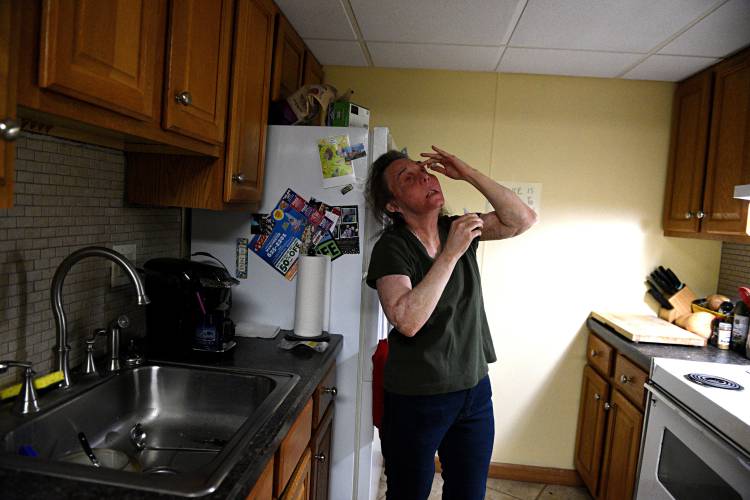
On Sunday, Nov. 11, she awoke to find her eyesight — and her newfound independence — was slipping away. Around 5:10 a.m., she awoke and cleared her eyes as she ordinarily would, only to notice that she could see less light than normal.
She immediately sought medical care, but hours later, she was completely blind — again.
Doctors told her that the synthetic cornea transplant that partially restored sight to her left eye had failed. Doctors performed surgery to remove the synthetic cornea and they replaced it with a temporary graft.
It was another setback in Tarleton’s 11-year quest to rebound from the mental and physical trauma she suffered.

“It was shocking. I was honestly pissy,” Tarleton said in an interview on Tuesday, acknowledging that she thought the synthetic cornea implanted in her left eye in 2009 would last her lifetime. “I didn’t like that it happened. I have just been so motivated and inspired to be independent.”
Over the past few weeks, she’s had to relearn how to perform daily tasks, such as finding the correct keys to press on her cellphone. Her sister, Kesstan Blandin, who lives in Florida, has moved in with her temporarily to help out.
Tarleton said losing her eyesight has been frustrating. But in typical fashion, she remains hopeful that another synthetic cornea transplant surgery could help her regain her eyesight and restore her independence.
Several matters are complicating the prospect for that procedure though. Scarred and in pain, Tarleton in 2013 received a full facial transplant, something that has positively changed her life but that makes future surgeries riskier.
She is on immunosuppressant medications, so her healing process isn’t like that of a healthy adult.

Her left eye also has been through a lot, including the initial trauma, multiple surgeries and infections.
Tarleton goes back to the doctors on Thursday and is hoping to be told that her eye is healthy enough for another surgery. However, if that isn’t the case, she said, she will learn to live with it.
“I am just trying to be realistic,” Tarleton said. “I am hopeful, but let’s wait and see, that’s what I keep telling myself.”
Even if she gets the surgery, there is no telling whether she will regain her sight again, she said.
Tarleton has sought to stave off total blindness since 2007, when the lye used in the chemical attack forever damaged her eyesight. (Her ex-husband died in prison last December while serving a 30- to 70-year sentence.)
A year later, doctors performed her first synthetic cornea transplant in her left eye, a procedure that didn’t take as well.
In 2009, doctor’s performed transplants on both eyes. She initially had good results, but later became completely blind in her right eye, with no potential to regain her sight.
After her latest setback, Tarleton reached out to the state Department of Education’s Bureau of Vocational Rehabilitation.
Under financial stress, she said she hoped the state would help set her up with a specialty computer designed for the visually impaired as well as the software she needs to navigate the device, something the state of Vermont helped her with in the past.
Having that will allow her to do job training, among other things, so she can earn an income to support herself.
In New Hampshire, she said, she sits at roughly 500th on a list of 1,000 people with disabilities who are seeking services.
There were 1,007 people on the list as of Nov. 27, according to the Department of Education.
Department of Education spokesman Anthony Schinella said he couldn’t comment on individual cases, or just what type of disability gets a person to rise to the top of the list.
Earlier this year, Commissioner Frank Edelblut announced a restructuring of New Hampshire’s Vocational Rehabilitation after he discovered “overspending by the previous bureau’s leadership,” according to an April news release.
In addition to overspending, a decrease in federal grant money and lower Social Security reimbursements played into the decision to restructure the agency, which would have run a deficit if changes weren’t made, the release states.
The Department of Education in May announced that existing customers would be served, and that new customers would be wait listed and placed into one of three categories to be served in that order: most significant disabilities, significant disabilities and less significant disabilities, according to a subsequent news release.
Last week, the Department of Education announced that 200 of the roughly 1,000 people on the list had been served since September.
Tarleton said she hopes she can get the assistance she needs.
“Why do people like me pay the price?” she said. “We are just not numbers on the budget.”
Since moving to Manchester, Tarleton said, she has changed her diet, lost 20 pounds and practices yoga. She also has been writing her second book, something she has set aside while she focuses on ways to earn a consistent income.
Tarleton had earned money traveling the country to share her story, but that work has slowed down, in part, because of her health.
“I am really focused on staying independent, regardless of my sight, and learning a new job skill to help myself financially so I can stay independent,” she said.
She and her sister have started a GoFundMe page to help cover monthly living expenses, new medical costs and expenses that come from her loss of sight. The website can be found at bit.ly/2AQLG5k.
