

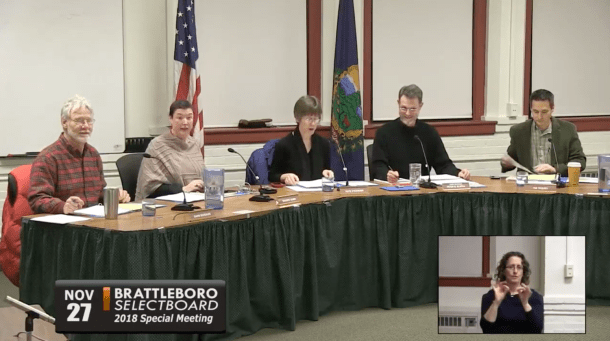
Community Access Television managers in Vermont are mobilizing to protect the small, local stations that provide residents with local government programming.
At stake is future programming at Vermont’s 25 independent, nonprofit Public, Educational, Government Access Management Organizations, or PEG AMOs, which provide coverage of city councils, select boards and other local government meetings. The PEG access centers run 66 full-time, commercial-free channels that also offer other local programming.
Cable companies are required by federal law to provide communities with use of one of these access channels. But the Federal Communications Commission has proposed to let cable companies place a monetary value on these services and deduct that cost from the franchise fees they pay to cities.
The result would be a cut in funding and a sharp blow to an institution that helps keep government meetings open and helps Vermonters stay informed, say advocates for the local channels.
“Our meeting coverage in general — city council, select boards, school boards, development review — is our most-watched programming; that’s what we get comments on the most,” said Kevin Christopher, executive director of Lake Champlain Access Television.
“The danger is all of that going away, and the transparency we provide, the connection to the community we provide, disappearing entirely,” he added.
Public access channel managers all over the U.S. have mobilized against the proposal. Vermont would be hit particularly hard because it has the most such channels per capita, according to the Vermont Access Network, which represents the state’s AMOs.

“Vermont is a stronghold,” said Lauren-Glenn Davitian, the executive director of CCTV Center for Media and Democracy, which advocates for public access to cable and all telecom networks. The center operates Channel 17/Town Meeting Television, a regional government access media center in Chittenden County.
“We have this unbelievable ecosystem of community media. It’s a good indicator of Democratic health,” she said.
The eight selectboards in the towns served by Brattleboro Community Television have come to rely on the service that the TV outlet provides, said Executive Director Cor Trowbridge.
“We have a close relationship with all the select boards because one of our camera operators is there every single time they meet, and has become an integral part of their production,” she said. “In some cases they use the video to take minutes, or to verify what somebody might have said.”
Community media operations use several different funding sources, according to Alliance for Community Media, an advocacy group that represents more than 3,000 PEG access organizations, community media centers and channel programmers nationally. The funding sources include franchise fees, PEG support payments, grants and individual donations.
Davitian said there have long been tensions between the PEG channels and cable companies, especially Comcast, which dominates Vermont’s local cable market.
“They don’t want to be told what to do, especially when it comes to their set top boxes, which is where all the intelligence of their network is,” she said. Other initiatives have come close to eroding funding for the local access channels, she added. But never this close.
“We’ve had a more favorable FCC in the past. Not great, but not this,” Davitian said.
Supporters of the change include groups like Council for Citizens for Against Public Waste, which filed a letter with the FCC in September saying that by requiring cable companies to offer access to the PEG channels, the commission was stifling competition and raising prices for consumers.
Channel managers earlier this fall asked viewers and politicians to file comments with the FCC showing opposition to the proposal. The initial filing period ended Nov. 14, but managers are asking supporters, particularly politicians and organizations, to file under “reply comments,” a category open through Dec. 14.
Christopher said his channel’s latest call for letters had yielded a few replies that he has filed on behalf of state lawmakers. Among other things, he said Vermont Access Network would ask U.S. Rep. Peter Welch, D-Vermont, to write a letter of opposition, similar to one published in September by U.S. Sen. Ed Markey, D-Massachusetts, and signed by Vermont Sens. Bernie Sanders, an Independent, and Patrick Leahy, a Democrat.
The issue is non-partisan, said Lynn Wurzburg of St. Johnsbury, a member of the League of Women Voters who has publicized the issue locally.
She said the PEG channels have become more important as other common local media sources wither.
“A lot of people watch these local stations; it’s a really direct way to get local information out there,” she said. “So many people read online media and don’t have a common local newspaper they read; to eliminate that would be definitely be a loss for the communities.”
Editor’s note: Lauren-Glenn Davitian is the wife of VTDigger editor Mark Johnson.
