


[S]tate regulators are considering a proposed budget of more than $900 million for Colchester-based OneCare Vermont, reflecting substantial growth in the third year of the state’s experiment in health care payment reform.
Administrators say the $257 million budget increase for OneCare – the limited liability corporation and accountable care organization that is managing Vermont’s all-payer model – reflects an increase in the number of health care providers and Vermonters participating in the initiative.
The all-payer model, based on a 2016 agreement between Vermont and the federal Centers for Medicare & Medicaid Services, is an attempt to contain health care costs and boost quality. The agreement runs from 2017 to 2022.
Four insurance programs – Medicare; Medicaid; Blue Cross and Blue Shield of Vermont; and University of Vermont Medical Center’s self-funded employee insurance plan – will again be involved in OneCare in 2019.
Officials are steering the health care system away from the current fee-for-service model – where providers are paid based on the number of services they perform – to a model in which doctors and hospitals who opt into the system receive a regular, predetermined payment from insurers. The shift in payment models is designed to put a premium on preventive medicine and improving health outcomes.
Michael Barber, the Green Mountain Care Board’s chief of health policy, said insurers are making “population-based payments, where providers accept responsibility for the health of a group of patients in exchange for a set amount of money.”
“The hypothesis is this will be a more predictable and sustainable financial model for payers and providers, will spur providers to work together in new ways and will give providers flexibility to make choices and investments that make sense for their patients but might not have made sense – financial sense, at least – in the fee-for-service world,” Barber said.
As the Green Mountain Care Board considers OneCare’s spending proposal prior to a vote in December, debate continues about whether the all-payer model is on the right track. Some say OneCare is not providing enough information about its operations, and state statistics show that the organization has not met growth targets.
Participating hospitals agree to a risk/reward model to cover fluctuations in the cost of health care, and that includes an amount they’ll be responsible for if costs exceed the predetermined payment. The idea is to contain annual growth of health care costs to no more than 3.5 percent.
There is also an emphasis on boosting health care quality: Some funding in the all-payer system is tied to quality measures that OneCare’s programs are supposed to meet.
Additionally, the state has set three specific health goals for the all-payer model. They are reducing chronic disease; reducing deaths due to suicide and drug overdose; and increasing access to primary care.
OneCare Vermont, which was created by University of Vermont Medical Center and Dartmouth-Hitchcock Medical Center, is supposed to be the vehicle for those changes. And the organization’s proposed 2019 budget shows that vehicle gaining momentum.
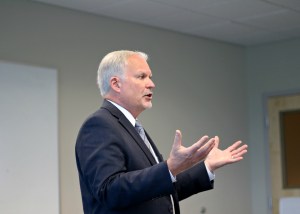
Todd Moore, OneCare’s chief executive officer, says the company is changing the dynamics of the health care industry.
“We’re still early in this all-payer model, and it continues to be quite a worthwhile but complex journey to understand how this should work and will work,” Moore said at a hearing in October.
The biggest piece of that budget is the projected “total cost of care” – that is, the amount of money flowing from insurers to providers. That number is $850.7 million in 2019, up from $607.2 million in OneCare’s budget for the current year.
The number of participating hospitals is increasing from 10 this year to 13 next year, as Rutland Regional Medical Center, Northeastern Vermont Regional Hospital and Gifford Medical Center have signed on for Medicaid-related services only.
Additionally, two hospitals that already had been affiliated with OneCare – Southwestern Vermont Medical Center and Mount Ascutney Hospital – are expanding their participation from Medicaid-only into other insurance programs.
OneCare is expecting tens of thousands of new “attributed lives” – or participating patients – to be involved in the accountable care organization next year. For example, state statistics project that there will be roughly 79,000 Medicaid customers participating in the initiative next year, up from about 42,000 in 2018.
However, OneCare administrators say patient-attribution figures are only a “best guess” until those numbers are finalized in January.
There are significant differences between estimates of the program’s size for 2019. The Green Mountain Care Board has projected that the number of patients participating in OneCare at a total of 196,418 next year. OneCare’s budget, however, is built to serve a smaller population of 172,365.
About 25 percent of the OneCare budget would flow as monthly, fixed, pre-payments from insurers to OneCare and then to hospitals.
The other 75 percent will be handled through the traditional, fee-for-service payment model in which providers are reimbursed for each treatment.
OneCare doesn’t touch the fee-for-service money, though administrators say it is still within the organization’s “scope of accountability.” A year-end reconciliation is based on a spending target for all of the monies that pass through the for-profit organization.
Eventually, all-payer program proponents want to see much more money move into the fixed-payment category. “Part of our strategy is to continue to evolve payment mechanisms and methodology away from fee for service,” said Tom Borys, OneCare’s director of finance.
The other, much smaller part of the OneCare budget proposal is $53.2 million allocated for operational costs and “population health management” spending.
That latter category covers a host of investments that are supposed to further the all-payer model. Examples include support for primary care practices, care-coordination services and home-based services for the elderly and those with special needs.
OneCare’s budget presentation to the Green Mountain Care Board shows population health management spending increasing by roughly $10 million to $37.2 million in 2019.
OneCare’s operating costs are proposed at $15.9 million next year, an increase of $3.4 million. Administrators say this represents “thoughtful growth to operations in order to accommodate an expanded network.”
A chunk of that increase also is tied to OneCare integrating RiseVT into the accountable care organization. RiseVT, a collaborative promoting healthy living and reduced obesity that started several years ago in Franklin and Grand Isle counties, is in the process of expanding statewide.
All of this adds up to a much larger accountable care organization with a much larger budget in 2019. But growth doesn’t necessarily equal success, and state officials say the jury’s still out on whether the all-payer model is succeeding.
Michael Costa, deputy commissioner of the Department of Vermont Health Access, said the state has seen encouraging results from Medicaid participation in the all-payer program. That includes more financial predictability for Medicaid and an upswing in patients’ primary care office visits.
“I think one of the most difficult parts of this program is that it’s going to just take time to understand its impact and performance,” Costa told the Green Mountain Care Board at a recent meeting. “We want to urge people to exercise real caution with how they interpret these results, because it is just far too early to take the experience we have and draw any medium- or long-term conclusions.”
But OneCare is significantly behind on meeting growth targets set out in the all-payer agreement.

Only about 50 percent of eligible Medicare recipients and 35 percent of all eligible people will be connected with the accountable care organization in 2019. The targets, however, for next year are 75 percent for Medicare and 50 percent for the entire eligible population. Those numbers continue to increase over the life of the agreement: By 2022, at least 70 percent of the eligible population is supposed to be participating in all-payer.
Officials stressed that the program is and will remain voluntary for health care providers.
“The state is merely creating the opportunity for health care providers to work together in a different way,” Costa said. “But the (accountable care organization) is a coalition of the willing, and providers have to choose this program themselves.”
OneCare says it is working to increase scale.
“It’s an important measure to pay attention to,” Borys said. “That said, this is a new and progressive journey, and it takes time to develop a network and get the (patients) in. And probably even more important … is getting all the payers on board with this model.”
The care board’s review of OneCare’s budget – which includes a public comment period that extends to Dec. 10 – has spurred both supporters and critics to speak up about the all-payer program.
Meg Hansen, executive director of the conservative policy group Vermonters for Health Care Freedom, questioned the efficacy and the proposed expansion of OneCare’s care coordination, health information technology and prevention programs.
Hansen has argued that the care board should not vote on the budget “until OneCare’s leadership offers candid and comprehensive responses to the many unanswered questions raised by public advocates.”
The state’s Health Care Advocate also has filed a detailed criticism of OneCare’s accountability and transparency. Additionally, the advocate’s office says “OneCare’s activities and 2019 budget proposal do not meaningfully address Vermont’s health care affordability crisis.”
Without making more of an effort to contain the growth rate in commercial insurance premiums, “OneCare will simply be a new bureaucracy funded by already struggling Vermonters,” the advocate’s office said.
Meanwhile, supporters are praising OneCare’s performance.
Molly Dugan, director of the statewide Support and Services at Home program – which is involved in all-payer – said OneCare has been “responsive, accessible and highly supportive.” That includes funding for a pilot project that embedded a mental health clinician in two downtown Burlington housing sites, Dugan wrote in a comment filed with the care board.
And John Sayles, chief executive officer of Vermont Foodbank and a member of OneCare’s board of managers, told the care board that his organization is “proud to be involved” in a St. Johnsbury project “that will test the role of local innovation” in the all-payer model next year.
“Improving the health of Vermonters and bringing down the cost of health care requires a full commitment to change and innovation,” Sayles wrote. “We hope that full support for OneCare continues in 2019 and beyond.”
The Green Mountain Care Board is scheduled for potential votes on the OneCare budget at meetings on Dec. 12 and Dec. 17. Related documents are available on the board’s accountable care organization budget page.
