

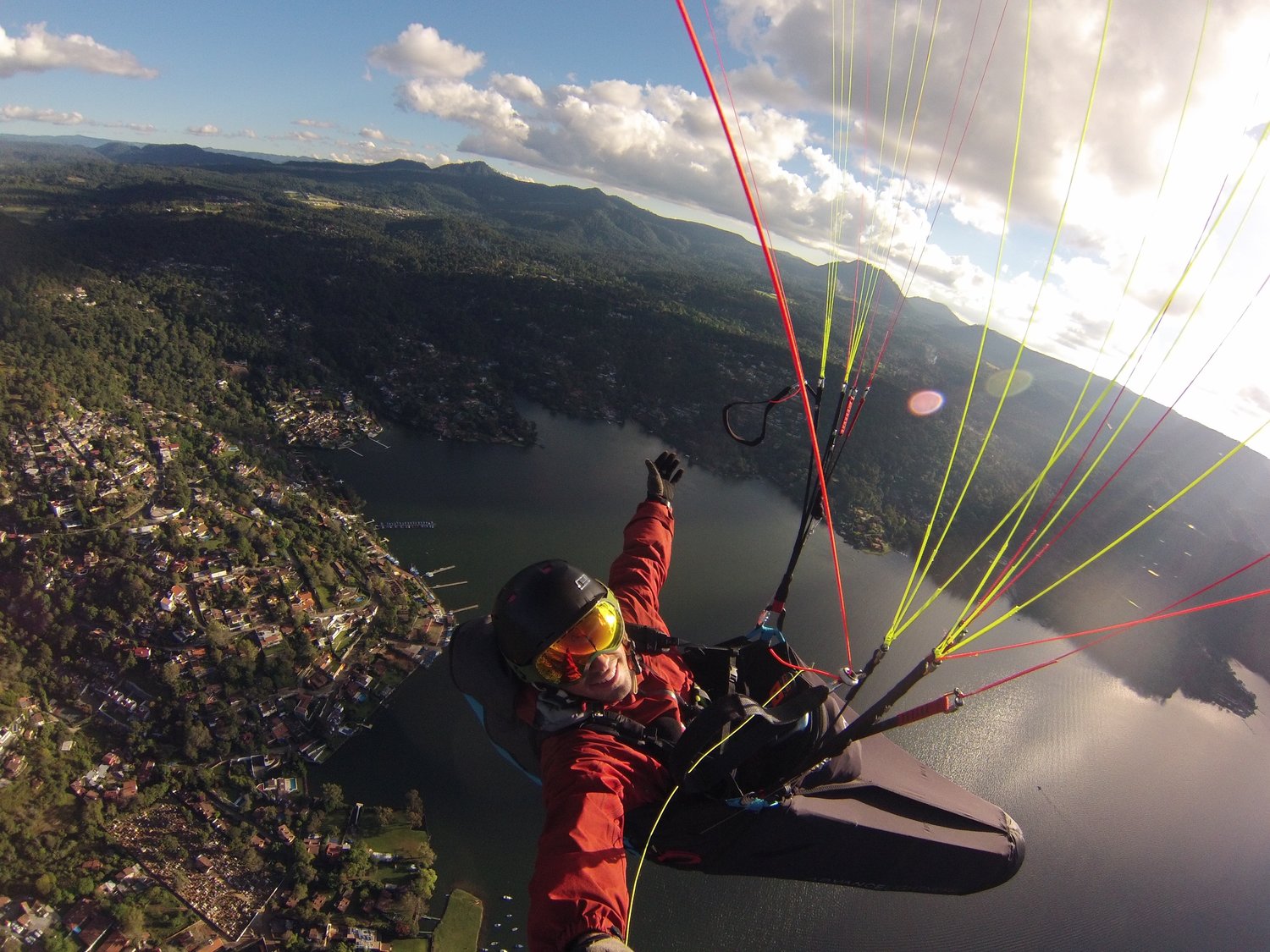
[I]t’s not easy to get liability insurance when you’re a paragliding company that takes students through maneuvers thousands of feet above Lake Champlain.
“It’s not low-risk stuff,” said instructor Calef Letorney, who owns Paraglide New England in Westford. Letorney carries a $2 million liability policy.
The national paragliding and hang gliding industry has had so much trouble getting insurance that two years ago it started its own insurance subsidiary, an entity known as a captive insurance company, that is domiciled in Vermont and includes members from around the U.S. The subsidiary, called the Recreation Risk Retention Group, has the unwieldy task of insuring companies that send customers into the air on flying devices such as hang gliders and paragliders.
The RRRG is one of about 600 Vermont-based captive insurance companies, part of a small and little-known niche business in which Vermont is a national leader. With captive insurance, one or more insurance clients create their own insurance company.
Hang gliding and paragliding are a good fit for a captive because they’re difficult to insure on the open market. Certified members of the industry used to buy their insurance together from Lloyds of London, said Letorney, but over the years, the rates kept rising, and eventually Lloyd’s dropped the industry altogether.
The new captive insurance firm was created in 2016 “because nobody was going to provide the insurance we needed,” said Letorney. “As far as we know, we’re providing the best coverage that doesn’t have a million loopholes designed to not protect anybody.”
Over the years, Vermont has positioned itself as a welcoming domicile for captive insurance subsidiaries, and now hosts a captives industry with an estimated $200 billion in assets. In Vermont, the industry employs about 500 people working in subsidiaries created by giants such as Starbucks, Disney, Planned Parenthood, Goodrich, Toyota, and Alcoa. The National Football League, Major League Baseball, CVS, Chevron, Boeing, and Hallmark Cards have or have had captive subsidiaries in Burlington, said David F. Provost, who is the deputy commissioner for captive insurance for the Department of Financial Regulation.
Like the hang gliding and paragliding industry, organizations with very large liabilities, like the Catholic Church, also have trouble finding insurance.
“There comes a point where the insurance companies don’t want you,” Provost said. “It’s a tradeoff between how much it costs you to transfer the risk to somebody else, vs. how much control you have by keeping the risk yourself. Companies figure out what they are likely to have for losses, and they might as well keep it because the insurance company will charge you the same thing.”
Vermont’s a quiet captive haven of sorts, third in rank by the size of its industry after Bermuda and the Cayman Islands, Provost said. Vermont has 18 state-approved captive management firms managing one to 100 captive insurance companies each, he said.

Provost couldn’t identify a clear reason for Vermont’s dominance in the industry. Thirty-eight other states have laws governing the creation of captives. Timing played a role when the Vermont Legislature set up a structure for captives in 1981, he said.
“We just happened to do it right,” he said. “We funded a staff, and we got a little bit lucky. Not long after we passed our law, the insurance market went into a crisis, and you couldn’t buy insurance at a reasonable price, so companies were forced to go to the alternative market.”
Letorney said his group chose Vermont because of its strong oversight.
“They looked at all the different hubs, and they really liked Vermont’s track record,” he said. Vermont-domiciled captives are required to have at least one Vermonter on the board, so Letorney was invited to join. “Yes, the insurance regulators in Vermont are gatekeepers that provide challenges, but they’re motivated to keep us solvent and in business, so rather than viewing that as a negative thing, we really embraced that.”
He added RRRG has an incentive that Lloyd’s didn’t to properly manage and mitigate its risks. Lloyd’s, he said, tended to settle cases quickly because that was easier than fighting claims, and that raised insurance rates.
“They settled all sorts of stuff that our lawyer would not have settled, which just makes our actuarial rates worse,” Letorney said. “We wanted to have control of our fate in terms of how we handle claims.”
Vermont’s captive industry grew rapidly until about 2000, when other states started putting their laws in place, increasing the competition. Now it has hit a plateau. That might change as autonomous vehicles take off. The vehicles create specialized risks that are difficult to underwrite, according to industry experts.
Provost sees general risks and liabilities rising, making captives more attractive.
“Around the world, large companies have such huge insurance bills that this is a tool for helping manage that,” he said. “Once you figure out you’re giving a million dollars to an insurance company to get $900,000 back, owning your own insurance company makes sense.”
Chuck Smith, who owns the paragliding company Fly Sun Valley in Ketchum, Idaho, said his industry thrives on the perception of risk.
“There are really not many places to go to get insurance,” Smith said. “Paragliding and hang gliding certainly have a perception of being high-risk. Whether that is true, that’s debatable.”
Correction: DFR deputy commissioner David F. Provost was interviewed for this story, not commissioner Michael Pieciak. Also, the caption on the photo has been corrected. The photo is not of Lake Champlain, it was taken in Mexico.

