


[A]fter 30 years as state botanist, Bob Popp has come to know Vermont’s topography the way few other people do.
In the summer months, Popp collects plant samples from the state’s mountaintops, lakeshores, riversides, meadows and forests. He stashes the samples between layers of newspaper, and in the winter months identifies them under a microscope.
One of Popp’s tasks is to submit information for a national database of plants. That database is used to populate Vermont’s Natural Resources Atlas, a tool managed by the state’s Agency of Natural Resources for developers, consultants, town planners and others to see where on a property there might be rare or endangered plants. The Department of Fish and Wildlife, where Popp works, also has a state database that is linked to a national database available for botanists around the country to see what is growing in other states.
Popp grew up in Queens and spent a short stint at Columbia University studying engineering before he discovered a love of botany while working as a camp counselor in New Hampshire.
“I loved being outside in nature, and identifying things and observing things, and it was like, ‘Wow, people get paid to do this?’” Popp said. “The light went off.”
He went on to get an undergraduate degree in botany at the State University of New York in Syracuse and did graduate work in plant ecology in Colorado and Massachusetts. He also spent a year in Kenya with a research team from the National Science Foundation. Popp joined the Vermont Fish and Wildlife Department in 1989 as the state’s first botanist, at the same time that the department also added a zoologist and a database manager.
VTDigger recently spoke to Popp about his work. The interview has been edited for length and clarity.
VTDigger: How do people use the plant database?
Bob Popp: A developer building a project can go on the Agency of Natural Resources website and look at the natural resource map. If you click on “threatened and endangered species” it shows areas where there are plants or animals that are rare, threatened or endangered. There are people who go out to town planning commissions and conservation commissions and show them how to use this.
All it will say on the atlas is “rare plant.” It’s kind of a Catch-22 because we want our information out there, but we can’t say exactly what species it is on the map because there could be unscrupulous people who would dig up, say, the rare ram’s head lady’s slipper.
So the atlas gives you an identification number for the rare, threatened or endangered species, and the developer or forester can call up and say, “Rare plant ID 529 came up; can you tell me what it is?”
I always do tell them, if it’s a landowner or developer or a forester doing forestry management plan. We want the information to be used.
VTD: Does Vermont have any plants that no other state has?
BP: Actually, yes, one — Green Mountain quillwort.
It was discovered four or five years ago, so it’s brand-new to science. It is three inches high and grows in shallow water. A retired high school physics teacher from New Jersey who moved to Vermont named Michael Rosenthal found this plant – I probably shouldn’t tell you in which lake – in southeastern Vermont. He’s a fantastic fern person with an amazing website. He collected some and tried to identify it and couldn’t. This guy is very good, so the fact that he couldn’t identify it was significant. He sent it to an expert out in Michigan, and the guy who looked at it said, “This is a brand new species.”
Rosenthal took me out to the site. He went out to a lot of other lakes and couldn’t find it again.
VTD: In your nearly 30 years on the job, what has changed?
BP: When I first started, I would get developers saying, “What? Some stupid rare plants can just stop my project?” People are aware now they can’t just build where ever they want to. They’ve always been aware they have to avoid wetlands, but now they have to avoid significant natural communities.
It’s hard to say if developers are supportive, or just accepting. Now they’ll go to the Natural Resources Atlas and call me and say, “There’s a rare plant on my project, what do I need to do?” They know it’s the cost of business in Vermont.
I mean, it does make it hard for developers, I acknowledge that, but development should accommodate for the impact it has on the environment.
As far as the environment goes, 29 years is just not even an eye blink in the course of history. In that period of time, the growing season has increased significantly. When I first started, my field season would end by late September. We’d get killing frosts and there would be no more plants to look at. Now I go into mid-October every year.
VTD: What do you tell people who ask you why plants are being protected?
BP: I tell them it’s a couple things. We have something like 161 species of plants listed as endangered or threatened on the state endangered species list. We have three that are on the federal list.
Eighty percent of the endangered or threatened plants are edge-of-range species. That means it is are more common elsewhere and in most cases we’re on the northern edge of the range. Or we are on the eastern edge of the range, and they are a Midwestern prairie species. They’re rare in Vermont, but common once you get out to the prairies, so people ask, “Why are we protecting these?”
What science has shown time and again is species on the edge of the range tend to be more genetically diverse than things in the center. That’s where evolution occurs most rapidly, especially in terms of climate change. If anything, if we’re at the peripheral on the north, those are the species that are going to be important to move the population north as the climate shifts.
Also, we protect them because they are part of our heritage. It would be like saying, “Who cares about Mount Mansfield, because we have the White Mountains on one side and the Adirondacks on the other?” This plant is a native that has always been here, so who cares if it’s common elsewhere? It’s part of Vermont’s heritage, and who are we to say it’s not important and shouldn’t be protected?

VTD: Is rare necessarily a bad thing when it comes to plants?
BP: No, not in and of itself, but the problem with rarity is threefold.
There have always been plants that are intrinsically rare, but the threat they are facing has increased exponentially due to habitat loss and destruction by human development. Invasive species and global warming are the other threats.
Some populations are declining, and we are doing some augmentation of populations. We’ll put plants out to kind of keep it going, but we only do that with super rare plants, and we only do that under very rigorous conditions, and we document everything we do.
Jesup’s Milk-vetch is one of the rarest plants in Vermont; they are only known in three places in the world, one in Vermont, along the Connecticut River, and two in New Hampshire. We are augmenting two declining populations; we got seeds and worked in conjunction with the New England Wildflower Society. We control everything we do and count it and see if it is working.
When I talk to garden clubs, people ask, “Shouldn’t we be getting seeds and going out in the wild and planting them?”
I get that people want to help, but we collect seeds from that population, whereas if people were to do this on their own, they might be getting plants from who the heck knows where. You can buy some of these things in catalogues and nurseries, probably the seed source is from the Midwest, so you’re taking plants adapted to Ohio and sticking them in Vermont. Do you really want that to reproduce and spread its genes?
I tell people that with most of these plants – and there are exceptions – they are rare for a reason. The ram’s head lady’s slipper is very specific to calcareous bedrock. It has always been rare, it is intrinsically rare, and it shouldn’t be more common. In all likelihood, if you tried to plant more, it wouldn’t survive.
VTD: What is the solution to the problem of invasive species?
BP: We have two options. We’re not going to eradicate them, so what I would suggest is you do what’s called early detection, rapid response. In Vermont, we treat those areas with herbicides, very carefully obviously.
If a new invasive is just coming into the state, before they can get a foothold and increase exponentially, that’s the time to hit them. When it’s really threatening a rare or endangered plant you have to control it.
Once they’re established it’s too late. With swallow wort, forget it.
VTD: What effect has global warming had on Vermont’s plants?
BP: It’s more of a factor with insects, like the Hemlock woolly adelgid, which attacks hemlock trees. That is just making it into Vermont, because it’s been too cold. If we get a really, really cold snap it kills 95 to 99 percent of them and knocks it back. We just don’t have it as cold as long as we used to.
There’s a new beetle in Massachusetts, the southern pine beetle; I don’t know if it’s in Vermont yet. And there are a lot more invasive plants to our south than our north. Maine has fewer invasives than Vermont does, and Massachusetts has more.
A hot dry summer isn’t going to eliminate any rare plant, but a series of hot dry summers is going to cause a decline. So there might be increased mortality, or maybe there will be decreased recruitment, so in other words the seedling might not be able to make it.
Say it’s an annual plant but has poor reproduction that year. The next year, you have an OK summer, and then the next two years are hot and dry. It’s like a downward trend, with the plant just not reproducing and sustaining itself.
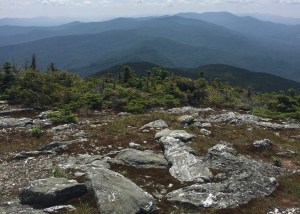
With our alpine plants, the temperature is not a direct factor. Having a warmer summer or warmer winter isn’t going to do in any of our alpine plants. What is going to happen is that less tolerant species that normally grow at lower elevations are now going to be able to survive at higher elevations; these plants are typically better competitors. Alpine plants are not good competitors but they are good at handling adverse conditions. So when adverse conditions are mollified a bit and are not as severe, other plants that are better competitors can start living there and it’s an uneven playing field.
So what I tell people is, as the climate warms, our alpine species are essentially going to be pushed off the mountain with nowhere to go. It’s not like they can migrate north; they’re on islands in the sky.
Down in the Smoky Mountains, there’s a 7,000-foot peak and all these really rare plants just have nowhere to go. This brings up assisted migration, which is very controversial — I’m not saying I support this — which is taking a plant from the Smokies and planting it on Mount Mansfield because it’s not going to survive anymore in the Smokies. People are doing that because they don’t want these things to go extinct. I think we should be talking about it; I don’t think we should be doing it yet. Some people don’t even want to talk about it.
VTD: Do you feel as though you have to be an advocate for plants in your job?
BP: Plants are the 1 percenters, but we’re the bottom 1 percent.
There are maybe 15 wildlife biologists in the state, and one botanist. There is virtually no federal funding for plants. When people buy a hunting license, motorboat fuel, a rifle, ammunition, the tax on it all goes back to the states. There is nothing like that for plants. The only money we get from federal government for plants is for two federally endangered plants, the Jesup’s Milk-vetch and the northeastern bulrush.
VTD: Is this because plants aren’t as charismatic as, say bears?
BP: There’s a long, long history of this with plants. It goes back to English Common Law or something, where plants were considered to be the property of the landowner. So under the federal endangered species statute, if you shoot or harass a bald eagle, you get a big fine. If you rip out a federally endangered plant, there is no federal jurisdiction unless you do it on federal land. In the National Forest, you can be prosecuted; on private land, nothing.
For example, with the northeastern bulrush, the power company came in and sprayed herbicide two years ago on a federally endangered plant. I called the U.S. Fish and Wildlife Service and said, “It’s federally listed, wouldn’t you want to know about this?” I got the person in the Concord field office. He said, “Why are you telling me this?” There was nothing he could do.
It’s a long uphill slog, and I think eventually there will be some federal funding for plants, but obviously not in this administration.
