

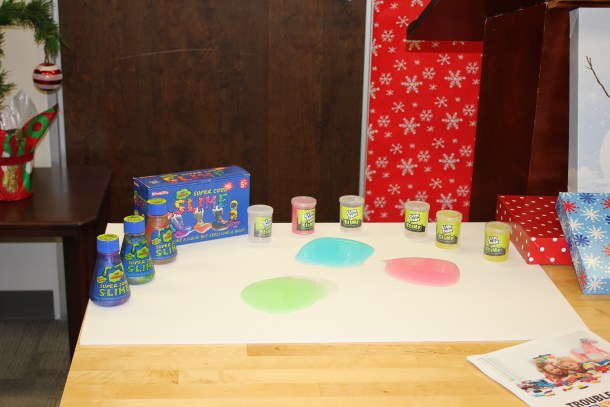
[S]tanding in front of an office wall bedecked with red and white wrapping paper, Samantha Hurt poured blue slime onto white plastic atop a wooden table.
“It’s a little bit jiggly,” Hurt, an environmental associate with the Vermont Public Interest Research Group, said of the slime. “But very fun for kids to play with.”
Slime has become a popular children’s toy in recent years, leading to “an explosion of different types” — multi-colored, neon, textured — on store shelves, said Hurt. But, the tempting blue glob on the table contained boron levels 15 times higher than the European Union’s limit for that mineral. Exposure to large amounts of boron in short periods of time can affect the stomach, intestines, liver and kidney, according to the CDC.
Days before Black Friday, the U.S. Public Interest Research Group Education Fund released their 33rd annual Trouble in Toyland report on Tuesday warning of the dangers of slime, ‘smart toys’ and balloons. The slime demo was part of a VPIRG press event this Tuesday announcing findings in the report.
Of 40 children’s toys surveyed, the report authors flagged 15 as containing potential choking hazards and unsafe chemicals. Paul Burns, executive director of VPIRG, said that decades after the first hazardous toy report came out, “you would have hoped that by today, parents could shop aisles of any store without worrying out about threats” to their children.
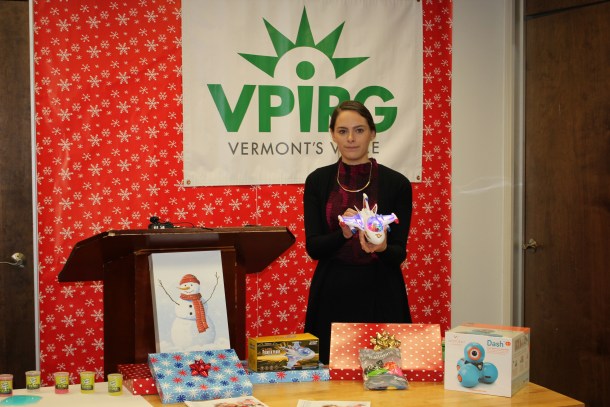
The main toys to watch out for this holiday season are:
— Six kinds of slime toys contain elevated levels of boron.
— Toys with small parts, like magnets, or “hatching toys” can pose a choking hazard for younger children but do not always have a warning label when sold online.
— Balloons cause the most choking deaths for children and often do not have a label warning that inflating them can be unsafe for children under the age of eight.
— Excessively noisy toys, like a plane from Haktoys that had noise levels above 85 decibels.
Under the Trump administration, there has been a reduced focus on consumer and environmental protection from the federal level, Burns said. VPIRG plans to revive the toxics substances bill this session to give broader authority to the Vermont Department of Health Commissioner to regulate chemicals in children’s products. The governor vetoed the bill last session, citing concerns that the bill would introduce needless complications for Vermont businesses as it would override the state’s existing toxic substances system established by a bill passed in 2014.
With the Democratic and Progressive supermajority in both the House and Senate, Hurt said she is confident the bill would pass this session.
“This year, we want to make it clear that children are more important,” said Hurt. “Industries don’t need protection — they have money.”
As smart toys become more popular, report authors warn that parents have a new “hazard” to watch out for: privacy invasion. Earlier this year, Hong-Kong based educational toymaker VTech Electronics Ltd. agreed to pay $650,000 to settle claims by the U.S. Federal Trade Commission that it did not obtain proper consent to collect electronic data from children. Hurt held up a robot that has been flagged by the Mozilla Foundation for sharing information with third parties “for unexpected reasons.”
The report also warns that because both fidget spinners and makeup are not classified as toys, they are not subject to as strict safety regulations. Last year’s USPIRG report found asbestos in makeup from Claire’s.
Report authors commended steps taken by advocates and regulators that have led to toys being “safer than ever before,” such as the passage of the Consumer Product Safety Improvement Act ten years ago. But, USPIRG would like to see regulators improve the effectiveness of toy recalls by requiring manufacturers to improve consumer outreach and track toys returned.

