

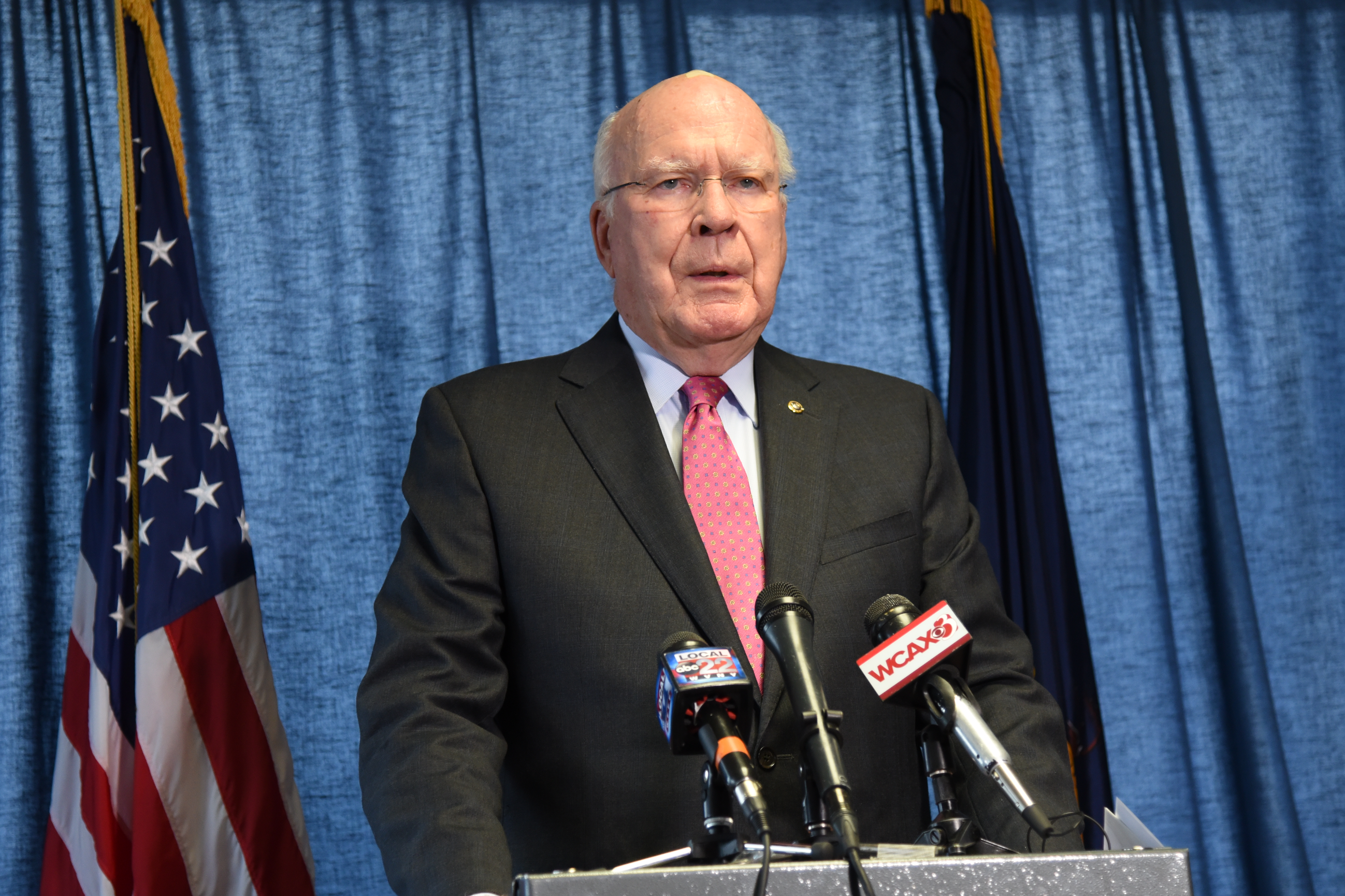
[L]egislation that provides funding for states to help prisoners re-enter communities and has been credited with lowering recidivism rates has been introduced in the Senate by Vermont Democrat Patrick Leahy and his Republican colleague, Rob Portman of Ohio.
Cited as an example of bipartisanship, the Second Chance Reauthorization Act would update and maintain Second Chance Act signed into law in 2008.
In a statement, Leahy said this legislation has led to a decrease in Vermont’s incarceration numbers by helping to mitigate the challenges inmates face when they are released back into the community.
“We are seeing it work in Vermont,” Leahy said.
Leahy pointed out that with the help of Second Chance Act funding, Vermont has seen a steady and dramatic decrease in the state’s incarceration numbers, dropping from an annual average population of 2,103 a day in 2012, down to 1,796 this year.
Tom Dalton, the executive director of Vermonters for Criminal Justice Reform, said the legislation is extremely important nationally and has had a “significant impact” on Vermont through the restorative justice approach.
The Vermont Department of Corrections says the bill has provided funding for a variety of programs including, the Adult Demonstration Grant, the Circles of Support and Accountability (COSA), and the State Recidivism Reduction Grant.
Derek Miodownik, restorative and community justice executive with the Department of Corrections, said the Second Chance Act has directly led to the establishment of “highly promising” programs designed to reduce recidivism.
According to the department, the recidivism rate for the 355 individuals who were served through programs funded by the bill was 30 percent — 107 individuals had re-convictions.
That recidivism rate is about half the national rate for inmates released from custody after three years in prison.
For the 54 individuals who went through the Circles of Support and Accountability program, a community based program, 64 percent did not have a re-conviction, according to the Department of Corrections.
Before federal funding through the Second Chance Act was available in 2008, the department had a 52 percent recidivism rate for individuals who had been imprisoned for three years.
“We expect to see 65 percent have a re-conviction, so we kind of flipped the script here,” Miodownik said.

Leahy and Portman introduced their bill at the same time Congress is poised to consider criminal justice reform legislation, which has emerged as an important issue with the power structure changing after the midterm elections.
The bipartisan First Step Act, which was also introduced on Thursday in the Senate, would overhaul the country’s criminal justice sentencing and give judges more discretion when sentencing nonviolent offenders, particularly for drug offenses.
President Donald Trump has publicly expressed his support for the bill, of which Leahy was an original cosponsor.
Dalton said he is pleased that criminal justice reform is gaining bipartisan support at the national level and that there is a growing realization the system was not working.
“I think there is agreement that what we are doing isn’t working and the punitive nature of the system costs too much for the taxpayer and the human costs are too high,” Dalton said. “They need to dial back on some of the excesses of recent years.”
