


[B]URLINGTON — The protesters who blocked traffic in Williston in July to draw attention to the Trump administration’s family separation policy are facing disorderly conduct charges in state court and arguing their actions were necessary to prevent greater evil.
Nine of the 11 adults who were arrested are seeking a criminal trial-by-jury, while two have accepted entry into a court diversion program. They are facing disorderly conduct charges, which carry a penalty of 60 days in jail and/or a $500 fine.
The state filed motions opposing the defendants’ necessity defense on Friday, arguing the protesters do not meet the requirements for the court to allow it.
More than 100 people attended the July 28 protest outside of the Immigration and Customs Enforcement agency tip center in Williston. The 13 protesters who were arrested — eleven adults and two juveniles — had refused orders to move out of the road.
The Trump administration’s policy that separated children from their families led to protests across the country.
Those arrested blocked traffic on Williston’s Harvest Lane for approximately an hour and fifteen minutes, according to an affidavit in the case.
Robert Appel, the lawyer for the defendants, said that the protesters believe their actions were justified, and that they want a criminal trial to draw attention to the issue.

“The necessity defense allows the defendants to argue to the jury that the actions that they took to protest a much greater harm should be excused because they were trying to save the greater community, the world, from the greater harm of family separation,” Appel said.
Deputy state’s attorney Zoe Newman filed two motions opposing the protesters’ use of the necessity defense Friday.
The defendants must prove that a reasonable juror would find the requirements of the necessity defense were met for the court to allow it.
These requirements stipulate that there must be an emergency situation; that the emergency must be so imminent as to raise a reasonable expectation of harm for the defendant or those they were protecting; that there must be no reasonable way to avoid the injury without doing the criminal act; and that the injury caused by the emergency must outmeasure the criminal action.
Newman argues that the defendants won’t be able to prove a reasonable expectation of harm for themselves or those they were protecting.
“There was no imminent danger and the defendants had time to exercise options other than breaking the law as demonstrated by those protesters who did not block traffic and by the option presented to defendants to move rather than be cited,” Newman wrote.
Newman argues that the defendants will not be able to prove that they reasonably believed that children would not be separated by ICE by their action of sitting in the road and blocking traffic. Additionally, she writes that political protesting does not meet the standard for the necessity defense as there is no imminent injury to the protesters or the party they are protecting.
The “necessity defense” has succeeded in a high-profile Vermont case before. In 1984, 26 protesters who had occupied the Winooski office of Republican Sen. Robert Stafford to protest U.S. involvement in Central America successfully used the defense to be acquitted of the trespassing charges against them.
However, protesters frequently attempt to use the necessity defense and are often barred by judges from using it.
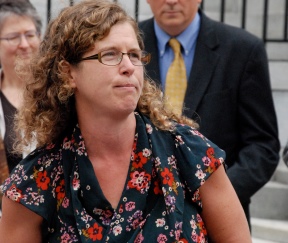
Rachel Siegel, the executive director of the Peace & Justice Center in Burlington, was arrested with her 14-year-old daughter Gertie.
“The point of civil disobedience is to shine a light on wrongs so that we might right them,” Siegel said. “It’s important to get the most attention possible, and a jury trial will do that so we might be able to right these wrongs.”
While Gertie Siegel had sought to move her case out of the family court — where proceedings are confidential — to the public criminal court so it could also raise further awareness, the state dismissed the case, Rachel Siegel said.
Appel declined to comment on the status of the other juvenile case because juvenile court is confidential.
Newman filed a second motion asking that evidence related to the White House’s policies on immigration and any actions taken by ICE be excluded from the case. Newman argues that White House immigration policies and ICE actions are not relevant to the facts of the case.
“Learning that Defendants disagreed with the White House’s policies and ICE does not make it more or less likely that Defendants recklessly created a risk of public inconvenience or annoyance by obstructing vehicular traffic,” she wrote.
Siegel said she does not believe the demonstrators are guilty of the charges.
“I believe we have a moral imperative to take a stance against something that actually is wrong that is happening,” she said. “What we did might technically break a law but it was critical to do that in order to bring attention and try to change what’s happening at the border and beyond.”
State’s attorney Sarah George said the filings speak for themselves and she would not be commenting on the case as that could create unnecessary prejudice with potential jurors.
Barring a decision by the state to drop the charges pre-trial, the next major decision in the case will be by a judge weighing whether to allow the necessity defense.
Appel will be filing a motion to counter the state’s motion, and a hearing on the motions has been set for Dec. 11. A trial could take place in January.
“I think if we were allowed the necessity defense, that there is a really good chance that the jury would be sympathetic to it, because the atrocities our government is committing, I think has been really piercing for most people” Siegel said. “There’s very few people, I think, who aren’t horrified at the idea of toddlers being separated from their families.”
