

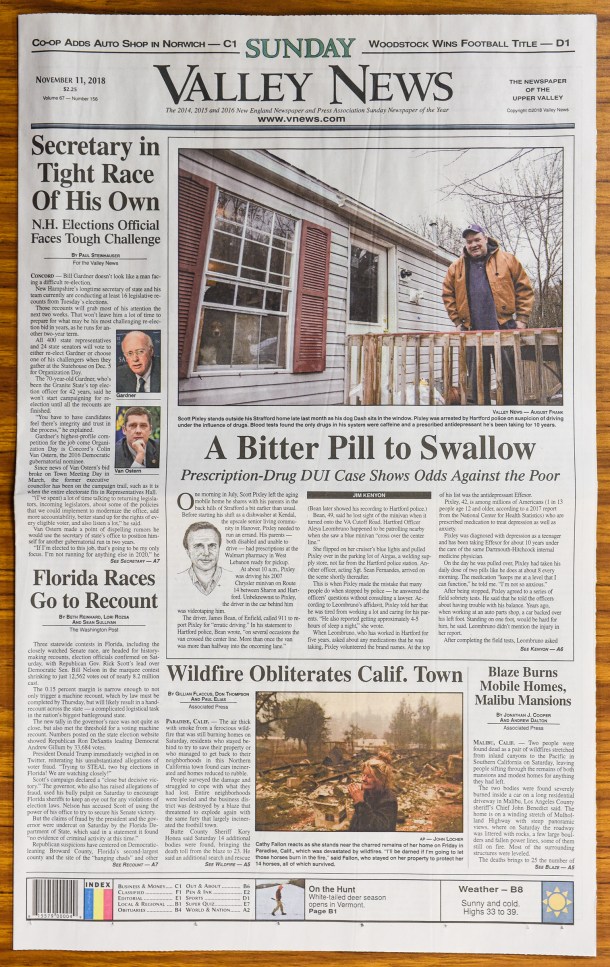
[T]he Windsor County state’s attorney is taking issue with a Valley News columnist over a series of stories published this week on Scott Pixley, a 42-year-old man who was facing DUI and negligent driving charges.
Jim Kenyon’s column detailing how Pixley’s life had been upended by the run-in with police won high praise from colleagues and readers (and was republished by VTDigger).
The article starts with Pixley leaving the mobile home in Strafford he shares with his parents and ends up with him in a Hartford jail cell worried about losing his dishwashing job at an upscale Hanover retirement community.
Pixley had been pulled over and arrested on that July day on suspicion of driving under the influence after another driver saw him driving erratically and called police. A police officer also said she saw him swerve. Upon being pulled over, he told police he was tired from working a lot and caring for his parents.
He also told police he had taken his regular medicine for anxiety and depression, which led them to call in a “drug recognition expert,” who carried out a blood test. Those test results came back weeks later — positive for caffeine, the antidepressant Velafaxine, and a byproduct of the antidepressant. Police arrested Pixley again on Oct. 14.

At the time Kenyon’s initial column was published, Pixley was facing charges of driving under the influence and negligent driving. Kenyon argued that “Pixley’s real sin is his poverty,” because anyone who can afford a lawyer would not have ended up in his situation.
Two days after the article was published, David Cahill, the Windsor County state’s attorney, dropped the DUI charge against Pixley. In the comments section on a news article about the decision on VTDigger, Cahill said the case had been reviewed per normal procedures and prosecutors decided there was no probable cause for a DUI charge.
He then went on to defend the negligent driving charge.
“A separate question is whether you, I, or anyone else, would want to be in the oncoming lane with Mr. Pixley approaching. After all, dangerous driving is not limited to DUI,” he wrote, explaining that a witness had followed Pixley for several miles and taken a video of him repeatedly crossing the centerline.
“Based upon those allegations we filed a Negligent Operation charge,” Cahill wrote. “Mr. Pixley is presumed innocent, and we will have to see how it plays out in a court of law rather than the court of Jim Kenyon.”
Kenyon wrote a second column after the DUI charge was dropped with the headline “Even Without Drug DUI Charge, a Long Legal Road Lies Ahead for Scott Pixley.” In the article, Kenyon said he was left “scratching his head” over why a criminal case was still moving forward.
“Cahill could have opted not to prosecute and sent the case back to Hartford cops. They still could have issued Pixley a traffic ticket for crossing the centerline,” he wrote.
The back-and-forth continued Thursday with a proposed commentary Cahill sent to VTDigger defending the negligent driving charge. The prosecutor started by saying that Kenyon had rightly drawn public attention to the transportation needs of vulnerable adults who live far from work.
“The inability or unwillingness to drive safely should not render a person a prisoner in his or her own home,” Cahill wrote.

“But this holiday season, there is another group that deserves equal compassion. On Thanksgiving Day, there will be sixty-four empty seats at the dinner table. Those seats belong to the sixty-four people who lost their lives on Vermont roadways last year,” he continued.
“The Windsor County State’s Attorney’s Office is dedicated to strictly enforcing criminal vehicle safety laws until there are no more empty chairs at Thanksgiving, even if it earns us bad press from a certain columnist whose opinions are presented as front-page news.”
Kenyon said in a telephone interview Friday that he respected Cahill, but just didn’t understand why Pixley’s case needed to be in the criminal justice system.
“David is very professional. He’s a good state’s attorney. He’s more progressive than most. But that doesn’t mean that journalists or newspaper columnists can’t question their decisions. You know, this isn’t Trump land,” Kenyon said.
“It’s our job to question authority. And again, I’ve drawn these conclusions after talking to many attorneys, so it’s not something I’m writing out of left field,” he said.
“I don’t know why he thinks this case is so egregious that it needs to become a criminal matter,” Kenyon said of Cahill.
Cahill said by telephone that Kenyon didn’t seem to understand the difference between bad driving and driving that is so dangerous that it puts other people’s lives in danger. “It’s nothing other than a near miss with tragedy,” he said of Pixley’s driving that day in July, “and that’s why it’s a criminal offense.”
Making matters worse, according to Cahill, both of Kenyon’s articles were front-page stories in the print edition of the Valley News, not the normal treatment for columns.
“It has the place of a news article and it gets a news article headline, but the facts presented are certainly one sided,” Cahill said.
Kenyon’s initial article was the main story in the newspaper’s Sunday edition, printed along with his headshot and a box in the center of the design with the author’s name — not normal presentation for a news story. The second column, published Thursday, was bylined “Jim Kenyon — Valley News columnist.”
Martin Frank, the newspaper’s editor, said he agreed about the important of labelling news and opinion clearly, and felt like the Valley News had done just that.
“I don’t see what else we could have done to signal that story was a column,” he said.
“Jim sometimes strays from what is a standard column length piece to more deeply investigate what he is writing about,” he said. “So when he does that, as in the case in Mr. Pixley’s story, we give him more space.”

