



This column is by Jim Kenyon, a columnist for the Valley News.
[O]ne morning in July, Scott Pixley left the aging mobile home he shares with his parents in the back hills of Strafford a bit earlier than usual.
Before starting his shift as a dishwasher at Kendal, the upscale senior living community in Hanover, Pixley needed to run an errand. His parents — both disabled and unable to drive — had prescriptions at the Walmart pharmacy in West Lebanon ready for pickup.
At about 10 a.m., Pixley was driving his 2007 Chrysler minivan on Route 14 between Sharon and Hartford. Unbeknownst to Pixley, the driver in the car behind him was videotaping him.
The driver, James Bean, of Enfield, New Hampshire, called 911 to report Pixley for “erratic driving.” In his statement to Hartford police, Bean wrote, “on several occasions the van crossed the center line. More than once the van was more than halfway into the oncoming lane.” (Bean later showed his recording to Hartford police.)
Bean, 49, said he lost sight of the minivan when it turned onto the VA Cutoff Road. Hartford Officer Aleya Leombruno happened to be patrolling nearby when she saw a blue minivan “cross over the center line.”
She flipped on her cruiser’s blue lights and pulled Pixley over in the parking lot of Airgas, a welding supply store, not far from the Hartford police station. Another officer, acting Sgt. Sean Fernandes, arrived on the scene shortly thereafter.
This is when Pixley made the mistake that many people do when stopped by police — he answered the officers’ questions without consulting a lawyer. According to Leombruno’s affidavit, Pixley told her that he was tired from working a lot and caring for his parents. “He also reported getting approximately 4-5 hours of sleep a night,” she wrote.
When Leombruno, who has worked in Hartford for five years, asked about any medications that he was taking, Pixley volunteered the brand names. At the top of his list was the antidepressant Effexor.
Pixley, 42, is among millions of Americans (1 in 13 people age 12 and older, according to a 2017 report from the National Center for Health Statistics) who are prescribed medication to treat depression as well as anxiety.
Pixley was diagnosed with depression as a teenager and has been taking Effexor for about 10 years under the care of the same Dartmouth-Hitchcock internal medicine physician.
On the day he was pulled over, Pixley had taken his daily dose of two pills like he does at about 8 every morning. The medication “keeps me at a level that I can function,” he told me. “I’m not so anxious.”
After being stopped, Pixley agreed to a series of field sobriety tests. He said that he told the officers about having trouble with his balance. Years ago, when working at an auto parts shop, a car backed over his left foot. Standing on one foot, would be hard for him, he said. Leombruno didn’t mention the injury in her report.
After completing the field tests, Leombruno asked Pixley to provide a breath sample to “rule out any intoxicating liquors.” Again, he obliged. In her affidavit, Leombruno stated the roadside Breathalyzer test showed a reading of .000 percent.
With the results of the Breathalyzer test clearly indicating that he had not been drinking, Pixley figured his biggest problems were behind him. He had already acknowledged that he was driving without insurance on his vehicle.
“I didn’t have the money for insurance, but that’s no excuse,” he told me. He expected to be issued a ticket and maybe even have his vehicle impounded.
“But the next thing I knew, they were putting my hands behind my back in handcuffs and stuffing me in the police car,” Pixley said.
He was arrested on suspicion of driving under the influence.
At the Hartford police station, Pixley, still in handcuffs, was placed in a holding cell.
“I felt like I had done nothing wrong, but here I was sitting in a cell,” he said. “All I could think was that seven years of working (at Kendal) was going out the window.”
Later in the day (Leombruno’s affidavit doesn’t give a time), State Police Trooper Jesse Robson arrived at the station to put Pixley through another round of sobriety tests.
Robson is among about 60 police officers in the state who are known as police drug recognition experts. It’s puzzling how anyone qualifies as an “expert” after only 72 hours of classroom instruction, but that’s all Vermont requires. (More on that in a bit.)
Among other things, Robson checked Pixley’s vital signs and examined his eyes, which would supposedly help determine whether he’d been using drugs. He was also checked for needle marks.
Pixley was then asked to provide a blood sample. Once more, he went along with the cops’ request. A handcuffed Pixley was again placed in the back of the cruiser — this time bound for Mt. Ascutney Hospital in Windsor.
His blood would be tested for, among other things, cocaine, fentanyl and cannabinoids — the chemicals found in marijuana. But the results of the lab tests wouldn’t be available for a while — months, in fact.
Back at the Hartford station, Pixley waited in the lobby for his sister, who picked him up around 3 p.m. It was too late for him to go to work, and he’d miss the next day, as well, to get his car out of the impound lot.
The fee was $220 — money he didn’t have. But when a Strafford couple heard of his predicament, they offered to help. (The same couple told me about Pixley’s arrest.)
I met Pixley, who at 6 feet tall and 265 pounds is a big guy, in early August. He told me that growing up in Strafford, he had struggled in school from any early age.
“I’ve always had learning issues,” he said. “I got held back in kindergarten.”
When he was in third grade, his mother, Kandy, received a call from an irate teacher. During a spelling bee, Pixley was asked to spell “shirt” in front of the class. He left out a key letter. The teacher was sure he’d done it intentionally.
Starting in elementary school, Pixley was diagnosed with severe learning disabilities that qualified him for an individual educational program, better known as an IEP.
At 16, he quit high school. “Everything was so hard,” he said. “I just stopped caring.”
His mother suspected that he could be suffering from depression. “It’s something that runs in the family,” she said. She had a brother who had killed himself in 1992 — a few years before her son dropped out of school.
Her son would “go into his room and stay there,” she said.
“I’d play video games for hours,” he told me. “It was my escape.”

Kandy Pixley took her son to the Clara Martin Center, a nonprofit that provides mental health services, where he was diagnosed with depression. He also started counseling. By the time he was 18, he felt well enough to return to school.
He took vocational classes at the Hartford Area Career and Technology Center, earning his degree from Hartford High in 1997 at age 21.
Pixley bounced around from one low-paying job to another. In his early 20s, he was a janitor at J.C. Penney in West Lebanon. One day while sweeping floors, he recalled, he suddenly felt “like everything was closing in” on him. “I just had to get out of there,” he said.
Pixley dropped his broom and headed for the door. His parents, who still drove back then, had dropped him off at work. The panic attack was so severe, Pixley couldn’t wait for them to pick him up.
He started walking, making it all the way into Vermont before a Strafford resident recognized him and gave him a ride. “That was when my depression was really bad,” he said, adding that he’d been taking a different medication at the time.
In 2011, Pixley was hired to wash dishes at Kendal. He works the noon-to-8:30 p.m. shift, and he recently earned a raise to $12.50 an hour. The job includes health insurance benefits, which makes his antidepressant medication affordable.
“It took 20 years, but I was finally feeling pretty good about life,” he said.
With his parents’ help, he scraped up enough money to get his car insured and pay the $182 traffic fine for driving without insurance.
On Oct. 13 — 2½ months after his traffic stop — Pixley received a call from Hartford police. The cops had received results of his lab tests. The next day, a Sunday, he drove to the station to be fingerprinted and have his mugshot taken. He was handed a citation for driving under the influence of drugs.
And what drugs would those be?
Three substances were found in Pixley’s blood — caffeine, Velafaxine (another name for the antidepressant Effexor) and O-Desmethylvenlafaxine —a byproduct of Effexor.
That’s correct.
Pixley was arrested for driving while under the influence of an antidepressant that was prescribed by his physician and that he’s been taking for 10 years. If convicted, he faces a hefty fine and suspension of his driver’s license for 90 days.
He’s scheduled to be arraigned in Vermont Superior Court in White River Junction on Nov. 20. He said he plans to plead not guilty.
Windsor County State’s Attorney David Cahill told me that he couldn’t talk about an ongoing case, but generally speaking, a charge of driving under the influence of drugs can be applied to antidepressants.
“It is possible although unusual,” Cahill said.
Being under the influence of prescription drugs can “compound the problem” if a driver is already drowsy, said Hartford Police Chief Phil Kasten. “This is a problem across the country, not just here.”
I recently told Pixley’s story to Diane Roston. She’s the medical director at West Central Behavioral Health, a nonprofit community mental health care provider, and an assistant professor in the psychiatry department at Dartmouth’s Geisel School of Medicine.
She’s been a psychiatrist in the Upper Valley for nearly 30 years.
I mentioned to Roston, who said she doesn’t know Pixley, that Leombruno had written in her affidavit about finding on WebMD.com that drowsiness could be a side effect of Effexor.
“It’s true that sedation is a possible side effect,” Roston said. “But unless there was a recent dosage change, it’s not likely the medication was the cause of his drowsiness.”
After talking with Roston, I called Pixley. He’s been taking the same dosage for years, he said.
The medication Pixley’s primary care physician prescribed him has been “around a long time and it’s been very effective for lots of people,” Roston aid.
A criminal case such as this could set an alarming precedent, Roston said. I knew what she meant. The impact on people dealing with depression could be enormous. Will the threat of being arrested force them to choose between driving to work and taking their medication?
Pixley is a persuasive example of just how unfair our criminal justice system can be. He can’t afford a decent lawyer, and since a first-time DUI offense doesn’t carry the potential of jail time, a judge is unlikely to grant him a public defender.
Instead of exercising his constitutional right to a trial, Pixley — and poor people in general — has little choice but to plead guilty. Meanwhile, the state continues to collect hefty fines and court fees from people who can least afford it.
I brought up Pixley’s case to George Ostler, a criminal defense lawyer in Norwich who has been practicing for 35 years. Now that Vermont is bolstering its cadre of so-called drug recognition experts, or DREs for short, “there’s a real pressure to prosecute driving under the influence of drugs,” he said.
In other words, Vermont’s DREs need something to do. In 2017, they were called upon to evaluate 263 motorists — a 12 percent increase from the previous year.
Vermont has employed DREs since 2005. But during the three-year debate in Montpelier over legalizing marijuana, the law enforcement community sold the Legislature on the need to beef up its ranks. Nine were added in September alone, bringing the total to about 60. (New Hampshire has nearly 100 DREs.)
Recreational marijuana use became legal in Vermont on July 1. Unlike with alcohol, however, states have been unable to establish quantitative measures that signal what amount of marijuana — or for that matter, any drug — constitutes legal impairment.
In an in-depth story in September written by Valley News staff writer Jordan Cuddemi, criminal defense attorneys from across the state questioned the science behind the DREs’ work.
In judging whether a driver is impaired, DREs often have little to go on beyond what a suspect tells them about their drug use. “When you don’t have that self-reporting, I am not certain that this is a reliable form of testing,” said Brattleboro lawyer Dan Davis, a former state trooper and Windham County prosecutor.
In Pixley’s case, he didn’t hide anything. He told police about the prescription medication he had taken that morning before getting into his car. Now they’re using that information to build a case against him.
“The state is making the assumption that the same investigative tools and field sobriety tests they use for alcohol work for prescribed drugs,” Ostler said.
In DUI-drug cases, “if there is no alcohol involved and you’re taking your medication as prescribed and it comes with no restrictions on driving,” the state has its work cut out, Ostler said. “It must prove impairment beyond a reasonable doubt.”
I asked to see the report written by Robson, the DRE who evaluated Pixley, but Hartford police had not yet received a copy, Kasten told me last week.
Mounting a strong defense for someone in Pixley’s situation, however, often requires hiring expert witnesses. Depositions, including those of the DRE and Hartford officers, would be needed.
“All those things are expensive,” said Ostler, estimating that the legal bills for a DUI-drug case could run $10,000 to $15,000.
Meanwhile police and prosecutors play with house money. Taxpayers foot their bill.
Police and prosecutors in Vermont currently hold another big advantage in DUI-drug cases. Ordinarily, a defense attorney might want to question the lab workers who tested a suspect’s blood samples. How the tests were conducted could be useful information.
In Pixley’s case, that would mean traveling to Willow Grove, Pennsylvania, or bringing the lab workers who conducted the tests to Vermont.
Why’s that?
The Vermont Forensic Laboratory in Waterbury doesn’t have the space or the “necessary equipment” to conduct DUI drug tests, said Adam Silverman, spokesman for the Department of Public Safety.
The state uses a private company called NMS Labs to conduct the testing, which on average runs nearly $250 per case. (And I thought Vermont only exported some of its prison inmates. Who knew that it also farms out vital pieces of criminal investigations to private out-of-state companies with little accountability as well?)
Considering Pixley’s lab tests showed only a prescribed antidepressant (and, oh yes, caffeine) in his system, he would seem to benefit from having lab workers testify on his behalf. But they’re 350 miles away in suburban Philadelphia.
How convenient — for prosecutors.
“The scientific proof isn’t there that links his antidepressant medication to his behavior that day,” Ostler said. “He could have been having a bad day, physically.
“Being a lousy driver isn’t illegal. There are lots of those.”
Although he’s not looking at jail time if convicted, Scott Pixley still has a lot riding on his case’s outcome.
Kandy and Marvin Pixley do as well.
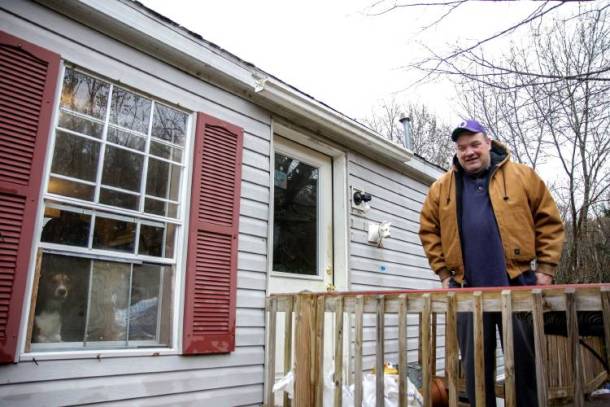
Last month, I sat down with Pixley and his parents in the living room of their mobile home in Strafford. Kandy Pixley, 63, was in a wheelchair. Diabetes had claimed her left leg just below the knee.
The day before our visit, Scott Pixley had picked up his 78-year-old father at the hospital, where he’d spent a couple of nights for a heart ailment. Marvin Pixley, an Army veteran who was a truck driver for 40 years, has had declining health for a while.
“Scott has been our rock,” Kandy Pixley told me. “He picks up our medications and takes us to doctors’ appointments. He takes us shopping. We couldn’t do it without him.
“If he loses his license, I don’t know what we’ll do.”
The Pixleys get by on their monthly Social Security checks and a small pension that Marvin earned for working with the state highway department for 10 years.
Their living room has a new pellet stove — or at least it’s new to them — which Scott recently bought from a co-worker at Kendal. Now he’s saving up to buy the pellets to burn in it.
The home’s outdoor oil tank needs replacing. Once that’s paid for, the family will have to come up with the money to fill the new tank.
In the meantime, Scott is picking up all the extra hours he can at Kendal. “When you’re poor, you just have to work harder,” he said.
I figured it couldn’t hurt to give Kasten, Hartford’s police chief, an idea of what Pixley and his parents are up against. I’ve always found Kasten willing to listen.
“The human aspect of what we do as law enforcement officers is always the greatest challenge,” he said. “Every person we deal with has a story. We work hard to be fair.”
But in the end, it’s not up to police, he said. Which is what many cops say — they make the arrests, and what happens to cases after that is in the hands of prosecutors and judges. But cops do have the discretion not to make an arrest, which makes me wonder why Pixley ended up in handcuffs after a Breathalyzer test showed he hadn’t been drinking.
If Pixley can’t afford a lawyer, I imagine there’s a good chance he’ll end up pleading guilty. He’ll pay a fine, and if he’s lucky, might only lose his driving privileges for 30 days or so.
But the last time I checked, there’s no public transportation that runs the 20 miles from Strafford to Hanover. So I’m not sure how he’d keep his dishwashing job that pays the bills and provides the health insurance that covers his medications.
Is Pixley the victim of a criminal justice system that’s being malicious or merely indifferent?
It’s probably the latter, although it’s a distinction that won’t have much significance to him if he’s forced to quit his job because he can’t drive for a while. What’s indisputable, though, is that Pixley’s real sin is his poverty: He doesn’t have the resources to demand that the system treat him fairly.
Jim Kenyon can be reached at jkenyon@vnews.com.
