

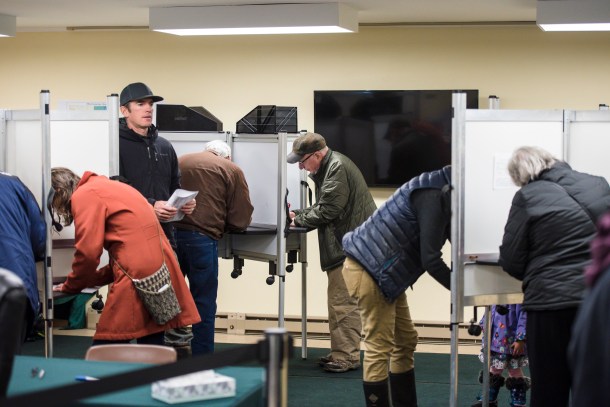
[T]own clerks and poll workers across the state say turnout is far higher than typical mid-terms and at presidential-year levels in some places, with less than three hours to go until polls close at 7 p.m.
“This is a contentious time in our country,” said Kathy Apgar, who was helping voters in New Haven. “I’ve worked every election for many many years and this has been one of the busiest I can remember. Young and old — it’s been a good representation of our population.”
VTDigger reporters in Addison, Rutland, Burlington, Montpelier and Lamoille counties found similar sentiment coming from those manning the polls, who said lines have been steady throughout the day despite the dreary weather.
The last midterms in 2014 set a low-water mark for voter turnout in Vermont, with less than 44 percent of registered voters casting ballots. The 68 percent of voters who turned out in 2016 was high, but fell short of 2012, when 72 percent of voters showed up.
Jim Holway, Ward 4 clerk in Burlington’s New North End, said turnout has been impressively high. “I would say it feels like we’re nearing the presidential level, anecdotally,” he said.
Tony Romeo, a ward clerk at the American Legion in Rutland City, said 728 voters had cast ballots by mid-afternoon Tuesday.
“I’ve got a feeling by the time 7 o’clock rolls around we’re going to be past what we had for the presidential election,” Romeo said. “It wasn’t past 900 for the presidential election.”
Rick Clarke, a professional pollster and political science professor at Castleton University, said that was good news for Democrats in down-ballot races.

“I think it might have some real impacts on the General Assembly just because if people are coming out in larger numbers and are less informed about those races, party is a large factor, in which case it’s going to help Democrats,” he said.
Democrats are hoping to flip about 10 seats across the state in order to put them within striking distance of a supermajority — factoring in allied Progressives and independents — that would allow them to override the governor’s vetoes.
But Clarke wasn’t so sure turnout would make any difference in the governor’s race, unless it was particularly high in certain areas that tilt heavily toward one party. The governor’s race is not as susceptible to party-driven politics, he said.
“We’ve seen that our gubernatorial contest in not a matter of party loyalty,” he said. And unlike some House candidates, voters know Gov. Phil Scott. “And they like him,” Clarke said.
Ellen Anderson, a politics professor at University of Vermont, said she thought turnout was unlikely to bring about big surprises in any races.
She predicted significant “drop-off votes” down the ballot in races for the Vermont House and Senate, where people vote for members of the congressional delegation, governor and perhaps some other statewide races, but then don’t fill out much of the ballot.
Anderson said “straight-ticket” voting for the party could benefit Democrats, but would largely bolster the direction a particular was already heading in.
The race most likely to be impacted by high turnout, according to Anderson, is the governor’s race. She said Democrat Christine Hallquist would need big turnout among younger voters and independents, noting that a VPR-Vermont PBS poll last month showed her performing best among young women, and showed almost a third of voters undecided.
“If they disproportionality swing to Hallquist, and she gets a much higher youth vote, then she’s got a chance, but it’s just a chance,” she said.
Alan Keays contributed reporting from Rutland City; Kit Norton from Addison County; and Aidan Quigley from Burlington.
