

This story by Jared Pendak was published by the Valley News on Oct. 26.
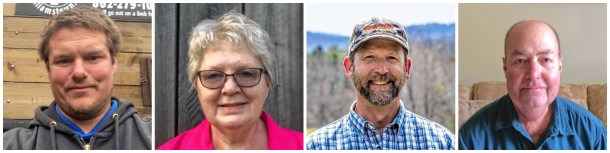
[C]HELSEA — A Republican incumbent from Williamstown, a former five-term Progressive, and two newcomers are running for the two Vermont House seats in the Orange 1 district.
Former state Rep. Susan Hatch Davis, P-Washington, is seeking to regain the seat she narrowly lost in 2016 to Republican Bob Frenier, who is not seeking another term.
Hatch Davis, who also is on the Democratic ballot, said she was “on the fence” about running after the recount.
She lost by seven votes, and the dispute over the recount even spilled into the House in early 2017.
Hatch Davis, 65, said she felt compelled to rejoin the fray in order to spearhead a “worker’s platform” in support of rural working families in her district, which includes the towns of Vershire, Corinth, Chelsea, Washington, Orange and Williamstown.
“When I knock on doors, I learn that people are struggling in the area,” said Hatch Davis, a retired state worker who spent much of her career in Vermont’s information technology department. “Working people are having difficulty making ends meet. They’re interested in things like affordable health care, affordable child care and preschool. No working families should have to decide if they’re going to pay the rent or the light bill at the end of the month, and that is more prevalent in our district than some people realize.”
Hatch Davis’ opponents include a pair of Republicans from Williamstown, state Rep. Rodney Graham and Christopher Covey, as well as Corinth Democrat Carl Demrow. Both Covey, 35, and Demrow, 53, are running for the first time.
The four candidates are aligned in opposition to a state-imposed carbon tax, saying viable alternatives to fossil fuels are not readily available. Each also generally is opposed to Act 46, the 2015 legislation that required neighboring school districts to consider merging or potentially be forced to by the state.
School districts in Williamstown and Chelsea voluntarily merged with those in Northfield and Tunbridge, respectively, in response to Act 46.
Demrow, 53, isn’t in favor of forced mergers and wants to see how the voluntary ones play out.
“I’d like to see a moratorium on mergers for a year or two, to see what some of the benefits might be for the districts that have already merged,” said Demrow, a construction worker and carpenter. “In rural communities, schools are a big part of the town and losing that focal point is really difficult. Taxpayers deserve to see if those longer bus rides and bigger class sizes are resulting in real benefits.”
Hatch Davis, who voted against Act 46, also lamented the loss of schools as community centers, while Graham said he feels as though small districts would continue to explore merger options, based on taxpayer need, without additional state interference.
Covey, who has three children in the Williamstown school system, said there are “pros and cons” to mergers, but generally feels smaller class sizes are better.
“Kids used to get a lot of their discipline at home, but nowadays with both parents working for most families, we rely, probably too much, on teachers for discipline. The more kids you have in a school, the more potential problems you can have,” he said.
Graham voted against this year’s legalization of recreational marijuana for adults.
“I think marijuana can lead to future addictions, and it’s hard to control young kids being exposed to it,” Graham said. “If you look at some of the data from other states that have legalized it, accidents from impaired driving and things of that nature have increased considerably.”

Demrow, Hatch Davis and Covey, meanwhile, all favor some form of tax-and-regulate system that would allow for retail sales of pot.
“If it’s going to be legal, there should be some mechanism in place so that there is an economic benefit,” Demrow said. “People love Vermont products, particularly agricultural products, so why should we let Maine and Massachusetts get all the revenue from growing it?”
The candidates’ views vary regarding different aspects of the controversial gun control legislation signed by Gov. Phil Scott in April, the main elements of which include banning bump stocks, limiting magazine capacities, expanding background checks and requiring completion of a hunter safety course for prospective gun owners under age 21.
While he voted against Scott’s gun legislation, Graham said he doesn’t take issue with its more conceivably practical safety measures.
“I don’t have a problem with the safety course,” said Graham, who said he does not own a gun but is nonetheless a proponent of Second Amendment rights. “You take a safety class if you ride a snowmobile or if you ride a motorcycle. I don’t see why you can’t take one if you’re going to go into the woods with a gun.”
Demrow, a gun owner and hunter, generally was in favor of the legislation, though he said he feels the magazine capacity limits will be difficult to enforce and that the safety course regulation could be problematic to expect of military service men and women under the legal age to purchase a gun.
Hatch Davis, whose husband, Brent Davis, is a hunter safety instructor, said she did not follow Scott’s gun legislation closely while not in office, but generally supports Second Amendment rights. She and Covey, a gun collector and occasional marksmanship competition participant, both indicated they would prefer to see increased mental health services to try to prevent violent behavior rather than impose restrictions on gun owners.
As for a potential carbon tax, all four candidates said one would be unfair for residents — and municipalities — in their district.
“All of the vehicles we use to plow, sand and grade roads run on gas, and the alternative technology just isn’t there at this point in time,” Graham said. “If it’s more expensive to do those kinds of things, it’s going to make everyone’s property taxes go up. At the same time, it’s going to be more expensive for home heating fuel.”
Hatch Davis said there are many ways Vermonters can reduce their carbon footprint without a tax.
“I was at a regional planning meeting recently and a big topic was things you can do to have a more sustainable lifestyle, like supporting locally grown food or growing your own,” she said. “Climate change is real and most people I know are on board with finding ways to make (renewable energy) more affordable. But people can’t afford something like switching their homes over to solar when they’re mostly concerned about their monthly bills.”
Williamstown Middle High School students will host a community forum with Orange-1 candidates from 9-11 a.m. on Tuesday in the school auditorium. The school is located at 120 Herbert Road in Williamstown.
