


Editor’s note: VTDigger will be profiling the major candidates for statewide offices ahead of the Nov. 6 elections. Tomorrow will feature a profile of Republican attorney general candidate Janssen Willhoit. Check out our voter guide here.
BURLINGTON — Vermont’s top prosecutor didn’t lose a fierce primary race to a seven-term incumbent, wait four years for the old man to step aside, and then run again just to uphold the status quo. TJ Donovan wants to leave his mark on the office of the Vermont Attorney General.
He says the AG’s office ought to be more like Longe Brothers Market where he bagged groceries as a teenager growing up in Burlington.
It was a business built on trust, he says, and money was secondary to the greater good. The owner of the old market in the South End, Phil Varricchione, was “the best teacher I ever had,” Donovan recalls. “You treated people with respect and you tried to solve their problems — he ran credit on the back of cigarette cartons, zero percent, and never sent a bill out. It was a community gathering spot where you didn’t ask questions, you helped people.”
Like his mentor, Donovan believes in people. He believes in second chances. That was the theme of his campaign kickoff speech at Burlington’s St. John’s Club in 2016, when he rolled up his sleeves, waxed nostalgic about his childhood, and told supporters that change was coming to the attorney general’s office. “No more gotcha politics, no hypocrisy, just service,” Donovan pledged.
“For far too long in my opinion, the attorney general’s office was out of touch and if people made a mistake they got whacked and we were taking money from Vermonters,” he said of his approach to the business community. “The best way to enforce the law in the state of Vermont is to give people the opportunity to comply with the law.”
Donovan got a second chance himself, years ago. He got drunk and beat up a guy as a teenager, an incident revealed by Seven Days in the final weeks of his failed 2012 campaign to unseat William Sorrell. A charge of aggravated assault was downgraded to simple assault in a plea agreement and wiped off his record.
He thinks others deserve the same. “When they fall down, we’re gonna pick them up, and we’re gonna get them back on their feet and we’re going to help them move forward,” he said at the St. John’s Club.
Donovan lost the 2012 primary race — there was the assault, a bruising poll and big spending on ads for his opponent. He calls it ancient history, but it’s the only time Vermonters have seen him in a political fight — and he didn’t stop throwing punches. He accused Sorrell and his most prominent backer, former Gov. Howard Dean, of illegal coordination with a super PAC. He said Sorrell overstated his record on fraud protection, got into bed with corporations and was partly responsible for rising opioid use and bloated prison populations.
The sometimes bitter campaign between Donovan and Sorrell was also noteworthy because the two grew up in prominent Burlington political families and often worked and broke bread together. As a boy in the late 1950s, Sorrell campaigned for Bernard Leddy, Donovan’s grandfather, who nearly ended a 104-year run of Republicans in the governor’s office. Phil Hoff, who accomplished that feat a few years later, was a family friend.
A kinder TJ Donovan has been on the campaign trail since then. He decided against taking on Sorrell in 2014, instead securing a third term as Chittenden County state’s attorney. In the 2016 attorney general’s race, after Sorrell announced he was retiring, Donovan was unchallenged as a Democrat and won by a landslide against Republican candidate Deb Bucknam, a lawyer from St. Johnsbury.

In office, Donovan has adopted a broad view of the attorney general’s mandate, taking on issues from poverty, the opioid crisis, mental health, labor rights, LGBTQ rights, environmental protection, domestic violence, data privacy and, most recently, robocalls. It’s made him popular with advocates and will serve him well if the 44-year-old runs for higher office, which just about everybody in Vermont expects him to do.
“He told me himself, years ago, he loves the political game and he wants to go as far as he can,” said Sorrell. Donovan’s supporters are OK with that. “If a person is choosing to ride the cause of economic and social justice to the top, I am happy to have someone do that,” said Barbara Prine, a staff attorney with Vermont Legal Aid. “I’ve never seen him get behind an issue that he didn’t give a shit about,” said Rep. Selene Colburn, P/D-Burlington, who worked with Donovan when she was a city councilor and he was the county prosecutor.
When it comes to second chances, most agree Donovan has made good on his word. By his own count, he has filed zero lawsuits against Vermont businesses. Instead he has set up a small business advocate to help companies come into compliance. He has been a proponent of new legislation that makes it easier for juveniles to expunge non-violent offenses, and another bill that puts a $200 cap on bail for misdemeanors. And he has been relentless in pushing to reduce the state’s prison population.
“We don’t understand the impact that incarceration has on people,” Donovan said during an interview Monday at the New Moon Cafe in Burlington. “I would go so far as saying many people in our system — I’m not talking about the police — prosecutors are cavalier about time. People have families, people have children, we have to get to a way to hold people accountable, making the victim whole, without destroying other people.”
This belief in redemption and the power of second chances is not just a moral one for Donovan, it’s economic — it will save the state money — and it extends to Vermont’s business community, which Donovan notes is mostly made up of mom-and-pop shops that can’t afford to hire attorneys or pay hefty legal settlements.
“I ran on trying to solve their problems by simply talking to them and saying, ‘What do you need to be accessible, to be predictable?’,” he said.
But not all businesses in Vermont are small, and it tends to be the bigger ones — the ones that can afford attorneys — that have had problems with the attorney general in the past.
Donovan’s predecessor, William Sorrell, regularly took enforcement actions against companies including Casella Waste Management, for anti-competitive contracts; Cabot Creamery Cooperative, for false claims about growth hormones; and Bove’s pasta sauce, for claiming it was a Vermont product when it was produced in New York using California tomatoes.
Donovan recently joined a number of state attorneys general who are suing Purdue Pharma, the maker of OxyContin, over its role in the opioid epidemic, and he’s held press conferences to announce windfalls from nationwide lawsuits against Volkswagen and Big Tobacco.
But when it comes to local concerns, he says he’s stayed focused on the quiet work of compliance.

“I’m not sure I’ve sued somebody in Vermont. I’ve sued Purdue Pharma. I don’t think I’ve sued somebody [here]. Have I worked out a lot of things? Yeah, I have. Because that’s what I ran on,” he said. “I think most people want to do the right thing — they just need the opportunity. That was true in that [criminal justice] system. It’s also true in the business community.”
Paul Burns, executive director of the Vermont Public Interest Research Group, said he was frustrated that at least one repeat offender — Casella Waste Management — was being allowed to expand its landfill in Coventry even as he and other advocates believe it is leaking leachate into the surrounding waterways.
“We certainly need a strong cop on the beat when it comes to looking out for those more local environmental concerns and there’s probably room for increased activity there,” Burns said, noting that the attorney general’s office was only one of the agencies that should step up its work in the space.
Sorrell chuckled when asked about Donovan’s strategy of compliance over enforcement, but wouldn’t comment on it directly. “If you don’t enforce the laws against Vermont companies, then you’re setting up a double standard of justice and I never thought that was right. You make more enemies when you take enforcement actions than you make friends,” he said in a telephone interview Tuesday.
Bove’s and Cassella contributed a $1,000 each to Donovan’s campaign against Sorrell in 2012, with additional donations from the personal accounts of executives at the companies. “Take a look at his donor list and there were some individuals from companies that I had taken enforcement actions against, he went and raised thousands of dollars from them,” Sorrell said.
Natalie Silver, Donovan’s campaign manager, said they had moved on from the 2012 race and didn’t respond to Sorrell’s claims. Donovan was highly critical of Sorrell’s national corporate supporters during their race. He said he would campaign the “Vermont way,” going door to door, keeping things local. Bucknam turned the tables in 2016, and then it was Donovan who was taking donations from outside Vermont.
“Frankly, I don’t think those large corporations care about the attorney general’s race in Vermont,” she said in a Vermont Public Radio debate. “They are funding your future.”
While many of Donovan’s Democratic colleagues — including gubernatorial candidate Christine Hallquist — have sworn off corporate contributions, Donovan says he doesn’t think such pledges make much of a difference. Corporate executives who wanted to contribute could simply write checks from private accounts, he said.
“The system’s messed up, OK, that’s the bottom line,” he said this week. As evidence of his commitment to the issue, he pointed to a committee on campaign finance reform that he created last year along with Secretary of State Jim Condos, which put out a report saying a publicly financed system would level the playing field.
“The question is does the Legislature have the political will to appropriate the money?” Donovan said. Until that happens, the attorney general says he will continue to play within the boundaries of Vermont law — this year he has taken donations from Coca-Cola, the National Beer Wholesalers Association and a number of national law firms.

Shap Smith, a former Democratic speaker of the House, refused to take corporate donations during an unsuccessful run for lieutenant governor in 2016, but was inclined to agree with Donovan about the significance of that move. “I made the decision because I thought it was the right one, but the fact of the matter is I had a lot of wealthy people giving me money, making contributions, who work for corporations. It was symbolic but I’m not sure it addressed the fundamental problem,” he said.
The fundamental problem, both Smith and Donovan agree, is the Citizens United Supreme Court decision that treats money as speech, and allows corporations to give as much as they please through political action committees that can’t coordinate with campaigns, but can pour money into outside advertising for their preferred candidate.
Given the circumstances, even some Vermont Progressives leading the push to ban corporate money from campaigns are willing to give Donovan a pass on the issue. “Would I love it if he didn’t take corporate money and still kicked ass? Yes,” said Colburn, the Progressive House member. “but I think that’s a challenging thing to do in the current climate.”
This year, it seems fair to say, Donovan doesn’t need the money. He is facing Rep. Janssen Willhoit, a defense attorney from St. Johnsbury who decided against running for a third term in the House. He entered the race only after Republicans were left scrambling to fill the ticket following an embarrassing primary in which perennial candidate H. Brooke Paige won the nomination to six different offices.
“I think he’s going to have an uphill battle,” Smith, the former speaker, said of Willhoit. “And if he had wanted to run a serious campaign, I think he probably needed to be in the race earlier. I would file his candidacy under ‘take one for the team’.” Donovan currently has a 39-point lead over Willhoit, according to a VPR-Vermont PBS poll released last week.
Donovan says he’s not taking anything for granted. He says his eyes were opened to the importance of having a well-financed campaign, and being ready for anything, during his campaign against Sorrell, when a super PAC called the Committee For Justice and Fairness spent $194,000 on advertisements for the incumbent late in the campaign.
“To this day, I can’t tell you where the money came from,” Donovan said. “I mean, it’s ancient history in terms of that race, but certainly a lesson to be prepared.”
Born in Burlington
Thomas J. Donovan Jr. couldn’t string a sentence together as a young boy, or even get out a full word. He’d say “jack” and his older sisters understood that he was heading outside to play and needed his jacket, recalled his mother, Johanna Leddy Donovan, who everyone calls Joey.
“He had no problem communicating because everyone sort of interpreted,” she said during an interview last week at Speeder & Earl’s in Burlington. Starting when he was 3 years old, TJ paid regular visits to the University of Vermont speech center. By the time he started kindergarten, he had caught up with his classmates.
“I think it’s amazing to think he came from there to now; he has such an ability to communicate and speak clearly,” said his mother, a retired teacher who is running a fairly low-key campaign for her ninth term as a Democratic representative for Burlington. TJ was a middling student in high school, she said. He liked history, but mostly tried to get good enough grades to remain eligible for the basketball team. (He still balls with his buddies once a week, but has stopped playing full court.)
The drunken fight during those years wasn’t an anomaly, at least not the drunken part. In an interview with Seven Days, Donovan quoted George W. Bush in describing his drinking problems during his late teens and 20s. “When I was young and stupid, I was really young and stupid,” he said.

Joey Donovan said her son turned things around academically at Merrimack College, where he was involved in civics programs and for the first time encountered widespread poverty during an internship with the nearby city of Lawrence, Massachusetts. “I think that was an eye-opener for him,” she said of his work with Spanish-speaking minority populations there. Upon returning from school, Donovan spent a year studying for law school and driving a van for Auto Master.
After getting his law degree at Suffolk University Law School in Boston, he headed to work at the Philadelphia district attorney’s office. “I think that’s where he experienced a new revelation that in a city like Philadelphia, he spent most of his days prosecuting people of color, and to a really unbalanced degree,” Joey said. “I think that kind of got him thinking about criminal justice and how it should be delivered.”
TJ Donovan returned to his hometown in 2002 and did a short stint as a deputy Chittenden County state’s attorney before going to work at the Burlington law firm Jarvis & Kaplan. He was following in the footsteps of his father, Thomas Donovan, who ran a private law practice and died in 2005. “My dad had an incredible influence on my life,” TJ said during a public access TV interview last year. “He’d take anybody that walked in off the street,” he added. “If somebody was down on their luck, my father was for them.”
In 2006, Donovan won a three-way Democratic primary for Chittenden County state’s attorney and cruised through the general election. (He also got married along the way, and now has two sons, who are dressing up as New England Patriots stars Tom Brady and Rob Gronkowski for Halloween.)
Prine, the legal aid attorney, said she remembers Donovan’s presenting a vision during that first campaign for state’s attorney that he has continued pushing as attorney general. “At the time he was saying those things, they were newer concept to Vermont — he was clear about having drug court, having mental health court and having restorative justice, and that those were priorities,” she said. “I remember going to the debate and hearing him talk about that, and the feeling in the room at the debate was crackly with controversy.”

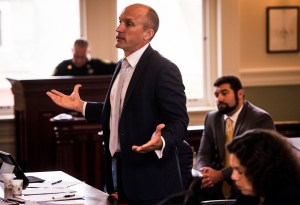
Donovan has a Bernie-esque ability to repeat the same pitch with the same intensity, and apparent sincerity, over and over. There’s a coach’s hoarseness to his voice and his hands never stop moving when he speaks, gesturing or just following the rhythm of his words. He’s still got the point guard’s build — he wears sharp suits and shiny shoes, but would fit just as well in a letter jacket, if not for his bald spot and middle-aged paunch.
He doesn’t want to talk about his future ambitions. “I think Christine Hallquist is going to be running for re-election in 2020 and I’m proud to support her,” Donovan said of the gubernatorial speculation. “I don’t try to get ahead of myself.”
His mother said she doesn’t talk much with TJ about his career ambitions, though people do approach her about it. Maybe he’ll run for governor if he feels he’s done what he wanted as attorney general, she said, then adds: “I’m also reminded on a weekly basis that we have a couple representatives in Washington who are not exactly young men.”
Vermont’s attorney general isn’t waiting to get on the national stage, or at least to take part in the national conversation. As Gov. Phil Scott tries to move as far away from Trump as possible without exiting the Republican tent, Donovan hasn’t missed an opportunity to blast the president, whether it’s immigration policies, regulatory rollback or social issues.
The latest Trump proposal to rile Donovan was a rollback of transgender rights by narrowly defining gender based on genitalia at birth. “What do you think that says to people?” he said. “You don’t matter, we don’t see you, we don’t acknowledge you. Oh, yes, I’m going to oppose that. And I’m gonna do everything I can to fight it. Because the message is more powerful sometimes than the legal argument.”
Vermont will oppose any attempt to eliminate recognition of transgender people. I want transgender people to know I see you and recognize you. Vermont will fight for you. https://t.co/hi6j1wvo5H
— Vermont AG Donovan (@VTAttorneyGen) October 25, 2018
It’s not a question of whether Trump’s listening, or even whether it plays well to Donovan’s constituents, he says, it’s a question of what’s right. Donovan says he believes in the power of the bully pulpit. Talk about it enough and people will come around. The same idea seems to apply to fellow law enforcement officers when it comes to criminal justice reform.
The attorney general has little say in how to prosecute the vast majority of cases in the state. That’s up to state’s attorneys in each county — the most powerful people in the justice system, according to the ACLU — who are accountable only to their own electorate every four years. Some state’s attorneys have joined Donovan’s push for a more progressive criminal justice system, Prine said. “There’s also prosecutors that have stayed in a mindset that is more formalistic and less looking at what is effective for a good community,” she added.
Dick Sears, chair of the Senate Judiciary Committee and a self-confessed Donovan booster, said progress on the criminal justice front was happening, but slowly and at varying places depending on the county. The Legislature has formed a sentencing commission to look at how state laws and statutes might be changed to come into line with a more progressive form of justice that would applied evenly across the state. “It’s a tough one,” Sears said.
The state’s defender general, Matthew Valerio, who coordinates public defenders, said that Donovan was “doing fine” as attorney general. “I think TJ has pointed the state in the right direction — I don’t think anybody disagrees with that,” he said. One of the big differences between Donovan and Sorrell, Valerio said, is how often the new attorney general shows up in the Legislature to push his priorities.
“He’s talked about bail reform, he’s talked about reducing incarceration for nonviolent offenders, he’s talked about trying to be a more treatment-oriented criminal justice system and being a leader in that regard and he has made efforts in the Legislature at doing that,” Valerio said. But that doesn’t mean state’s attorneys are listening.
“In terms of change on the ground, it’s not really the AG’s office that has lot to do with that,” Valerio said. “I think the entrenchment of the 14 elected state’s attorneys is next to impossible to overcome.”
Donovan championed a series of bail reform measures that took effect in July this year, setting a $200 limit on bail for misdemeanor offenses (Willhoit wanted it to be zero). The change received broad support from lawmakers, victims rights groups and some progressive county prosecutors, like Sarah George in Chittenden County and David Cahill in Windsor County. But it has not been well received among many rank and file law enforcement, said Vince Illuzzi, state’s attorney in Orleans and Essex counties.

Illuzzi called Donovan’s overall efforts “somewhat revolutionary” and said “he’s really put into fast forward” reforms to the criminal justice system that have been talked about for the past decade or so. “I think he’s really pushed the envelope, some might say a bit too far,” he said. “You hear a lot of grumbling, not universal, but certainly some grumbling.”
The main gripes among law enforcement, according to the Illuzzi (who has also spent time as a lawmaker and lobbyist), are that it has become too easy for criminals to slip in and out of the justice system, and that policies diverting people away from courts are ahead of the resources available to help people struggling with addiction or mental health problems.
“For some people it doesn’t work, so police become frustrated because they feel they’re wasting their time generating paperwork and sometimes they refer to it sarcastically as ‘catch and release.’ In the police world, that’s frustrating,” Illuzzi said. “That’s the opposite side of it. You have to try to find a balance that prevents people from reoffending.”
Illuzzi said that the state was simply not investing the needed funds, or training enough professionals, to handle those who are diverted into treatment programs, mental health facilities or halfway houses — meaning that too often they end up back on the wrong end of the law. When local communities see criminals back on the streets again and again, he said, fingers inevitably point at the state’s attorney.
“If they’re getting burned by some of these programs then you’re going to see a reluctance to defer or refer cases,” Illuzzi said. “It’s not a criticism, it’s just that in the process of pushing these reforms you’ve gotta be sure the infrastructure is in place.”
Donovan said the criticism that his policies were ahead of the state’s capacity for reform were “probably” true. “I think we have a mental health crisis in the state,” he said, which requires everyone involved in the criminal justice system to “really understand the impact addiction, poverty, violence, domestic violence has on kids, and the lifelong impacts.”
“That’s going to take money,” Donovan said, whether it comes from the federal level or from a rethinking of the state’s budget. Sending people to prison might be the easiest option in the short-term, he said, but it was not going to address the root causes of crime and poverty.
“I think the long-term dividend is gonna be paid by making those investments in community health, and that’s what I support.”
All the AG’s hats
The response to police shootings in Vermont can feel like a ritual. After the shooting there is a press conference announcing an investigation, then silence for a few months. Then the attorney general gets behind a podium with police brass lined up behind him and announces that the use of force was appropriate.
There were three of these shootings over the course of about six months from late 2017 to early 2018, leaving three civilians dead. Donovan mostly stuck to this script. Allen Gilbert, the former head of the American Civil Liberties Union in Vermont, is among those who thinks something has to change. “At some point somebody has to say ‘Too many people are being killed this way.’ I mean why aren’t people outraged by this?” he said.
Gilbert says the legal interpretation being used by police is too broad. It’s the same standard that led a grand jury in Cleveland to decide not to indict police officers who shot dead a 12-year-old boy outside a Cleveland community center. The question in that case and in shootings in Vermont: Would a reasonable person in that situation fear death or serious bodily injury?
“I don’t see how you change that standard, because it’s a reasonable person,” said Donovan. “So it’s not a police officer’s standard of reasonable.” It’s the attorney general ultimately who decides what a reasonable person would have felt if they were in the shoes of one of his colleagues.

“The chief law enforcement officer in the state is in a real bind,” Gilbert said, “where he or she has to be able to work with police bringing the charges but must also work for justice and make sure the right decisions are fair to the public are developed and implemented.”
Donovan says that he follows the facts in each case, pointing to his decision in 2014 as state’s attorney to file charges against Jason Nokes, a Winooski police officer who shot an unarmed man the previous year, after a Taser failed to subdue him. Nokes pleaded no contest to reckless endangerment and providing false information to police, but got off without any jail time and did not admit any guilt.
During his 2016 campaign, Donovan said he was in favor of creating a citizen review panel to look at how police handle dangerous situations, and the factors at play leading up to officer-involved shootings. Asked about that last week, he pointed to the Mental Health Crisis Review Commission, which was set up last year but has yet to produce a report.
David Scherr, who heads the attorney general’s newly created community justice division, said Donovan’s description of the commission was accurate. “Certainly it is a civilian review panel of sorts for a category of police shootings,” said Scherr. The commission is currently looking at the case of Phil Grenon, a 76-year-old man who suffered from paranoid schizophrenia and was wielding a knife when Burlington police shot him to death in his own apartment.
During his final months as state’s attorney, Donovan cleared police in that shooting. Scherr said the commission is not only reviewing the police response, but taking a more holistic look at the decisions that led up to the shooting, and will then make recommendations for how such outcomes can be avoided. Any police-involved incident that led to serious injury or death of a mentally ill person will be reviewed by the commission, Scherr said. “Clearly they’ll have to work through a bit of a backlog here,” he added.
Scherr is among a new cast of deputies and division heads at the AG’s office. “TJ has brought a more youthful, energetic crowd of people to that office,” said Valerio, the defender general.
Status quo on public records
One face that hasn’t changed is William Griffin, the chief assistant attorney general. Griffin’s role might better be described as Donovan’s chief defense strategist, advising him on issues like public records and lawsuits against state officials. Some inside the office call him a “lawyer’s lawyer.” Some outside the office call him “Dr. No.” Donovan said he didn’t want to comment on the influence of Griffin within the attorney general’s office. He did say there were lively debates about the issue of public records.
Donovan preached transparency on the campaign trail. Gilbert, the former ACLU director, said he hasn’t delivered. “Donovan appears to be stuck in what the old way of thinking has been. Even though he has tried to be good on this issue something seems to have prevented him from doing what he perhaps knows is the right thing,” he said.
A few months ago the attorney general’s office set up a website where people can see what public records requests are being approved and which are being denied, and for what reasons. “I think over the last two years, I think we have improved,” Donovan said about releasing information. “I think we’ve been self critical, or that we’ve been self reflective.”
Critics might point to the state’s EB-5 fiasco as evidence to the contrary — the attorney general has argued against releasing public documents despite pushback from the governor’s office. Donovan is sitting on some 2.5 million pages of documents that might expose the role of state officials in a defrauding of foreign investors of some $200 million. He says he’s just doing the job that he was elected to do, because it’s the taxpayers who will pay if Vermont officials are found liable for the fraud.
“I think oftentimes, it is the balance of trying to strike that balance, again, between the public’s right to know versus the ability to do your job,” he said. The attorney general’s job, in cases where state officials are being accused of wrongdoing, is to defend them, Donovan explains, and in this case that means smothering information until two outstanding cases accusing state officials are wrapped up.
What about the Article 6 in the Constitution, which says that at all times, “in a legal way,” government officials must be the trustees and servants of the people? Who says shielding taxpayers from legal fees is more important than telling them the truth? Donovan notes that the attorney general is not, by legal definition, a constitutional officer.
Asked the same question, Sorrell says this: “Sometimes those different hats look very different and sometimes they’re not compatible with one another and that’s the unfortunate reality.”
More than anything, Donovan asks for patience when it comes to the story of state involvement in the Jay Peak Ponzi scheme, and releasing documents that might show what officials knew and when about the biggest fraud in the history of the EB-5 program and in the state of Vermont.
“When this thing’s over, things get released. But until the court rules, I have a professional obligation to represent my clients [state officials]. I have a fiduciary duty to represent my clients. I know it’s not popular, but that’s the job,” Donovan said.
The lessons of Longe Brothers Market, where the customer gets what they need — no questions asked — don’t always apply when you’re the attorney general.
