

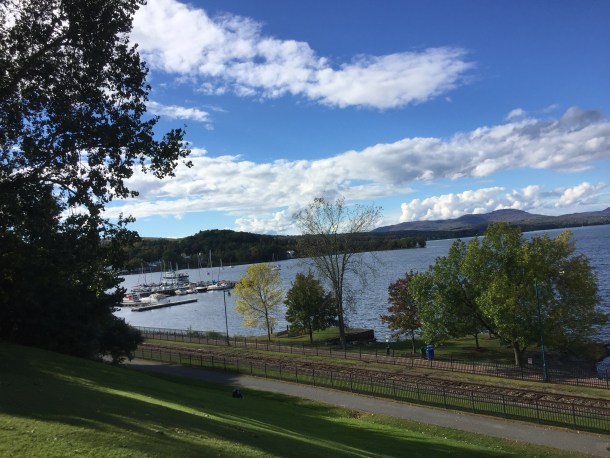
The city of Newport has officially expressed its opposition to a 51-acre expansion of the neighboring Coventry landfill.
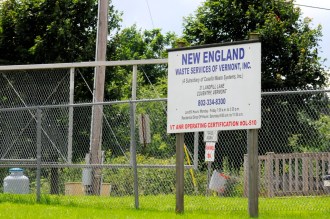
On Friday, the state’s solid waste program issued a final permit to Casella Waste Management’s subsidiary NEWSVT for a 10-year renewal of the existing 78-acre lined landfill and an expansion to its south. At a City Council meeting Monday night, council members and Mayor Paul Monette voted unanimously to “take a stance” against the expansion and to stop accepting leachate.
Newport has little say as to whether the landfill perched above Lake Memphremagog grows, but the city’s wastewater treatment plant has accepted much of the leachate produced by the landfill.
Opponents of the landfill expansion hope this move by the city will lessen what they perceive as potential impacts to water quality. “We had a little victory,” said Charlie Pronto, head of citizen’s group DUMP who put the motion before the council to consider. “We need a lot more of them because we oppose the expansion. Period.”
Newport Mayor Paul Monette said the council agreed to formally come out against the expansion because of increased truck traffic and a lack of a long-term plan for waste management, among other concerns. The landfill is expected to be filled in 22 years with the expansion.
“The state really had no plans 20 years out” for disposing of waste, he said.
The Coventry landfill expansion will, like the current operation, be double-lined with a leachate collection system. Until yesterday, up to 15,000 gallons of leachate a day were treated at Newport’s wastewater treatment plant on the Clyde River, for which Casella paid about $185,000 annually. The council’s vote to stop accepting the leachate “came down to unknowns regarding PFAS,” said Monette.
PFAS, a group of toxic man-made chemicals, gained notoriety in the state after they were discovered to have contaminated drinking water in Bennington. The final permit issued by the DEC last week contains additional requirements
for both Casella and the state to collect more data.
Newport’s wastewater treatment plant is located on the Clyde River, which drains into Lake Memphremagog. Some neighboring Quebecois and local residents have expressed concerns that the wastewater treatment plant does not adequately remove chemicals like PFAS from the leachate. They also question whether the landfill should be so close to the lake.
“That’s the biggest concern I have also is (that) the lake is a drinking water supply for Sherbrooke and Magog,” said Monette.
Casella has to test PFAS levels in landfill leachate and in incoming waste likely to have higher levels of contaminants, like biosolids. They also have to research options for pre-treating leachate to lower PFAS levels. The DEC, which has conducted preliminary PFAS sampling around the state, will collect further data on PFAS in landfill leachate and work, along with other states, to develop surface water standards for PFAS.
“This is an emerging contaminant and I think everybody involved, from us to the state, is trying to figure it out,” said Joe Fusco, vice president of Casella. “We’re as concerned as everybody.”
He added that PFAS is a “systemic” challenge not limited to landfills. “It is in laundry detergent and shampoo and other common uses in modern life.”
The state cannot set limits for PFAS levels from wastewater treatment plant discharge until surface water standards are developed for the contaminant class, said Jessica Bulova, head of the DEC’s wastewater management division. She noted that as PFAS are still a relatively new contaminant of concern, “we’re still trying to get a handle, as a nation, on them.”
But members of DUMP and Memphremagog Conservation Inc., a Quebec nonprofit, do not want to wait for those standards to come out.
“Until they can figure out a safe way of treating PFOA out of the leachate, I’m asking (the plant) to stop taking it,” said Pronto.
Casella has agreements with Vermont wastewater treatment plants in Montpelier, Essex, Barre and Burlington to treat the leachate. It has similar arrangements with Concord, New Hampshire, and Plattsburgh, New York.
“We’re getting all their garbage,” Pronto said of Burlington and Montpelier. “Let the leachate go there and they can pollute their rivers instead of ours.”
He hopes sending the leachate further afield will spur opposition to the landfill beyond the Northeast Kingdom. “We would love to see Montpelier say, you know what, we don’t want this crap either.”
Monette said that while the city does not have Act 250 party status, the city as “one of the larger municipalities up near the landfill” will send a letter to the environmental review board opposing the expansion.
