


This story by Caleigh Cross was published by the Stowe Reporter on Oct 11.
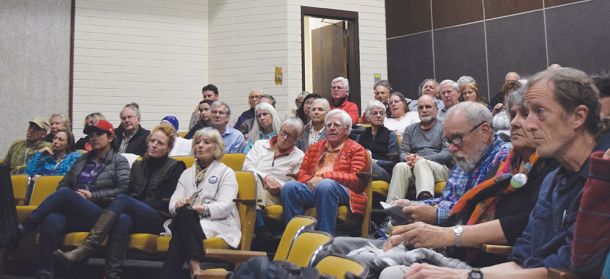
[S]TOWE — Passions for Stowe’s well-being ran high Oct. 3 at a debate between Rep. Heidi Scheuermann and Marina Meerburg, competing this fall for Stowe’s seat in the Vermont House of Representatives.
“We just have very different visions of how to get there,” Meerburg said.
All the same, the two women praised each other’s campaigns, and shook hands when the smoke — and more than 200 people in the Stowe High School auditorium — had cleared.
Scheuermann, a Republican, has held the House seat since 2007. She owns a property and development business in town, grew up in Stowe, and “played on every tennis and basketball court I could find,” she said.
“I’ve been instrumental right here in Stowe” in listening to residents’ concerns and translating them into action in Montpelier, Scheuermann said. “I enjoy this job as much as I did” 12 years ago.
To Scheuermann, keeping taxes low, keeping local control of education and ensuring individual freedoms are key.
Meerburg, a Democrat, runs a translation business, served on the Stowe Conservation Commission for eight years, and spent time as its chair.
She praised turnout at the debate, hosted by the Stowe Reporter and moderated by managing editor Hannah M. Normandeau and news editor Tommy Gardner.
“Our world is changing, and we need to change with it,” Meerburg said. “We need to be proactive as a state.”
Environmental concerns, mandatory paid family leave and state support of higher education are among Meerburg’s issues.
Normandeau and Gardner asked each candidate how she relates to her national political party.
“I am proud to call myself a Democrat,” Meerburg said. “We are, for now, the adults in the room.”
However, she doesn’t stand with the national Democratic Party’s support of corporate welfare.
“They didn’t stand up enough for regular people” this year, Meerburg said.
Scheuermann defined herself as “a proud Vermont Republican,” in the mold of Justin Smith Morrill or George Aiken. She ticked off a few times she’s strayed from party lines, including in 2009, when she was among the first to vote to legalize same-sex marriage, and this year, when she supported legislation that banned possession of bump stocks, which increase the rate of fire of semiautomatic weapons.
Economic issues
Scheuermann outlined her three-part economic policy at the Statehouse: “Encourage, reward, protect” — that is, encourage businesses to invest in their communities, reward them by encouraging them to “reinvest that success” in themselves, and protecting businesses from heavy taxation that could halt growth.
“I think it is critical. I think I’ve done that throughout my career,” Scheuermann said.
Meerburg champions investments in infrastructure, and encouraging more “green tech” businesses to operate in Vermont.
“I don’t believe in corporate welfare,” she said. “Small businesses and entrepreneurs (are) what fits well” in Vermont.
Education
Reform of school funding is one of Scheuermann’s passions and she has fought for it throughout her 12 years in the Legislature, she said.
The state spent $1.7 billion last school year to educate 80,000 students, according to Scheuermann.
“It is absolutely suffocating municipalities,” she said.
In 1997, the Vermont Supreme Court ruled that student opportunities from one school to another were so inequitable, the system was unconstitutional. The court ruled that public education was a state responsibility, not local, and ordered the Legislature to come up with a statewide school-funding system.
The result was Act 60, designed to spread the education burden equitably across Vermont’s more than 250 communities.
Stowe, with property value of more than $2 billion, supplies a lot of school taxes.
“It’s like my sister has my checkbook,” Scheuermann said, to rousing laughter. “We moved from local control to state control. I believe there’s some place in the middle.”
Meerburg praised the Lamoille South Supervisory Union, which oversees Stowe’s schools, for its cost-saving measures.
In higher education, she said, the problem is that it’s too expensive, largely because of anemic state support for state colleges and universities. That high cost is a barrier to young people choosing a college, and eventually living in Vermont.
Scheuermann says if people feel connected to their school budgets, cost-cutting decisions “will happen organically.”
“When you have a small school, what do you cut?” Meerburg asked. “Schools are kind of like the hearts of our community. … I don’t have 12 years of experience but I’m absolutely committed to finding solutions” to high property taxes to support schools.
“The way not to do that is to use one-time money” to buy down education costs and avoid increasing property taxes, as Gov. Phil Scott did this year, Meerburg said.
Scheuermann supported that measure, and said she’d do so again, because to her, keeping property taxes low is a top priority.
Social issues
On social issues, Scheuermann and Meerburg have plenty in common.
Both support a woman’s right to choose on reproductive decisions, including abortion.
Meerburg said she didn’t support Brett Kavanaugh’s confirmation as a U.S. Supreme Court justice, because of the sexual assault allegations against him and because “he completely disqualified himself” with a partisan political reaction to the challenges to his confirmation.
Scheuermann declined to take a stance on Kavanaugh. “I’m running for the Vermont House. I think what is happening in Washington right now is ugly and sad. It’s party politics that I have stayed away from.”
Almost $50,000 has been contributed to the campaign funds for both candidates, with Scheuermann raising more than Meerburg. Both said they use much of the money for marketing and print products.
Both think Vermont should establish a taxed and regulated market for marijuana, since possession of small amounts of the drug became legal July 1.
“To have cannabis be legal to grow and have, but not to sell, is not a workable situation,” Meerburg said.
“It becomes about governing,” Scheuermann agreed.
Both support reconstruction of Stowe’s village sidewalks, a $3.4 million project voters will consider at the polls Nov. 6.
That project could go hand in hand with burial of downtown Stowe’s utility wires, a $3.2 million project also on the ballot Nov. 6. Scheuermann supports that project, too; Meerburg says she hasn’t made up her mind.
On environmental issues, both candidates support better public transit and more bike lanes.
“Waiting on climate change is not going to make it easier,” Meerburg said.
Neither candidate supports a proposed carbon tax, but “we do need to address this,” Meerburg said of vehicle emissions that contribute to climate change. “We are falling short by far.”
The topic of paid family leave struck sparks.
Scheuermann said a proposal for 12 weeks of paid family leave at 70 percent of the worker’s wages is “completely unsustainable. It will collapse on itself.” It would be funded by an increase in the income tax, but the payout total would be too high, Scheuermann said.
“This is not the time to add a very large state program to our tax bills,” she said.
Meerburg disagreed. “Everybody would be paying into it. Everybody would not be taking advantage of this. We need this program,” she said.
Closing statements
“I’m proud of the work I’ve done on your behalf, and there’s still work to do,” Scheuermann said.
“It’s time for a change,” Meerburg said.

