

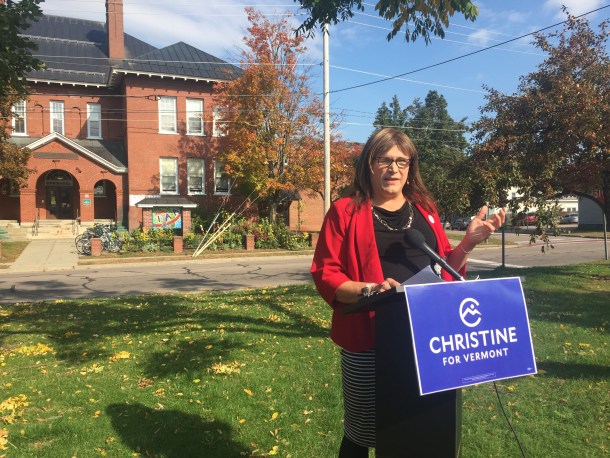
[B]URLINGTON — Democratic gubernatorial nominee Christine Hallquist on Wednesday called for an overhaul of the state’s education finance system and slammed Gov. Phil Scott’s record on schools.
At a small press conference held at a park across from Burlington’s Integrated Arts Academy, Hallquist jabbed Scott for “barking orders from Montpelier” instead of working with teachers and schools, and proposed transitioning away from a property tax to an income-tax based model to pay for schools.
“Scott has decided that as part of the affordability crisis, schools are the problem, as opposed to being the solution,” Hallquist said. “We cannot grow our economy if we cut education.”
But while the event – and a gubernatorial debate later that night in Rutland – helped crystalize key differences between the two candidates’ education priorities, it offered scant details about what, exactly, Hallquist’s education finance overhaul might look like.
“It will allow older people and people on fixed incomes to stay in their homes. It’ll create a more fair way to pay for our education. And it’ll create a more progressive tax structure overall,” she said.
The former electric utility executive said that such an overhaul would have to happen gradually. And a campaign staffer later added that the plan would include a tax refund for renters, to make sure they weren’t essentially double-taxed, since the non-residential property tax would stay in place. And, as in the current system, taxes would go up or down depending on how much a local district spent per pupil.
But the campaign and the candidate were both mum about such details as timeline for implementation, or by how much, on average, the state’s income tax would need to go up. All told, the residential property tax currently raises a little over $400 million for schools.
Hallquist’s campaign manager Cameron Russell suggested the lack of detail was by design. Such a plan “has to be a conversation with a Legislature,” he said, and Hallquist would, “in contrast with the governor,” work collaboratively with lawmakers.
Another staffer, communications director David Glidden, said later that the campaign would “absolutely” release additional details for voters to consider before Election Day.
“Yes, a rough estimate will be released. Absolutely. I’m not sure we’re going into the finites on rates,” he said.
The Vermont NEA and certain lawmakers have long sought to transition to a more income-based tax system for funding schools. Like Hallquist, they argue the wealthiest Vermonters ultimately pay a far smaller share of their income, compared to low- and middle-income taxpayers, to fund K-12 education.
The NEA, which has endorsed Hallquist, along with the nonprofit Voices for Vermont’s Children and the Public Assets Institute, a Montpelier think tank, have renewed its push for a new funding model this year, with a plan eliminate the residential property tax altogether.
The NEA’s plan, which mirrors Hallquist’s, has been described in broad strokes. A more fleshed-out proposal is expected some time in the fall, but NEA officials said additional details might not be out before voters head to the polls in November.
Either way, reforming education finance is widely expected to be a topic of debate in the upcoming session. State Sen. Anthony Pollina, P/D-Washington, said he generally supports Hallquist’s idea and plans to put forward a similar proposal once the Joint Fiscal Office has crunched some numbers.

But he also said he’s been disappointed with how few specifics the Hallquist campaign has put out – on education finance as well as the rest of its policy ideas.
At a gubernatorial debate in Rutland on Wednesday night, Scott, who has made cost containment his hallmark education priority, criticized the Democrat’s plan for not addressing the rising cost of schools. He asked audience members to raise their hands if they made over $1 million, $500,000, or $300,000, and when none presumably did, he implied the state’s progressive tax structure was to blame.
“I’m not sure how many of these rich people we have left in Vermont, because they are moving out,” he said.
That kind of rhetoric is effective, Pollina said, when the opposing camp has little that is concrete to put in front of voters.
“They’re making it easy for him to dismiss it,” he said. “I think it’s up to the Hallquist campaign to actually challenge the incumbent and put details on the table.”
