

[T]he Scott administration’s phosphorus extraction plan is one step closer to launching on farms and municipalities around Vermont. But another critical part of the clean water puzzle — a long-term funding source for the state’s water quality projects — remains a mystery.
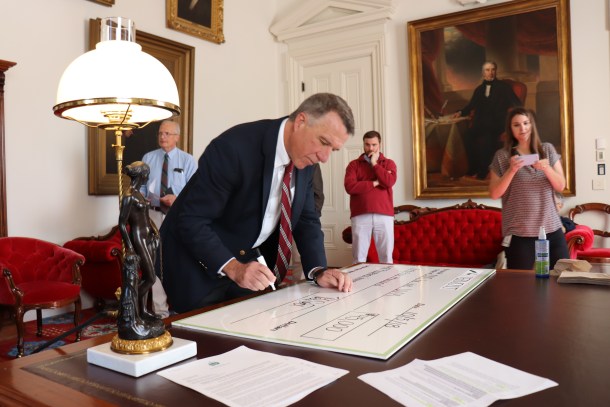
The six proposals that won state funding to prototype phosphorus removal technologies were announced by Anson Tebbetts, the secretary of the Agency of Agriculture, Food and Markets at the governor’s press conference Friday.
Gov. Phil Scott referred to the state’s phosphorus innovation challenge, launched earlier this year, as a “new approach” to thinking about cleaning up the state’s waters.
“The problem we face is balance — we have more phosphorus going into our waterways than we can take out,” said the governor. “Currently, we’re focusing most of our efforts on just one end of the issue, working to direct runoff from our waterways.”

The state hopes to find projects that will “extract phosphorus from a waste stream before that waste is ultimately land applied or before it reaches a surface water,” said Agency of Natural Resources Secretary Julie Moore.
A state evaluation team reviewed more than 25 initial proposals, and winnowed the list to six that seem the most practical to use in Vermont, said Moore.
“None of them are, you know, in my mind I call it ‘the crazy guy in his basement’,” she said.
One winner, Green State Biochar, proposes the development of a nutrient-rich “p-cake,” binding phosphorus to charcoal and creating an electric field to remove phosphorus from wastewater treatment facilities. Roger Pion, Donna Pion and Luke Persons, owners of the Barton company, said they have already been working with hemp farmers interested in using their product as fertilizer.
The other five winners are Agrilab Technologies Inc. of Enosburg Falls, Digested Organics of Ann Arbor, Michigan, DVO Inc. and University of Vermont, Rock Dust Local LLC of Bridport, and the Village of Essex Junction, Chittenden County Solid Waste District and UVM.
The grant money for this stage of the contest is $250,000 and is split among the winners in amounts ranging from $25,000 to $50,000.
The semi-finalists will use the grants, which come from clean water funding in the capital bill, to develop prototypes of their removal technologies and phosphorus-rich products, said Moore. The state will then select one or more finalists to scale up based on estimated per cost pound of phosphorus removal.

The governor stressed that phosphorus capture would be done in tandem with existing on-farm best management practices and other water quality efforts. But environmental advocates have chided the Scott administration for not coming up with a long-term clean water funding source.
Under Act 64 and an EPA mandate from 2016, Vermont was supposed to have developed a plan for long-term clean water funding by the end of 2017. In a progress report in April, the federal agency gave the state a “provisional pass” for securing short-term clean water funding, but says that it will check in next year about the “critical” long-term funding source for Lake Champlain cleanup.
When asked at the press conference what his proposal for long-term clean water funding is, Scott declined to provide specifics.
“I’ve committed to that long-term funding, we’re going to come up with a source,” he said. “I’m looking at existing sources right now, ongoing, and I’m not ready, at this point, to divulge that.
“We’re right in the middle of campaign season and I’m afraid that anything that I propose, at this point, might not be well received, for all kinds of different reasons, as you might expect,” Scott added. “So I’d rather get through the election, and then, let’s work on this together so that we have a viable source.”
Scott scoffed at one reporter’s characterization of this approach as a “secret plan.”
“I mean I’ve said that I’m going to be looking within the budget, utilizing existing tax structure, because I don’t believe that we have to raise another tax.”
“I’ve been pretty clear on that,” he added.
