

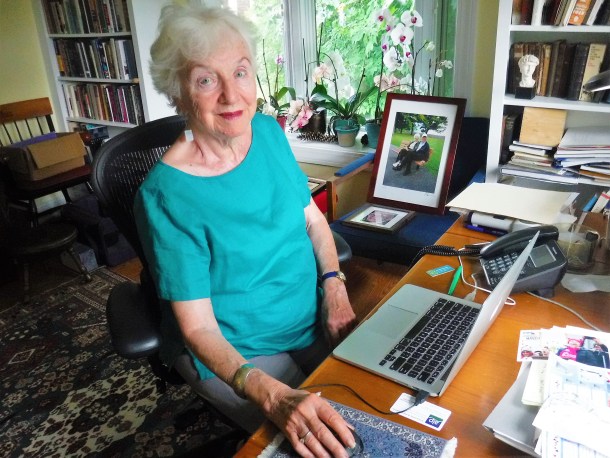
[W]hen Madeleine Kunin published her first memoir in 1994, she chose her words carefully. As the book’s title reminded, Vermont’s first and so far only female governor turned deputy U.S. education secretary was “Living a Political Life.”
“Most women cannot risk revealing public emotion; they are asked to take the toughness test each time they appear in public,” she wrote. “A silent assessment is made by the audience as a woman approaches the podium: Can this woman be as strong as a man?”
A quarter-century later, after serving as U.S. ambassador to her native Switzerland, the now-retired Kunin has penned a second memoir — in part to revisit the subject of sex.
“Even in my eighties I am capable of attraction, susceptible to flattery, something stirs,” she writes. “When I was becoming sexually aware, women were not supposed to be sexual creatures. Lust was reserved for men. Oddly enough, it is as we get older that we can say to ourselves, yes, we are.”
So begins Kunin’s new book “Coming of Age: My Journey to the Eighties.” Addressing everything from love and sex to aging and death, it’s both “intimate in its revelations” and “breaks ground,” Vermont author and National Medal of Arts recipient Julia Alvarez says.
“I can write differently now than when I was involved in politics,” Kunin notes in the foreword. “I can be more personal. I don’t wear the same shrink wrap I once sealed myself in. I can be more reckless about being judged. I no longer have to filter my words through a fine-meshed screen, leaving out phrases that might not please, or worse, offend and get me into trouble. My existence, when I was in public life, depended on public approval. I belonged to my audience. Out of public office, I belong more to myself.”
Kunin’s first book told the story of how a 6-year-old Jewish girl, immigrating to America to escape the Nazi threat during World War II, became a self-described “worried mother” who campaigned for a safer railroad crossing for her Burlington neighborhood before winning election to the Vermont House in 1972.
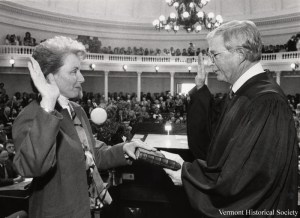
On paper, Kunin appears to have climbed the political ladder with ease: She became the state’s first female Democratic whip in 1974, first female leader of the House Appropriations Committee in 1976, lieutenant governor in 1978 (Consuelo Bailey was the first woman to hold the post, in 1954), first female governor in 1984, deputy U.S. education secretary in 1993 and Swiss ambassador in 1996.
But for Kunin, the ascent felt anything but smooth. When she wrote about juggling family and career in “Living a Political Life,” “the first draft had so many passages about guilt that my editor took large chunks out,” she says. But that didn’t stop her from penning a follow-up memoir.
“No matter what form of address precedes my name, I am, in my mid-eighties, indisputably, an old woman,” she writes in the 200-page hardcover published by Brattleboro’s Green Writers Press. “The coming-of-age memoir documents the rapid change from adolescence to adulthood; this coming-into-old-age memoir describes a slower and more subtle process.”
Kunin, who celebrated her 85th birthday Friday, bemoans the fact the elderly are portrayed as either popping Advil for arthritis or Viagra for sex-infused vacations.
“Images in the media do not tell the real story of what it is to be old today.”
Kunin’s book features all the hues of aging. Take her “white crown” of hair. The blue ambassador suit that survived the downsizing move from her old house. The red “defy the dark expectations” kitchen walls and living room chairs at her new Wake Robin retirement community apartment in Shelburne.
The latter color doesn’t compare to the fiery blush of chapters titled “Attraction” and “Late in Life Love.”
“Some years after my divorce I had begun to peruse dating sites,” she writes. “I knew that they produced many wonderful romances, but I dared not enter my name for fear I would be discovered: ‘Former Vermont governor, late sixties, looking for …’”
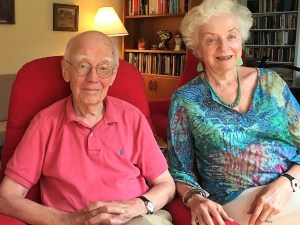
Kunin was 71 and on her own for a decade when she met John W. Hennessey Jr., a 79-year-old widower and former dean of Dartmouth College’s Tuck School of Business. Marrying in 2006, the two traveled the world: China, Egypt, England, France, India, Italy …
Then came the turbulence.
“Age is eroding my senses,” she writes.
Kunin now plays lost and found with hearing aids, reading glasses and a phone in “a bright red case so I’d see it when I left it on the couch, the coffee table, or in the dark depths of my handbag.”
She’s also making peace with such memories as her father’s 1936 suicide when she was a child; her 1995 divorce after 34 years of marriage, four children and five grandchildren; the 2012 death of her brother Edgar May, a Pulitzer Prize-winning journalist and Vermont state senator; and her second husband’s recent depression, insomnia, pneumonia and struggles with a cane, walker and wheelchair.
“A low level of anxiety permeated our partnership,” she writes. “If he fell when I was with him, it would be my fault. If he fell when I was not with him, it would also be my fault, only more so. I found myself, as an old woman, reliving the tension I had experienced as a young woman. Should I give myself to the children, or should I venture out to my own life?”
The succeeding chapter “How Will I Die?” lists all the illnesses, injuries, complications and choices — including those in Vermont’s new Patient Choice and Control at End of Life Act — she has seen friends and neighbors wrestle with.
“I don’t believe in life after death, although it is tempting to believe that I will meet my parents and grandparents, Edgar, and all my loved ones in heaven,” she writes. “It would be a crowded reunion.”
That group increased by one Jan. 11 when Hennessey died at age 92. Kunin had finished her manuscript — which she dedicates to her late husband — just before and chose not to add anything after.
Her publisher, Dede Cummings, nonetheless requested one revision. In a world where women average 77 cents for every dollar that men earn and a nation where women constitute half the population but only about 20 percent of Congress and corporate boards, she wanted a few closing words of hope.
“Change is happening where it never surfaced before,” Kunin writes in the afterword. “The MeToo movement has toppled sexual abusers off their pedestals at a dizzying rate. But the rate of devastating decisions made by the president — from his Supreme Court nomination to his separation of immigrant children from their parents — has left many women and men outraged, but fatigued. I am often asked: ‘Tell me, what can we do?’”
Her response: “We must continue to take to the streets the old-fashioned way. Be vocal and visible. The long-term answer is at the ballot box. Organize, vote.”
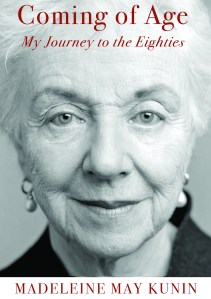
Kunin is set to embark on a statewide tour, starting Tuesday at Shelburne Farms and continuing Oct. 9 at Greensboro’s Highland Center for the Arts, Oct. 13 at the Brattleboro Literary Festival, Oct. 16 at Montpelier’s Bear Pond Books, Oct. 20 at Phoenix Books Rutland, October 23 at Middlebury’s Vermont Book Shop, Oct. 25 at Phoenix Books Burlington, Nov. 1 at Waterbury’s Bridgeside Books, Nov. 9 at Manchester’s Northshire Bookstore and Nov. 16 at Norwich Bookstore.
“Old age is liberating, though it’s still hard to say the words ‘old age,’” she says in an interview. “I can take these risks now — yet I must confess I’m still a little anxious what the reaction will be. Part of me wants to share and part of me wants to be self-protective.”
The book offers its author inspiration.
“I know that death is close, but life is always closer,” she writes. “Although my future no longer feels infinite, it is filled with possibilities that I want to explore. As long as I’m curious about what will happen next, how things work, how the world works, I want to be alive.”


